The Purpose Discovery Sprint That Turns Meaning Into Execution in 14 Days
This playbook shows how to run a two week Purpose Discovery Sprint that produces a purpose people can execute, not admire. A purpose statement should do one job: make decisions easier. The output is not a prettier sentence. The output is a decision filter, a set of default behaviors, and a simple scoreboard that keeps the work honest.
Most teams are not short on ambition. They are short on signal. Purpose becomes fog when it starts as language, gets negotiated into safe adjectives, then gets laminated.
Why Purpose Work Fails (And Why a 2-Week Sprint Beats a 2-Month Offsite)
Purpose work fails when it is treated like branding instead of architecture. Words get chosen first, then reality is asked to fit inside them. That is how teams end up with values that sound noble and change nothing, plus a calendar full of initiatives that compete like houseplants fighting for the same patch of sun.
The symptoms are familiar: competing priorities that all claim urgency, context switching that taxes attention, and initiative soup that tastes like effort but does not feed outcomes. Meetings multiply to manage the complexity that meetings created. Progress becomes a rumor.
A short sprint works because it flips the sequence. It starts with evidence and builds toward language. Lived meaning is data. Purpose is a decision filter built from that data. The goal is not to manufacture inspiration, it is to locate the moments when the work already proved meaningful and reverse engineer what made those moments true.
There is also a practical advantage: a two month offsite creates space for theatrical alignment. A two week sprint creates constraints that force honesty. Modern busyness is remarkably creative at producing motion that feels profound, right up until Monday.
The Purpose Discovery Sprint: The 14-Day Blueprint (Overview + Schedule)
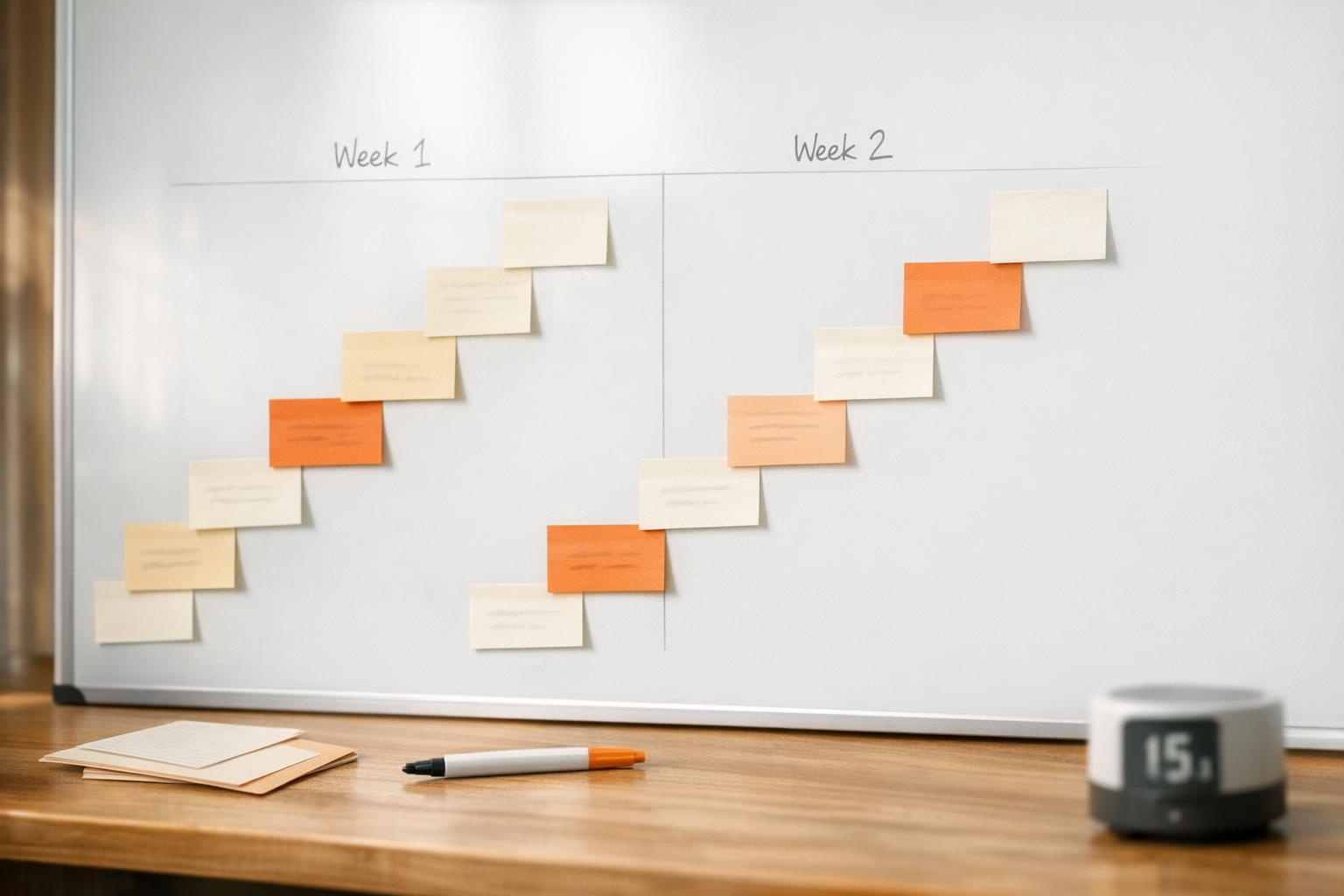
The sprint is two weeks for a reason. Week 1 collects evidence. Week 2 turns that evidence into a draft, then pressure tests it until it can survive real trade offs.
Three roles keep it clean. A facilitator protects the process and pacing. A note taker captures quotes, patterns, and contradictions in one living document. A decision owner holds the pen at the end, so the output does not die in consensus.
Four deliverables make the sprint executable. First, a draft purpose statement that names who is served, what change is created, and the standard of integrity that defines the work. Second, a set of 3Ps behaviors, the default actions that prove the purpose in practice. Third, a visual scoreboard with a small number of lead measures over lag trophies. Fourth, an activity trap list, the inventory of busywork that must be reduced or removed.
Two guardrails prevent the sprint from becoming another ceremonial exercise. Keep the work reversible until validation, meaning drafts are allowed to change without ego. Reduce friction to ship by using short sessions and one shared workspace, and keep every note, quote, and decision in one place so the sprint stays coherent. Design for default, meaning the final system should make the right actions the easiest actions.
Week 1: Gather the Evidence (Meaning Moments + Customer Reality)
Week 1 is a disciplined search for high signal moments. The aim is not to collect opinions about purpose. The aim is to collect evidence of meaning that already happened, then trace it back to its sources.
Start with short team interviews focused on when the work felt meaningful. Ask for specific scenes, not general sentiments. What happened. What constraint made it hard. What choice made it right. Listen for energy, pride, usefulness, and the presence of real trade offs.
A useful prompt is to ask where the work created a noticeable before and after for someone. Another is to ask which moment made the team unusually proud to attach a name to the result. These questions tend to surface the real ingredients of meaning: a clear customer, a visible outcome, and a standard that required discipline.
Then run Why x3 on the strongest patterns. The script is simple, and it should feel almost uncomfortably plain. Take a meaningful moment and state it as a claim. Ask, Why is this important. Capture the answer in one sentence. Ask again, Why is that important. Capture again. Ask a third time. The goal is to reach the underlying value at stake, the thing that would still matter if tactics changed.
Avoid the common failure mode where Why becomes circular. If the answer is essentially because it matters, the question has not gone deep enough. If the answer becomes a slogan, it has gone vague. The best answers land in concrete stakes: time saved for someone, risk reduced, dignity protected, confusion removed, trust earned.
Finally, ground the sprint in customer reality. Observe how customers actually use outputs, not how internal teams hope they use them. Watch where they hesitate, where they improvise a workaround, and what they ignore entirely. Then talk to the customer’s customer, the person downstream who experiences the result. This step prevents internal mythology from becoming strategy.
One caution keeps Week 1 clean: story bias and loudest voice bias. Humans are good at telling persuasive stories about themselves, especially in conference rooms. Use written notes, then cluster them into themes. Let patterns win, not volume.
Week 2: Synthesize, Draft, and Pressure-Test for Accountability
Week 2 turns evidence into a statement that can take weight. A useful purpose is a load bearing beam. It should hold priorities in place when pressure arrives.
Draft one sentence with three parts. Name who is served, as specifically as possible. Name the change created, in plain language that points to real outcomes. Name the standard of integrity, the line that will not be crossed even when it would be easier to cut corners. The statement should read like a promise that can be kept, not poetry that can be applauded.
Then pressure test the draft with accountability questions, answered in writing, not debated into softness. Ask what will be stopped because it does not match this purpose, even if it is familiar or politically safe. Ask what will be said no to in the next 30 to 90 days, even if it looks like growth. Ask what will be measured weekly to prove the purpose is being practiced. Ask what trade off will be accepted to protect the standard of integrity. If these questions cannot be answered cleanly, the statement is not ready to steer work.
This is where many purpose statements collapse. If nothing will be stopped, the statement is decoration. If nothing will be measured, it is a mood. If no trade off is named, it is an aspiration without cost.
Treat the early purpose draft as a reversible decision, easy to adjust without drama. Once the purpose is tied to hiring criteria, product commitments, and customer promises, it starts behaving like an irreversible decision, expensive to change and painful to reverse. The sprint exists to find the right words before the words start running the organization.
For a longer version of this accountability lens, Why Most Purpose Statements Fail and the Accountability Fix That Makes Them Useful expands the pressure test into a repeatable operating rhythm.
Make It Real: 3Ps Behaviors, a Visual Scoreboard, and the Activity-Trap Kill List
Purpose becomes real when it is translated into defaults. A team does not rise to its intentions, it falls to its systems. The translation layer is behavior.
Attach 3Ps behaviors, a simple behavior set that keeps the purpose from floating away. One effective definition is principles as the standards that govern decisions under stress, practices as the default actions people can actually do on a busy Tuesday, and proof as the evidence that shows up on the scoreboard.
Write the behaviors so they can be observed. If a behavior cannot be seen, it cannot be coached. A practical way to write them is to capture one forced choice, one weekly habit, and one visible signal. For example: when forced to choose, prioritize ______ over ______. In weekly planning, protect ______ by doing ______. Each week, the team will be able to point to ______.
Now build a simple visual scoreboard. Keep it small enough to review in five minutes. Choose three to five lead measures, inputs that can be controlled, plus one lag outcome that confirms the inputs are working. Lead measures should feel almost plain, because they live close to the work: number of customer observations completed, cycle time from idea to shipped output, percentage of work released in small increments, or the count of priority decisions explicitly run through the purpose filter. The point is not to win at metrics. The point is to make progress visible and steerable.
Then create the activity trap kill list. Beware of the activity trap, the work that creates the feeling of responsibility without the reality of impact. Add candidates ruthlessly: meetings that exist because nobody wants to be the one to remove them, reports that summarize what no one uses, rituals that track motion instead of progress. If the purpose is the compass, this list is the clearing of underbrush that lets movement happen.
Implementation should be boring in the best way. Schedule the first weekly review, assign owners to each measure, and set a 30 day customer validation check. Ask customers directly whether the stated purpose matches their lived experience of the work. If the answer is no, treat it as useful data, not a threat.

A purpose sprint is not a spiritual retreat for the organization. It is closer to tending a garden and installing irrigation. The work is quieter than a rallying speech, and far more durable. Run the sprint in the next 14 days, keep the early version reversible, and let customers validate what the team claims to stand for. A purpose people can execute is one that can survive a calendar.