The Peer Accountability Loop That Keeps Practice Alive When Willpower Drops
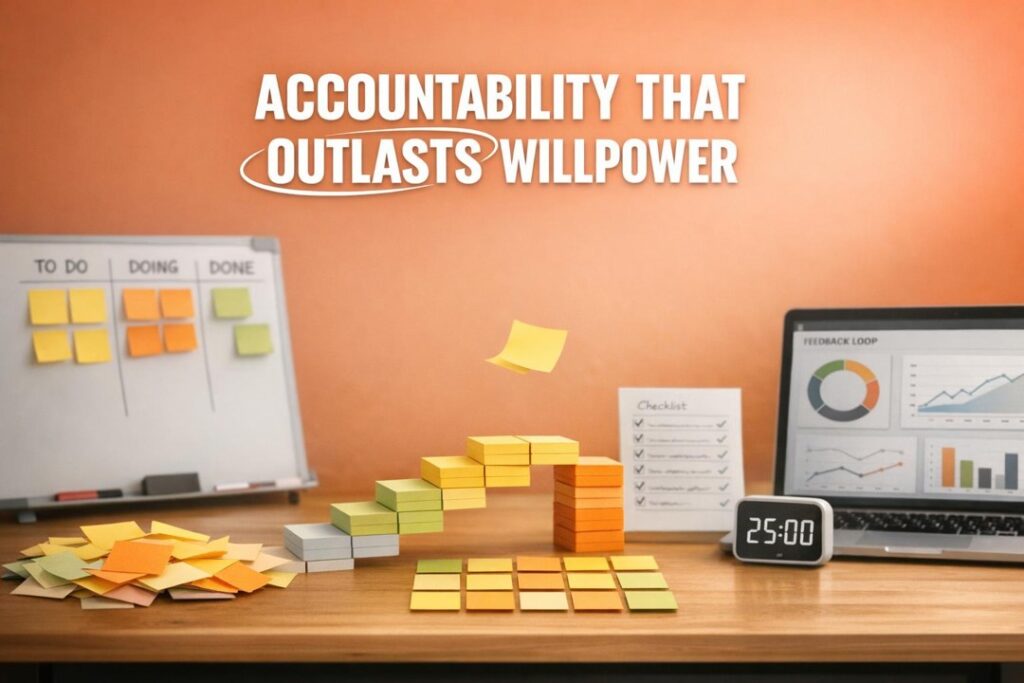
Peer accountability is not a motivational speech delivered by friends. It is a reinforcement loop that makes follow-through the default even when willpower is low. The loop is simple: make a commitment, make it visible, get feedback, solve obstacles, repeat. When those four parts stay connected, practice stops relying on mood and starts behaving like a system.
A quiet truth sits underneath most stalled goals: effort is rarely the issue. Continuity is. And continuity is less about personal grit than about what happens after the initial burst of intention meets a Tuesday afternoon.
This is a journey from scattered effort to structured clarity: what peer accountability is, why it works when willpower does not, and how to apply it without turning life into a compliance program.
What peer accountability is (and is not)
Peer accountability is a shared structure that converts private intention into public follow-through. It works because it changes the environment around a commitment. The commitment is no longer an internal negotiation. It becomes a small social contract with a rhythm.
In architecture terms, it is scaffolding, not decoration. Scaffolding does not create the building, but it makes the building possible when the weather is unreliable. Willpower is weather. Systems are shelter.
This is also where many groups go wrong. They confuse “being in a group” with “having a system.” A chat thread filled with supportive messages can feel productive while producing nothing but emotional motion. The goal is not more encouragement. The goal is fewer loopholes.
A useful distinction: accountability is not policing, and it is not performance. Policing creates resentment. Performance creates vanity. Real accountability is closer to a well-designed rehearsal space. It makes the right action easier to start, easier to repeat, and harder to quietly abandon.
Modern busyness makes this more necessary, not less. Calendars fill up the way junk drawers fill up, one “quick thing” at a time. Without a structure that protects a commitment, the week turns into a polite disappearance of priorities.
When the structure is clean, it protects energy. It removes the daily decision tax of “Should this happen today?” The answer was already made, and someone else can see it.
How the 4-part loop makes practice survive low willpower
The peer accountability loop works because it is cyclical. Each turn strengthens the next one, and each missing part weakens the whole. Here is what each part does, and why it matters.
1) Commitment, decide the smallest honest promise.
A commitment is not a wish. It is a specific behavior attached to a time window. The smaller and more concrete the promise, the more likely it survives contact with reality. “Write for 20 minutes before lunch” has edges. “Work on the book” has fog.
The non-obvious part is honesty. Overcommitting is not ambition, it is future self-sabotage with better branding. A peer loop amplifies whatever is committed, so the first job is to commit to something repeatable, not impressive.
2) Visibility, make the behavior observable.
Visibility is the bridge between intention and follow-through. It can be as light as a shared check-in, a screenshot, or a simple “done” message. The point is not to create surveillance. The point is to remove the private exit ramp.
Think of it like investing with automatic contributions. The amount can be modest. The consistency is the edge. Visibility is the autopay that keeps the contribution from becoming a monthly debate.
3) Feedback, get signal before the week is gone.
Feedback is any response that improves the next attempt. It can be encouragement, but it should also include calibration. “That goal is too big.” “That plan ignores travel.” “That metric is lagging, pick a lead measure.”
Without feedback, visibility becomes performative. People start reporting outputs that look good, not behaviors that compound.
4) Obstacle-solving, treat friction as design data.
Obstacle-solving is where most accountability efforts quietly fail. They check in, they celebrate, they feel supported, then they repeat the same breakdown next week.
A durable group treats obstacles like engineers treat a faulty process. What caused the break? What is the smallest change that prevents it next time? Maybe the problem was time, but often the problem was transition cost. Starting was too hard, the environment was wrong, the scope was bloated, or the plan depended on a perfect day.
When obstacle-solving is built in, the loop creates compounding reliability. The group is no longer just watching behavior. It is improving the system that produces behavior.

Why body doubling works, even when nobody talks
Body doubling looks almost too simple to take seriously. Two people show up, work quietly, and leave. No coaching. No deep conversations. Just presence.
Its power is not the same as “visibility” in a check-in thread. It is real-time accountability, a greenhouse instead of a scoreboard. The moment the session starts, attention has a container, and the usual leak points become obvious. The phone becomes heavier. The tab spiral becomes less charming. The brain realizes someone else is also staying put.
Most modern work fails at the start line, not the finish line. The hardest part is often the first three minutes: opening the file, resisting a tab spiral, settling the nervous system. A shared session reduces that friction. It creates a soft boundary that says, “This block is for practice.”
Body doubling also removes the need for constant self-trust. Self-trust is valuable, but it is expensive to manufacture when life is noisy. A scheduled coworking slot is cheaper. It is a default.
For a broader comparison of options, including accountability partners and masterminds, this breakdown is a useful companion: Accountability Partner vs Mastermind vs Body Doubling Which Structure Fits Your Goal and Personality.
How to run a lightweight support group that actually holds, weekly or bi-weekly
A peer system should feel almost boring. Boring is a feature. Boring means it can run on low willpower.
A practical baseline is a small support group that meets weekly or every two weeks, long enough to check in and troubleshoot, short enough to avoid turning into a second job. The goal is not to create another social obligation. The goal is to create a cadence.
The guiding principle is simple: keep the loop intact. A clean meeting agenda is less about control and more about protecting signal.
“You can form a small support group that might meet on a weekly or bi-weekly basis to share your plans, your progress and your challenges. Having a peer group will help to foster a greater sense of accountability and you can learn from one another.”
One short structure is enough, and it fits in narrative rather than bureaucracy. A single check-in can follow four prompts:
- Plan: one commitment for the next interval (behavior, not ambition)
- Proof: what was done since last time (visible, simple)
- Friction: what got in the way (one obstacle, named plainly)
- Fix: one design change to test next (reduce friction, collapse scope, adjust timing)
Notice what is missing: long speeches about motivation. Motivation is welcome, but it is not the mechanism. The mechanism is repetition plus refinement.
A small upgrade is to track lead measures instead of lag trophies. Hours practiced. Sessions completed. Pages drafted. Reps logged. Lag measures like outcomes and applause can show up later, but they are not useful for steering the week.
The failure mode most groups miss, and the integrity upgrade
Most accountability groups stall for one reason: they stop at visibility. Everyone knows what everyone “plans” to do, and everyone is kind about the fact it did not happen. Kindness without design becomes permission.
The integrity upgrade is not harshness. It is precision. Precision sounds like, “That plan was too big for the week that was actually lived.” Or, “That obstacle keeps repeating, the environment needs a change.” It is a gentle refusal to let vague language hide a pattern.
Another common failure is social comparison. The group becomes a subtle stage where people trade impressive workloads. That creates motion, not progress. A better norm is quiet specificity and respect for constraints. High achievers do not need more pressure. They need fewer commitments and cleaner execution.
For a deeper look at why groups drift and what makes accountability compound over time, this related piece connects the dots: Why Accountability Groups Stall and the Integrity Upgrade That Makes Them Compound.
Peer accountability works when it protects the next repetition. The question is never, “Did it happen perfectly?” The question is, “What will make it happen again?”
If the loop feels heavy, shrink it. If the loop feels performative, add obstacle-solving. If the loop feels fragile, tighten the commitment until it is undeniably repeatable. Practice does not need more heroics. It needs a structure that survives ordinary weeks.