The 45-Minute Weekly Accountability Sprint for Honest Check-Ins and Faster Follow-Through
Why Most “Accountability” Meetings Fail and What This Sprint Fixes
After reading this, a team, peer group, or founder circle should be able to run a 45-minute weekly accountability sprint that turns scattered intentions into dated commitments, visible progress, and practical obstacle removal. Not a status meeting. Not a support group. Not a soft-lit room where everyone nods while the same project quietly ages in the corner.
Most accountability meetings fail because they confuse motion with progress. People arrive with updates, explain what happened, describe what might happen next, and leave with the pleasant fog of having participated. The language sounds responsible, but nothing has been engineered. No next action. No date. No visible scoreboard. No named obstacle. No clear request for help. Everyone is busy, everyone is sincere, and somehow the work still has no traction.
Noise is everything that sounds like progress but cannot be acted on. Signal is a dated commitment, a named obstacle, a clear help request, and a visible status that tells the group what reality requires next.
The uncomfortable truth is that accountability is rarely a motivation problem. Capable people usually do not need more pressure. They need a tighter operating system. They need fewer commitments, sharper language, and a room where friction is named early enough to be fixed before it becomes a postmortem with snacks.
This sprint is for busy, high-agency professionals who want honest momentum without theater. It works for small teams, leadership groups, peer accountability pods, entrepreneurs, creators, and anyone whose calendar is full but whose priorities keep slipping through the floorboards. It is not for groups seeking emotional processing as the primary outcome. Human reality belongs in the room, but the room has a job: convert intention into action and remove the obstacle in front of it.
The premise is simple. Once a week, for 45 minutes, each person shares proof of practice, names one next commitment with a date and time, identifies one obstacle, asks for one form of help, and updates a visible board. The goal is not pressure. It is precision.
The 45-Minute Weekly Accountability Sprint Agenda
A good accountability sprint feels less like a meeting and more like a workshop bench: clean surface, sharp tools, no decorative clutter. The facilitator’s job is not to inspire everyone into a temporary glow. The job is to keep the cadence honest, protect the clock, and make sure every person leaves with one visible commitment and one less excuse hiding in the machinery.
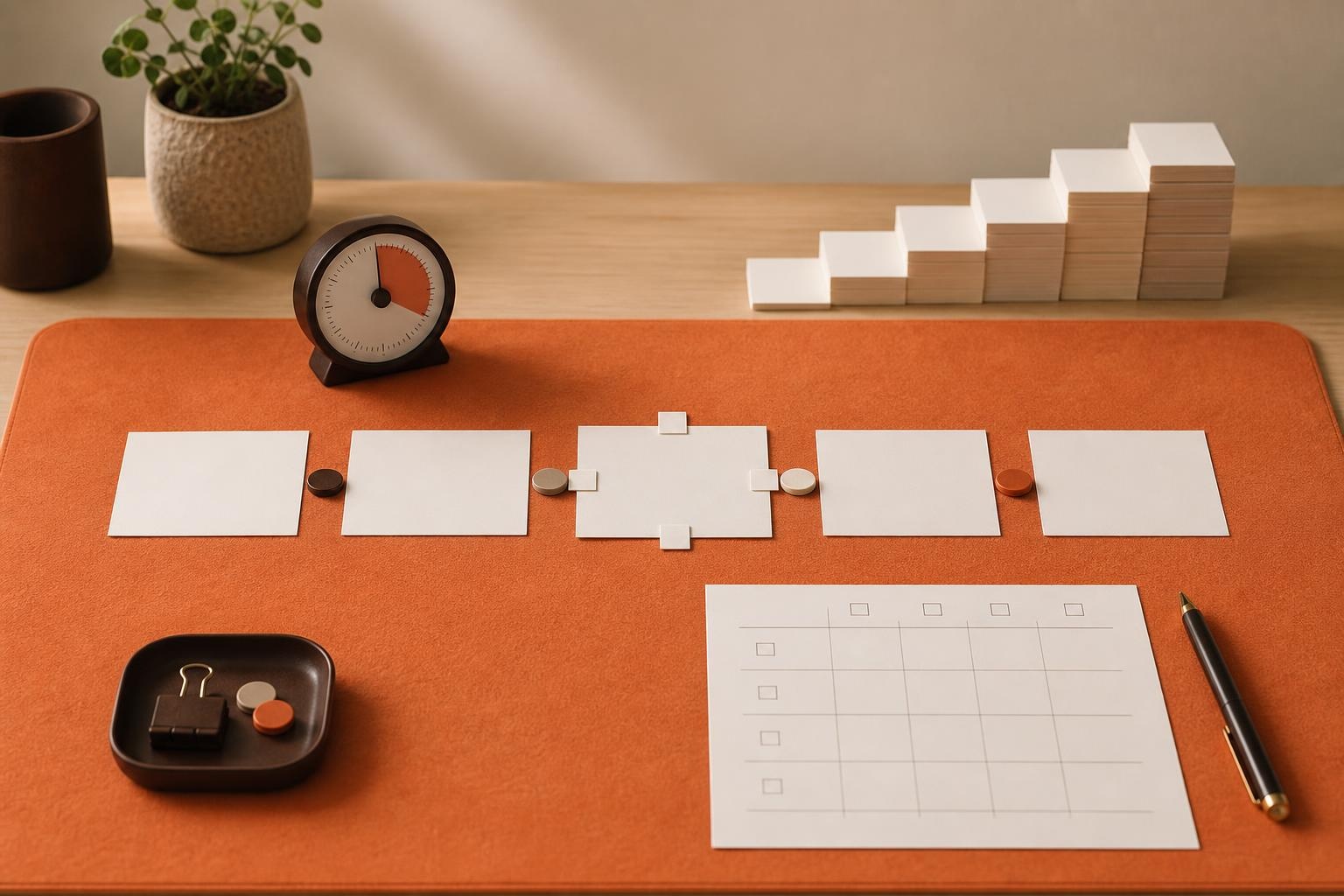
Use the same 45-minute structure every week. From 0:00 to 5:00, the facilitator opens the sprint and resets the rules: “One commitment per person, dated and schedulable. One obstacle. One clear help request. Anything too large goes to the parking lot.” From 5:00 to 15:00, each person shares a win as proof of practice. From 15:00 to 30:00, each person states one next commitment with a date and time. From 30:00 to 40:00, each person names one obstacle and one help request. From 40:00 to 45:00, the group updates the visual board, confirms owners, and closes.
Start with three minutes of wins as proof of practice. Each person shares one tangible result tied to a previous commitment. The win does not need to be heroic. “The proposal draft was sent Tuesday at 2 p.m.” is better than “Made good progress on business development.” Proof matters because it trains the group to value evidence over atmosphere. Without it, the meeting becomes a warm bath of good intentions, and warm baths are famously poor project managers.
Move next into commitments. Each person states one next commitment, and only one. The commitment must include a date and time. “Work on the hiring plan” is not a commitment. “Draft the first version of the hiring scorecard by Thursday at 10 a.m.” is. This is where many groups accidentally sabotage themselves. They let people name three priorities, five hopes, and a backup ambition in case the week develops extra oxygen. Too many commitments create the illusion of seriousness while quietly reducing the odds of completion.
Then comes the obstacle. Each person names one thing most likely to block the commitment. Not a dramatic list. Not a tour of every possible risk. One obstacle. The discipline matters because vague anxiety becomes usable only when it is compressed into a specific obstruction: “Waiting on pricing from finance,” “No uninterrupted writing block,” “Unclear approval from the client,” or “Decision owner has not been named.” If the obstacle stays fuzzy, the week absorbs it. If it becomes visible, the group can do something with it.
After the obstacle, the person makes one clear request for help. This is where accountability stops being a performance of independence and becomes a practical exchange of leverage. The request should name the help, the owner, and the next step. “Can someone help?” is a sigh wearing a name tag. “Priya, can you review the pricing section by Wednesday at noon?” is a bridge.
The final step is updating the visual board. Every commitment gets recorded, dated, and marked green, yellow, or red. No one should need to reconstruct reality from memory after the meeting. Memory is a charming liar, especially after Thursday.
The facilitator can keep the sprint tight with simple prompts: “What was the proof of practice?” “What is the one next commitment?” “When will it happen?” “What is the obstacle?” “What help are you requesting, from whom, by when?” If the conversation drifts into problem-solving too early, use a parking lot. Capture the issue and assign a short follow-up outside the sprint. Otherwise, one person’s complex knot consumes the room, and everyone else leaves with sympathy instead of structure.
A different problem appears when a group becomes too efficient too quickly. The meeting gets crisp, the board gets updated, and nobody says the true thing. “Yellow” becomes “green with concerns.” “Blocked” becomes “still evaluating.” That is not maturity. That is fear with nicer formatting. The sprint only works when directness is treated as care, not criticism.
If the group is larger than six, split it. Scale is useful in factories and newsletters. It is less useful when twelve people are waiting to say, “Same as last week.” The sprint depends on airtime, and airtime disappears when the room grows beyond the clock.
For a broader version of this operating rhythm, this related guide on accountability that actually works expands the same principle: stop performing progress and start solving the practical problem in front of the work.
The Visual Scoreboard: Top 3 Commitments in Green, Yellow, Red
The visual scoreboard turns accountability from a private intention into a shared feedback loop. That is the quiet force of it. People do not need more invisible ambition. They need a small, honest system that reflects reality before reality gets expensive.
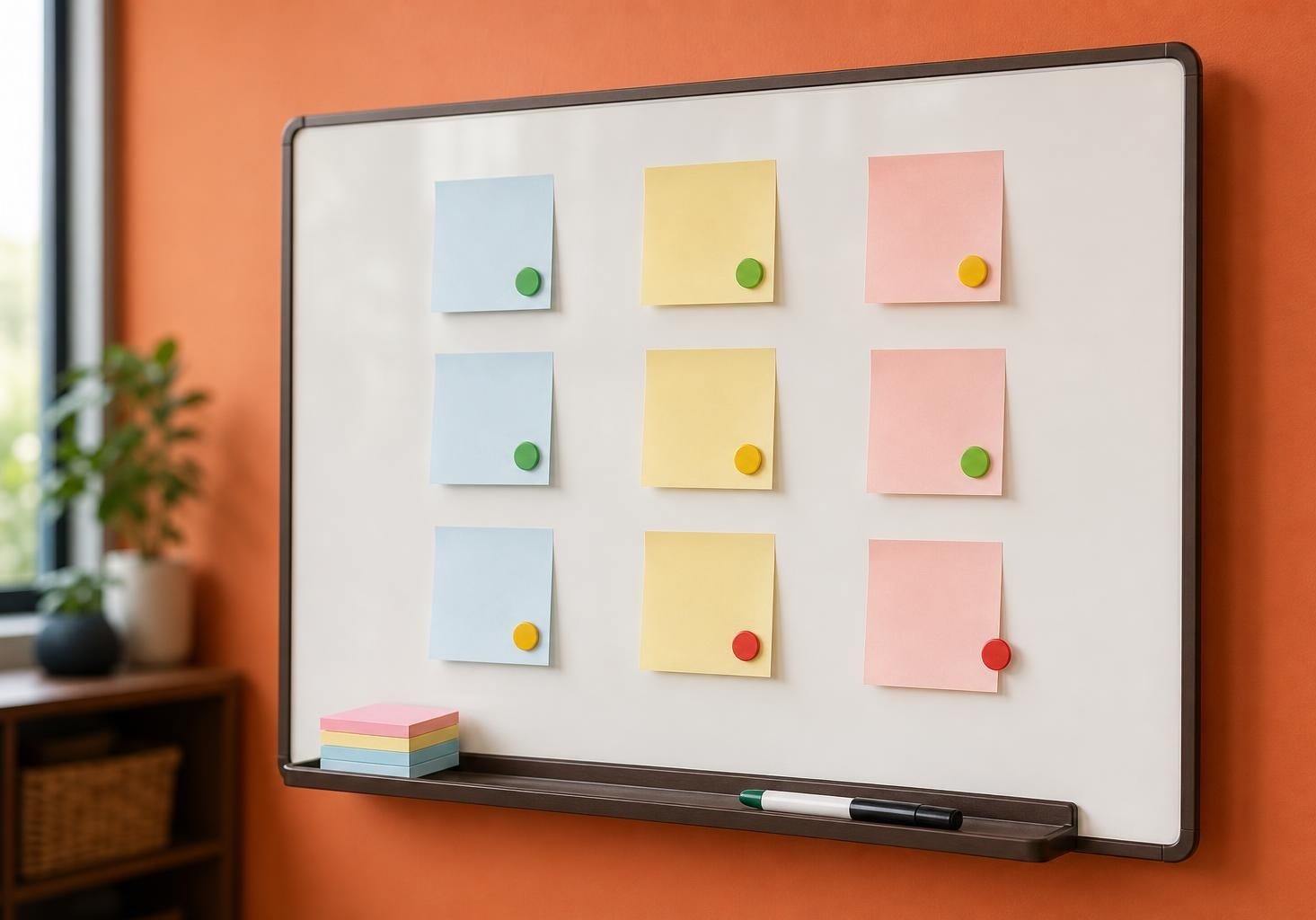
Set up a board with each person’s “Top 3 commitments” visible at all times. Each commitment gets a status color: green, yellow, or red. Green means on track with the next action scheduled or completed. Yellow means at risk with a named obstacle. Red means off track with a recovery plan needed. The colors are not moral judgments. They are traffic signals. A red light is not a character flaw. It is information that prevents a collision.
The principle is direct: visuals “should sit where other people can see them.” That line is more practical than it first appears. A hidden dashboard is a diary. A visible board is an environment. If the board lives in a forgotten document three clicks deep, the group has built a shrine to avoidance. Put it on a physical wall, pin it in the team channel, keep it open during the sprint, display it as a shared dashboard, or keep it on a second monitor during the meeting. Visibility changes behavior because it reduces the gap between what people said mattered and what their environment reminds them to do.
A minimal board needs only a few fields: Person, Commitment, Due date and time, Status, Obstacle, Help requested, Helper or owner, and Next check-in. Anything more ornate invites maintenance theater. The board should feel like an assembly line, not a museum exhibit. Few items. Clear status. Fast updates. No decorative complexity.
What most people get wrong is treating visibility as surveillance. That poisons the system. The board is not there to shame adults into productivity, which rarely works for long and usually produces creative hiding. The board exists to shorten the distance between signal and response. Green means keep going. Yellow means remove friction. Red means stop pretending and redesign the path.
This distinction matters because a scoreboard can either build trust or quietly corrode it. If red is punished, people will protect themselves with vague language. If yellow is treated as early intelligence, people will surface risk while it is still small enough to manage. The healthiest groups learn to see yellow as a gift. It is the moment when the bridge is cracking but still repairable.
This matters because invisible work creates invisible decay. A missed commitment kept private becomes a personal burden. A missed commitment made visible becomes a design question. Was the scope too large? Was the calendar unrealistic? Was the dependency unnamed? Was the commitment actually a wish dressed in office clothing? Once the board reveals the pattern, the group can fix the system instead of quietly judging the person.
Message Templates and Ground Rules So the Sprint Runs Itself
A sprint becomes durable when the language around it is as clear as the meeting itself. Without prepared messages and ground rules, every week requires fresh emotional labor. Someone has to remind the group, restate the norms, soften the ask, and drag the conversation back from the swamp. That person will eventually get tired. Systems that depend on one person’s patience are not systems. They are delayed collapses.
Use a simple invite message: “This 45-minute weekly sprint is designed to turn commitments into visible progress and remove obstacles early. Come prepared with one proof of practice, one next commitment with a date and time, one obstacle, and one help request.” That message tells people what the room is for and, just as importantly, what it is not for.
The weekly reminder can be even shorter: “Before tomorrow’s sprint, update your current commitment status and bring four things: your win, your one next commitment, your obstacle, and your help request.” Specific prompts reduce the chance that people arrive carrying a vague cloud of updates. Vague clouds are how calendars get weather systems.
A pre-sprint prompt should ask: “What did you complete or practice? What is the one commitment you will make next? When will it happen? What is most likely to block it? What help do you need, from whom, by when?” A follow-up recap should confirm: “Commitment, owner, due date and time, status, obstacle, helper, next check-in.” If the recap does not assign owners and dates, it is not a recap. It is a souvenir.
The ground rules are simple enough to remember and firm enough to protect the room: honesty over optics, specific over vague, commitments over intentions, obstacle naming without excuse-making, and help requests as a strength signal. Confidentiality boundaries should be stated if sensitive work or personal constraints are discussed. Candor cannot grow in a room where people fear their rough edges will be exported without context.
One more rule deserves special protection: no problem-solving rabbit holes during the main sprint. When an issue needs deeper work, assign a short follow-up with the right people. Ignoring this rule creates the familiar meeting tragedy: one person gets free consulting, four people check out, and the group produces beautiful narratives and zero shipping.
The quiet test of the sprint is whether it can run when the usual organizer is absent. If the templates are clear, the board is visible, and the rules are understood, the system carries the work. That is the point of good design. It reduces the need for heroic remembering.
4-Week Kickoff Plan: From Awkward to Automatic
The first four weeks should build rhythm before ambition. New systems often fail because people try to perfect them before they have earned any data. Start plain. Let the awkwardness be part of the installation process. Every useful operating system feels slightly unnatural before it becomes the way things get done.
In week one, set the rules, build the board, and run the first sprint with training wheels. Expect some vague commitments and a little social politeness. Correct gently but immediately. If someone says, “Move the client project forward,” ask for the visible next action and the date it will happen. If this correction is skipped, the group learns that fuzzy language is acceptable, and the sprint becomes a better-dressed version of the old meeting.
In week two, tighten commitments into calendar slots. Every commitment should be attached to a specific date and time, not merely a deadline. “By Friday” still leaves too much room for Friday at 4:47 p.m., when the mind is negotiating with snacks and regret. Ask each person to name one obstacle and one help request. This is where the group begins to learn that asking early prevents drama later.
In week three, add one simple metric: commitments completed on time. Do not turn this into a complex analytics project. Track the completion rate and look for recurring obstacles. If three people keep turning yellow because approvals are slow, the problem is not personal discipline. It is a bottleneck. If one person is always red, the issue may be over-commitment, unclear priorities, or a hidden capacity problem. The metric is not a trophy. It is a diagnostic instrument.
In week four, refine the board, rotate the facilitator, and decide what to cut. Keep what helped. Remove what created drag. If someone dominates the sprint, give the facilitator permission to interrupt with warmth and precision: “Parking that for follow-up so every commitment gets airtime.” If people over-commit, reduce the scope until the work fits reality. If help requests stay vague, require a name, a date, and a next step. Avoidable confusion is expensive because it feels harmless while it is happening.
Common issues should be treated as design feedback, not personal failure. Chronic yellow usually means dependencies are being named too late. Chronic red usually means commitments are too large, too vague, or competing with unspoken priorities. Dominance by one person usually means the facilitator has not protected the container. The fix is not more encouragement. The fix is a smaller commitment, a clearer owner, and a faster correction loop.
By the end of four weeks, the group should feel the difference. Not fireworks. Something better: steadier movement, earlier truth, less private anxiety, fewer heroic rescues. The sprint works because it respects the actual conditions of modern work. Attention is limited. Trust is built in small moments. Progress compounds when the environment keeps pointing people back to the next right action.
Run the first sprint this week. Put the board where people can see it. Ask for one commitment, one obstacle, and one request for help. If the group cannot tell the truth for 45 minutes, what exactly is the rest of the week being built on?