The 30-Day Purpose to Priorities Sprint for Team Alignment
A 30-day purpose to priorities sprint is a practical system a team can try to turn shared meaning into 2 to 3 clear priorities and a visible scoreboard. The point is not to write a prettier purpose statement. The point is to make better trade-offs, choose what matters now, and create a feedback loop that shows whether the work is moving in the intended direction.
This playbook works best for leadership teams, product teams, and functional teams that need alignment without adding another layer of meetings. Results vary, because team maturity, customer access, decision rights, and follow-through all matter. Still, the structure gives the team something useful: a calm sequence for moving from “What are we really here to do?” to “What gets attention this month?”
What This 30-Day Sprint Is and the Rules That Make It Work
This sprint gives a team four weekly moves: surface meaningful work, write purpose with the customer in view, pressure-test that purpose, then convert it into a few priorities and a public scoreboard. It is for teams that have enough customer signal to make informed choices and enough willingness to stop doing some work so the important work has room to breathe. It is not a fit for teams that want alignment as theater, want every project to stay equally urgent, or have no owner who can carry decisions into the operating rhythm.
The useful tension is this: purpose should not sit above execution. It should constrain execution. A good purpose statement helps a team say no with less drama. It makes trade-offs less personal because the decision is no longer “whose project wins?” but “which work best serves the customer outcome this team exists to create?” Without that constraint, purpose becomes a soft paragraph in a hard system. People nod at it, then return to the same overloaded roadmap.
By the end of the sprint, the team should have four working artifacts: a draft purpose statement grounded in customer language, a pressure-tested rationale that explains why the purpose matters, 2 to 3 active priorities, and a simple public metrics board. These artifacts do not need polish. They need enough clarity to guide choices on a Tuesday afternoon when a new request arrives and everyone is tempted to say yes.
Set a few rules before the first meeting. Keep sessions timeboxed. Assign one decision owner, even if the process is collaborative. Use written artifacts instead of relying on verbal agreement, because verbal agreement often hides different interpretations. Separate reversible decisions from irreversible ones so the team does not overthink every small move. Favor lead measures over lag trophies, because lag metrics often tell the team what already happened after the chance to adjust has passed.
The tool stack can stay simple: a shared document, a place to collect customer notes, and a one-page scoreboard. Complexity is not a sign of seriousness here. The goal is to design for default, meaning the system should keep running without heroics, reminders, or one exhausted person dragging everyone back to the plan.

Week 1: Capture What Feels Meaningful Without Turning It Into a Debate
Week 1 is about collecting the raw signals of meaning before the team tries to turn them into strategy language. This matters because teams often jump straight to wordsmithing, then get stuck in abstract debates about values, vision, and tone. The room starts discussing whether “empower” is better than “enable,” while the actual evidence of meaningful work sits untouched in customer calls, delivery stories, and decisions people felt proud to defend.
Start with individual reflection for 15 to 20 minutes. Ask each person to write about specific moments, not ideals. When did the team do work that felt worth the effort? When did a customer experience a real improvement because of the team’s choices? When did the team protect quality even though it cost time? When did a trade-off feel difficult but right? These questions pull the team out of vague aspiration and into lived evidence.
The share-out should be structured, not open-ended. Each person gets a short window to name two or three moments and the reason those moments mattered. The facilitator captures exact phrases where possible, especially words that point to customer outcomes, internal standards, and emotional energy. If the group is remote, use a shared board with one idea per note. If the group is larger than eight people, split into smaller rooms first so quieter voices do not disappear behind the most confident speakers.
Then cluster the notes into 5 to 10 themes. Do not name the clusters with nouns like “quality” or “trust” if that makes them too broad to guide action. Use verb phrases instead: “reduce customer confusion,” “protect reliability under pressure,” “make hard decisions visible,” “shorten the path from request to result.” Verb phrases have movement inside them. They point toward behavior.
Then again, the exact opposite can happen when a team over-processes meaning. A room can take something honest and alive, then sand it down until it sounds like every other company’s wall poster. That is the quiet failure to avoid. The purpose of Week 1 is not to reach consensus on beautiful language. It is to preserve the evidence before polish erases it.
End the week with a one-page Meaning Inventory. It should include the top themes, a few example proof points, and the customer or business consequence attached to each theme. If this step is skipped, Week 2 becomes guesswork wearing formal clothes. The team may still produce a statement, but it will not carry the weight of real experience.
Week 2: Write a Crisp Purpose Statement With the Customer in the Frame
Week 2 turns the Meaning Inventory into a purpose statement that helps the team make decisions, especially when priorities compete. A crisp purpose statement names who the team serves, what outcome matters, and how the team contributes when conditions are imperfect. It should sound like a working tool, not a commemorative plaque.
Use a simple drafting frame: “Help [customer] achieve [outcome] by [unique approach], even when [constraint].” A product operations team might draft, “Help product teams ship reliable decisions faster by making customer signals easier to find, compare, and act on, even when roadmaps are crowded.” A customer success team might try, “Help growing customers reach value sooner by removing confusion in the first 30 days, even when their internal process is messy.” A finance team might write, “Help leaders make disciplined bets by turning financial trade-offs into clear options, even when the pressure is to fund everything.”
The strongest version is usually not the most inspiring one. It is the one that can settle a real argument. Test each draft against three questions. Is it specific enough that another team would not claim it as their own? Does it use language a customer would recognize? Does it help decide what to start, stop, or shrink? If the answer is no, the statement may be pleasant, but it is not yet useful.
What most people get wrong is treating purpose as a morale exercise before treating it as an operating constraint. A team does not need a sentence that makes everyone feel good for a few minutes. It needs a sentence that exposes weak commitments. If the purpose says customer confusion is the problem, then a priority that only improves internal reporting may need to wait. If the purpose says speed to value matters, then a six-month internal platform rebuild needs a sharper reason to stay on the list.
Bring in the customer lens before the team falls in love with its own phrasing. Pull five recent customer quotes, support tickets, sales notes, churn reasons, onboarding comments, or session observations. Read them without defending the current plan. Then rewrite the purpose using words customers actually use. Maybe the team says “activation.” The customer says, “We could not tell if setup worked.” Maybe the team says “workflow efficiency.” The customer says, “We keep copying the same data into three places.” That translation matters. Without it, the team risks optimizing its own vocabulary while customers keep struggling in plain language.
By the end of Week 2, publish a draft purpose statement and three decision principles that follow from it. For example: “Use customer language before internal labels,” “Shorten the first successful action before adding advanced features,” and “Collapse scope before delaying feedback.” These principles are small enough to remember and practical enough to use when a meeting starts to drift.
Week 3: Pressure-Test Purpose Using Repeated Why and Customer Observation
Week 3 tests whether the purpose is grounded in evidence or just emotionally convincing to the people who wrote it. This is the week that protects the team from performative clarity, the kind that sounds sharp in a workshop and then falls apart when it touches customer behavior.
Start with the repeated why test. Take the draft purpose and ask why it matters. Then ask why that answer matters. Continue until the team reaches either evidence, a clear belief, or an uncomfortable gap. Every answer needs a proof point or a planned check. If the team says, “This matters because customers need faster onboarding,” the next question is, “What evidence shows onboarding speed is limiting success?” The answer might be support volume, low setup completion, delayed first value, or customer quotes. If no evidence exists, that does not mean the idea is wrong. It means the team has found an assumption that needs to be labeled.
Apply the same test to the top two meaning themes from Week 1. If “protect reliability under pressure” emerged as a theme, ask why reliability matters to the customer, why the current experience creates risk, and why this team is the right group to address it now. The exercise can feel repetitive. That is part of its value. Repetition separates conviction from habit. It reveals where the team has been borrowing certainty from familiar language.
The second validation loop is customer observation. Keep it light enough to complete in a week. Listen to three support calls. Read ten churn or renewal notes. Watch five session recordings. Sit with a customer-facing teammate and ask where customers hesitate, repeat questions, or invent workarounds. Capture each observation in the same pattern: the situation, the customer goal, the friction, the workaround, and what success looked like when it happened.
Here is the honest moment: the team may find that its purpose is close, but not quite right. Good. That is not failure. That is the system doing its job. A purpose statement should improve when it meets reality. If the team discovers that customers do not care about “more visibility” as much as “knowing what to do next,” the language should change. If the team learns that the real friction is not product capability but handoff confusion, the priorities should reflect that.
Decision hygiene matters during this week. Label uncertainties clearly. Write down what would change the team’s mind. Keep decisions reversible where possible so the team can move without pretending it has perfect knowledge. If this pressure test is skipped, the team may choose priorities based on confidence rather than contact with reality, and confidence is expensive when it sends good people in the wrong direction.
Week 4: Choose 2 to 3 Priorities and Build a Public Scoreboard That Gives Rapid Feedback
Week 4 converts purpose into a narrow set of priorities and a public scoreboard that keeps attention on what matters. This is where alignment becomes visible. Not through a longer all-hands message. Not through another planning deck. Through the work the team chooses, the work it pauses, and the measures it agrees to watch.
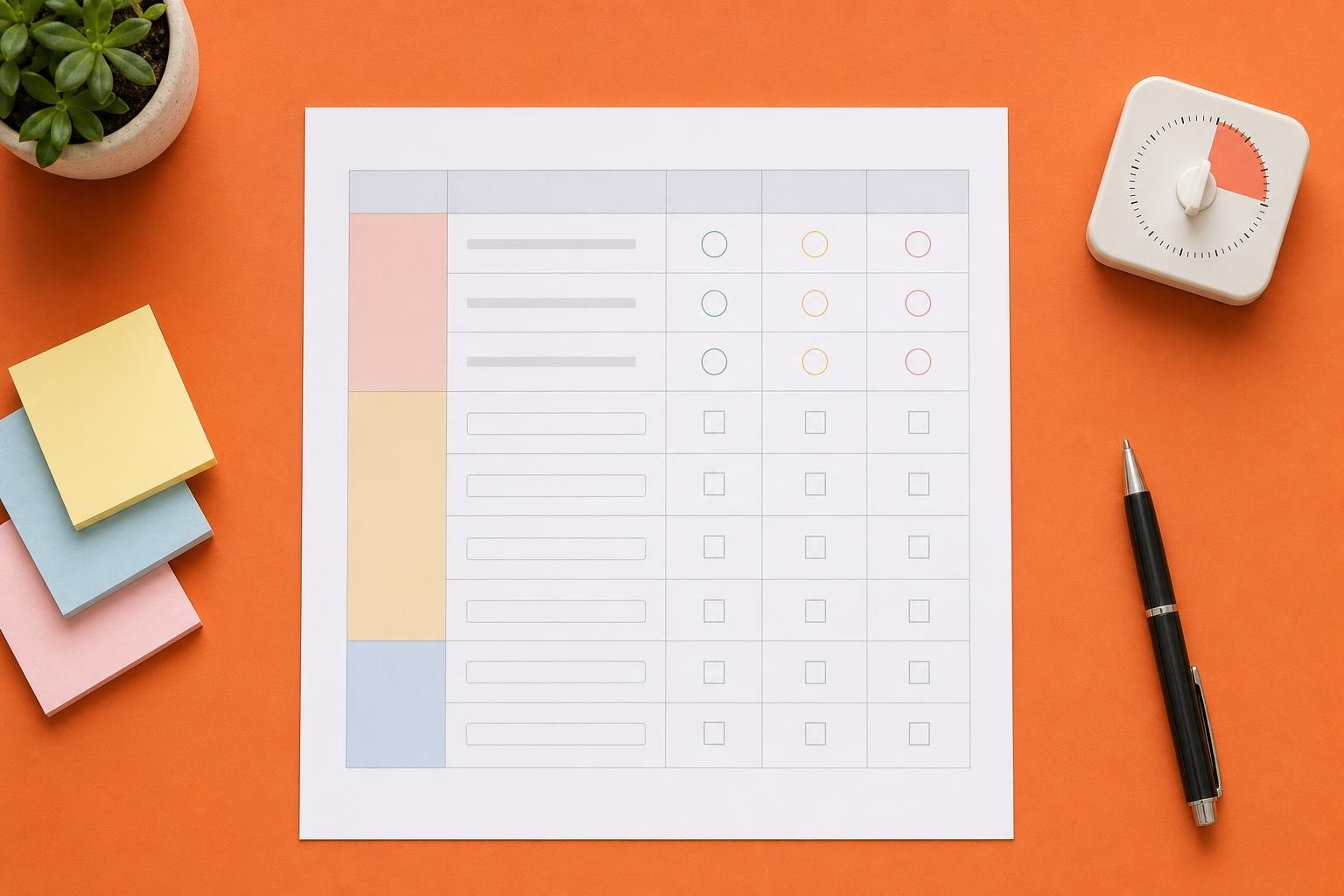
Start by listing candidate priorities. Pull from customer observations, meaning themes, strategic commitments, operational constraints, and known friction. Then score each candidate against three criteria: customer impact, focus cost, and time-to-feedback. Customer impact asks whether the work changes something the customer can feel or benefit from. Focus cost asks what attention, people, meetings, and trade-offs the work will consume. Time-to-feedback asks how quickly the team can learn whether the work is helping.
Choose 2 to 3 priorities. Not five. Not seven with “tiers.” The number matters because priorities compete for the same calendar, the same cognitive bandwidth, and the same decision energy. When everything stays active, the team does not have priorities. It has a crowded hallway. Work bumps into work, owners negotiate in side channels, and progress becomes hard to see until frustration is already baked into the quarter.
For every chosen priority, explicitly name what is being de-prioritized. This is the part many teams avoid because it creates a moment of discomfort. Still, hidden trade-offs become future conflict. If a platform cleanup is chosen, perhaps a reporting enhancement waits. If onboarding clarity is chosen, perhaps a new advanced feature moves to the next cycle. Saying this plainly protects trust because people can see the cost of focus rather than discovering it through silence.
Each priority should have a thin-slice deliverable within 14 days. This is the “reduce friction to ship” rule. A thin slice is not a fake milestone or a status update. It is a small customer-relevant or workflow-relevant release that creates learning. A revised onboarding checklist, a simplified first-run screen, a new support triage rule, a one-page decision memo template, or a manual concierge test can all count if they create observable feedback. Without a thin slice, a priority can become a large container for vague effort.
Then build the scoreboard. Keep it to 3 to 7 metrics, mostly lead measures. “Metrics should provide rapid, meaningful feedback.” A lead measure might track setup completion in the first session, number of unresolved onboarding blockers, time from customer request to first response, decision memo completion before review, or percentage of priority work shipped in thin slices. Lag metrics such as revenue, retention, or NPS may still matter, but they often move too slowly to guide weekly behavior.
“When metrics are publicly displayed, they are a reminder to everyone of what is important.” Public does not need to mean performative. It can mean pinned in the team channel, visible in the project hub, reviewed at the start of the weekly operating meeting, or posted in the shared workspace. The scoreboard should show the priority, lead measure, target, owner, update cadence, and current status. If a metric needs a private explanation every time, simplify it. If a metric makes the team look good but does not guide action, remove it.
Guard against vanity metrics and lag trophies. A vanity metric is easy to celebrate but weak at changing behavior, such as total page views when the real problem is activation confusion. A lag trophy confirms something after the team can no longer adjust, such as quarterly revenue when the weekly question is whether the new onboarding flow helps customers reach first value. The scoreboard should help the team decide what to do next, not decorate a review meeting.
Publish the scoreboard where the work already happens. Update it before the weekly review, not during the meeting. Use the review to ask what the measures suggest, where friction remains, and which thin slice should ship next. If the scoreboard is hidden in a private file, the team will drift back to memory, opinion, and the loudest urgent request. Visibility is not about pressure. It is about reducing avoidable confusion.
After Day 30: Run the Next 30 Days as an Experiment, Then Refine the System
After Day 30, treat the priorities, purpose language, and metrics as working hypotheses rather than permanent declarations. Results vary, and that is exactly why the next cycle matters. A sprint is useful only if it changes the team’s default way of operating once the calendar event is over.
Run a short retro before choosing the next cycle. Ask what moved, what stalled, what created unintended consequences, and what should change in the system. A priority may have been right but too large. A metric may have been visible but not meaningful. A decision principle may have sounded clear until a real trade-off exposed its weakness. These are not reasons to abandon the process. They are the raw material for making it sturdier.
Keep the ongoing cadence simple. Hold a 15-minute weekly scoreboard review. Review customer signals every two weeks. Check priorities monthly, with no more than 3 active priorities at once. Update metrics before meetings so the conversation can focus on judgment rather than data gathering. Revise measures when they stop producing useful feedback. A stale metric becomes office wallpaper. People see it, then stop noticing it.
The deeper discipline is not the 30-day sprint. It is the refusal to let purpose float above the work while priorities multiply below it. Pick a start date. Assign an owner. Schedule the four weekly sessions. Then ask the question most teams postpone because the answer has consequences: if this purpose is real, what work no longer deserves the team’s best attention?