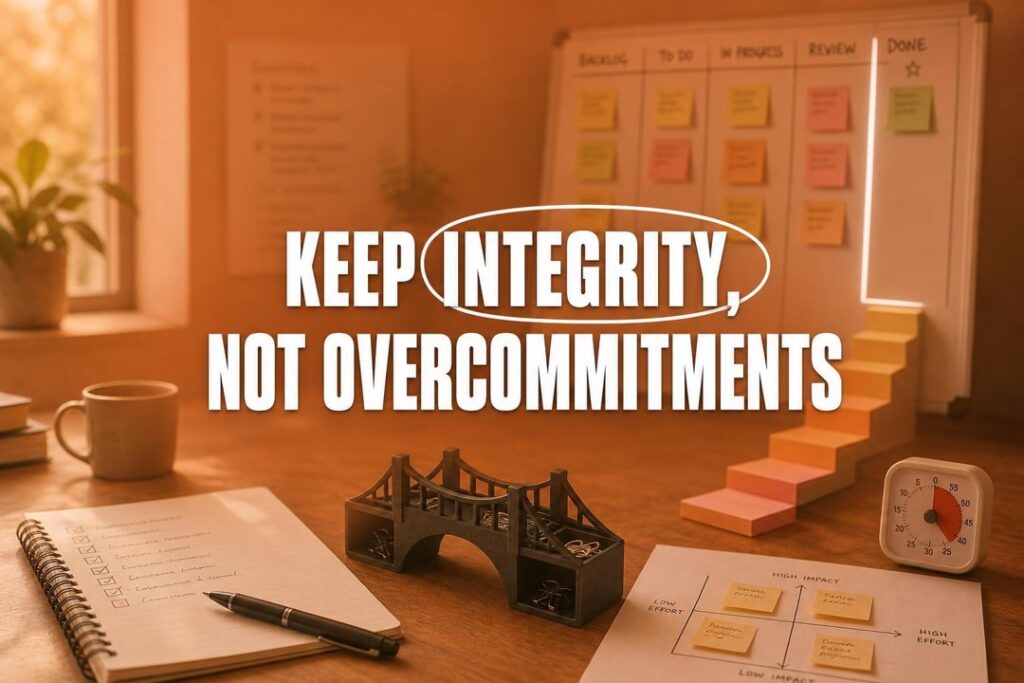
Overcommitment Is Not Ambition, It Is a Leadership Integrity Gap
Overcommitment is usually treated like a calendar problem. It is not. It is a credibility problem, a systems problem, and eventually a culture problem. When leaders say yes faster than the organization can honestly deliver, the cost does not disappear. It compounds inside rushed handoffs, hidden rework, brittle priorities, and the quiet erosion of trust.
The uncomfortable truth is that overcommitment often wears the costume of ambition. It sounds energetic. It looks responsive. It gives everyone the warm little dopamine hit of possibility. Then Tuesday arrives, the work has to pass through actual human hands, and the promise turns into interest-bearing debt.
Teams do not burn out because they lack ambition. More often, they burn out because every commitment enters the room with no visible price tag.
What Most Leaders Get Wrong About Overcommitment
Most leaders assume overcommitment means there is too much work and not enough time, but the deeper issue is that promises are being made without a truthful accounting of capacity, constraints, and tradeoffs.
That distinction matters because time management advice often aims at the wrong target. A team can use better calendars, sharper meeting hygiene, and fewer notifications, and still remain trapped in the same pattern if leadership keeps treating capacity as elastic. The calendar is only the receipt. The purchase happened earlier, at the moment someone said, “Yes, we can do that,” while already knowing the machine was running hot.
This is why overcommitment becomes an integrity gap. Not moral failure in the dramatic, villain-with-a-cape sense. Something quieter. A gap between what gets promised and what the system can reliably support. The team hears one thing in the planning meeting and experiences another thing during delivery. After enough cycles, people stop believing the promise. Worse, they stop believing the planning process.
Here is the contrarian part: the cure for overcommitment is not better productivity. More productivity can make the problem worse because it gives a sloppy promise-making system more room to hide. A better test is simple: if a commitment requires last-minute rescue, unclear ownership, or invisible overtime to succeed, it was not a commitment. It was a wish with a deadline.
The Hidden Interest Your Team Pays
Every overpromise creates a debt, and the team usually pays it in forms that never appear on a dashboard.
The first payment is rushed handoff. Work that should move cleanly from one person to another arrives half-shaped, missing context, or carrying assumptions nobody had time to challenge. The receiving person has to become part detective, part translator, part emotional support animal for a process that should have been designed with more care. This is where quality starts to leak, not because people are careless, but because ambiguity has been shipped downstream.
The second payment is workaround culture. People stop using the system because the system cannot keep up with the promises. They create side channels, private spreadsheets, emergency chats, and hallway agreements that solve today’s problem while making tomorrow’s work harder to understand. The organization slowly becomes a house with too many unofficial doors. Everyone can get in somehow, but nobody knows which entrance is safe.
The third payment is learned helplessness. When the leader consistently saves the day, the team learns a dangerous lesson: escalation is faster than ownership. Why wrestle with tradeoffs if the boss will override the constraints? Why protect focus if the final hour will be rescued by someone with enough authority and caffeine? This is not empowerment. It is dependency wearing a headset.
Then again, the exact opposite can happen when a leader refuses to rescue too often. The team can feel abandoned if constraints were never made visible and decisions were never clarified. That is the messy middle leaders have to face. Commitment discipline does not mean disappearing behind a wall of “no.” It means making reality visible early enough that people can make adult decisions with real information.
The most expensive cost is trust. Not loud, dramatic distrust. The quieter kind. People still attend the meeting. They still nod. They still update the tracker. But inside, a small calculation begins: this deadline will move, this priority will change, this promise is probably theater. Once that calculation becomes normal, leadership has to spend twice as much energy to get half as much belief.
For a practical companion on this pattern, the related piece Commitment Discipline for Chaotic Workdays Make Fewer Promises and Keep Them explores why fewer promises often create more actual progress.

Reactivity Feels Productive Until It Becomes the Operating System
Overcommitment survives because reactivity quietly replaces intention with whatever seems most urgent in the moment.
Most people begin their day in neutral and then react to whatever confronts them. The inbox speaks, the meeting expands, the urgent request knocks politely and then moves into the guest room. By noon, the day has a shape, but not because anyone designed it. It has the shape of whatever shouted with the most confidence.
Leaders are especially vulnerable because responsiveness is socially rewarded. Answer quickly. Remove blockers. Keep momentum. These are not bad instincts. In small doses, they are useful. But when responsiveness becomes the default operating system, the leader becomes a human patch cable, connecting broken circuits all day and calling it strategy.
The sharper edge is that overcommitment can become a way to avoid choosing. Saying yes to everything postpones the discomfort of priority. It allows a leader to look generous, ambitious, and aligned with every stakeholder. Very respectable. Very expensive. The actual choice still happens later, but now it happens through delay, fatigue, and quality compromise instead of deliberate tradeoff.
This is where integrity comes back into the frame. A clear no, a narrower scope, or a renegotiated deadline may feel uncomfortable for five minutes. A dishonest yes can punish a team for five weeks.
Integrity-Based Commitments Make Constraints Visible
Integrity-based commitment means making fewer promises, defining them more clearly, and defending them with visible constraints instead of private heroics.
The word “integrity” can sound ornamental, like something etched onto a lobby wall next to a plant that has seen too much. In practice, it is mechanical. Integrity means the parts fit together. The promise fits the capacity. The deadline fits the scope. The owner has the authority. The team can see what must be paused, reduced, or refused to make the commitment real.
A healthy commitment has a shape. It names the outcome, not just the activity. It identifies the decision-maker, not just the meeting attendees. It exposes the constraint, not just the desired date. It clarifies what will not be done, which is where many plans politely look away.
One useful commitment sentence sounds like this: “We can deliver this outcome by this date if we reduce this scope, pause this work, and keep decisions within this response window.” Plain. Slightly less glamorous than a motivational poster. Much more useful.
Without that level of clarity, the team fills in the gaps with hope. Hope is a fine human virtue and a terrible project management system. It does not assign ownership. It does not reduce scope. It does not tell the designer which request wins when three stakeholders all believe their item is “quick.”
Visible constraints also protect leaders from becoming the hidden buffer. If the team sees capacity, tradeoffs, and decision rules, they can participate in reality instead of waiting for rescue. This turns commitment from a performance into a contract with the work.
The goal is not to become rigid. Rigidity is just chaos with better posture. The goal is to become trustworthy. Trustworthy teams can adapt because they know what is true. They know the fast lane is reserved for the few moves that matter, not every request that arrives wearing an urgent hat.
A Practical Reset for Leaders Who Want Fewer Broken Promises
The reset begins by treating focus like a budget and commitments like investments, because every yes spends attention before it produces results.
Start with a visible commitment ledger. Not a sprawling task list, not a decorative roadmap, not a graveyard of optimistic dates. A simple view of the active promises the team has made, who owns them, what outcome defines done, and what constraint could break delivery. This gives the team a shared source of truth. Without it, people manage work through memory, status theater, and the sacred office ritual of asking, “Wait, who has this?”
Next, require a tradeoff before accepting new work. If something enters, something else must move, shrink, or stop. This is the discipline most teams avoid because it makes cost visible. But invisible cost is still cost. It just shows up later as context switching, missed details, and people doing “one quick thing” at 9:47 p.m. while pretending it is not work.
Use scope reduction before deadline panic. When a commitment starts to wobble, the first mature question is not “Who can work harder?” It is “What version of this still creates the intended outcome?” Collapsing scope is not lowering standards. It is protecting the promise from becoming a swamp. The consequence of ignoring this is predictable: the team ships a bloated thing late, then spends the next cycle cleaning up the mess it was too rushed to prevent.
Create a decision response window. Many commitments fail not because execution was slow, but because decisions sat in someone’s inbox like bread left out overnight. If leadership approval is required, define how quickly decisions must happen. If that window cannot be protected, the deadline is not real. Simple as that.
Finally, make rescue visible. When a leader saves a commitment through extra effort, name it as a system exception, not proof that the plan worked. The wording matters. “We delivered because two people absorbed unplanned work” is different from “Great job, team.” The first creates learning. The second trains everyone to repeat the same mistake with better smiles.
A strong leader does not prove commitment by saying yes under pressure. A strong leader proves commitment by protecting the conditions under which yes can be kept.
The New Standard Is Fewer Promises, Kept Cleanly
A team becomes calmer and stronger when promises are treated as design objects, not emotional reactions.
This is the shift from performative busyness to operational integrity. The leader stops measuring ambition by how many plates are spinning and starts measuring credibility by how few need emergency catching. That change can feel almost suspicious at first. Less frenzy. Fewer heroic updates. More work moving through the system without dramatic music.
Good. Drama is not a KPI.
The real ambition is not to say yes to everything. It is to build a team that can be believed. A team where commitments are clear enough to guide behavior, constrained enough to survive contact with reality, and honest enough that people do not need to decode what leadership secretly means.
So the next time a new request arrives with urgency in its voice, the better leadership question is not “Can the team squeeze this in?” The better question is sharper: “What promise would have to become less true for this promise to be made?”