
How to Delegate More Decisions Without Losing Quality or Accountability
A leader can stop being the decision bottleneck by moving control from individual approvals into a small set of visible project rules. Define the normal path for routine work, validate requirements early, reuse proven solutions where appropriate, and specify the conditions that require an exception review. Teams then have clear local decision rights, while quality, compliance, and higher-risk work retain appropriate oversight.
The surprising part is that responsible autonomy usually needs more clarity, not fewer constraints. When people know what normal work looks like and what makes work unusual, they can act without waiting for permission on every choice. The leader’s work shifts from personally controlling each task to observing, coaching, and improving the system that governs the work.
Why does delegation fail when leaders simply tell teams to take ownership
Delegation fails when ownership is offered without usable decision boundaries. “Use your judgment” can sound empowering, but it leaves important questions unanswered: What quality level is expected? Which decisions can be reversed? What evidence is needed before proceeding? When must someone bring in compliance, a customer owner, or a senior leader?
Without those answers, teams tend toward one of two unhelpful extremes. They escalate routine decisions because the cost of being wrong feels unclear, or they create local variations that make quality, timing, and accountability difficult to see across the work. Neither outcome is a lack of effort. It is a lack of an agreed operating path.
A leader can make accountability stronger by making the boundaries visible. The team should be able to say, “This decision fits the agreed rule, so I own it,” or “This condition falls outside the rule, so this work needs an exception review.” That is more useful than vague permission and less burdensome than leader approval for every task.
What are decision rights in a project operating system
Decision rights are clear agreements about who can decide, what they can decide, the rules they must follow, and when they must involve others. They turn delegation from a personal judgment call into a shared practice.
A project rule is a limited, repeatable constraint that guides normal work. A rule might set the maximum size of a project, require early validation before substantial build effort, or ask teams to use an established pattern before creating something new. It gives local owners a reliable basis for acting.
An exception boundary is a specific condition that sends work onto a different review or approval path. It does not remove decision rights from the team. It helps the team recognize when the normal path no longer provides enough rigor for the risk involved.
This distinction appeared in a delivery example in Learn to See the Invisible. Rather than having the leader direct each project, the team agreed on four rules governing project length, requirement validation, reuse, and the additional protocols needed for audited work. The leader learned to manage the rules and use observations of team and customer interactions to coach project leaders.
Which project rules let teams decide routine work locally
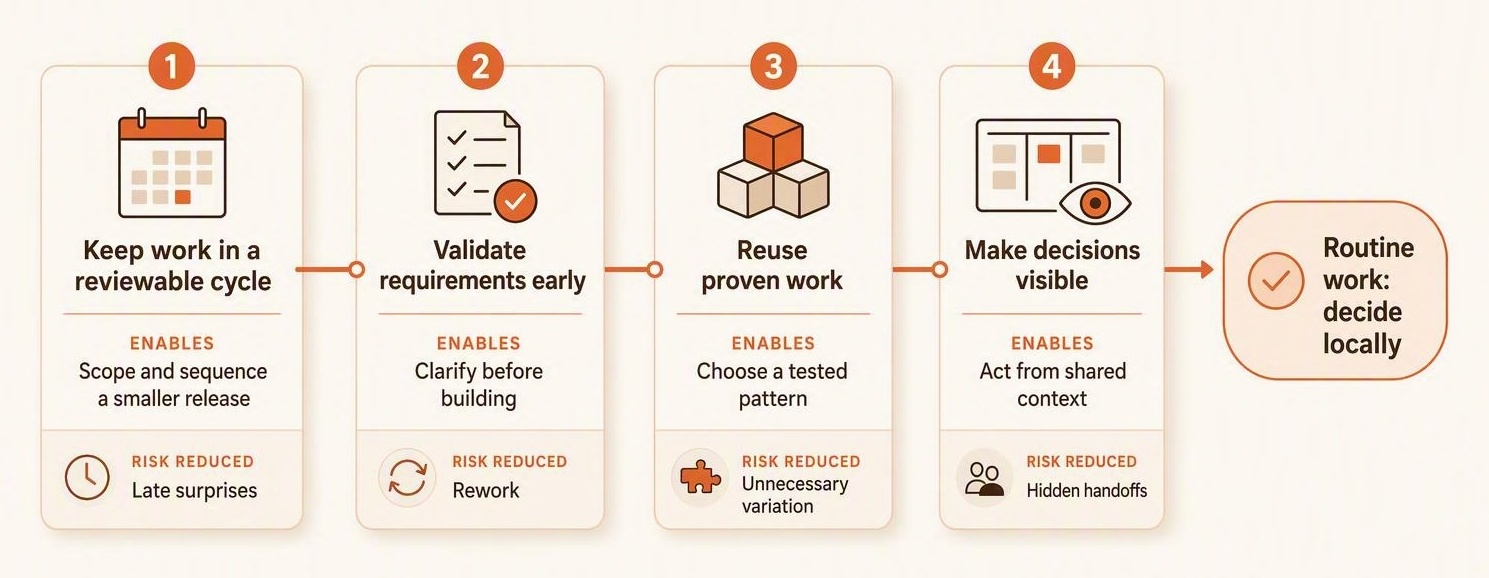
A small set of project rules can give teams room to decide routine work locally while keeping the work visible and reviewable. Here is a system to try, adapted to the nature of your work rather than treated as a universal standard.
-
Set a maximum project cycle
Keep routine work within an agreed cycle so it can be reviewed before assumptions, scope, and dependencies grow too large. This enables the local owner to break work into smaller decisions, sequence a release, or recommend a narrower first step without asking for approval simply because the work exists.
The risk reduced is long-running work that becomes difficult to assess until late in delivery. In the book’s example, no project could take longer than a year, with the reflection that modern work often benefits from much shorter cycles. Ask: What is the longest cycle in which this type of work can stay understandable, testable, and reviewable?
-
Validate requirements before substantial build effort
Require a lightweight representation of the requested outcome before the team commits significant effort. Depending on the work, that may be a mock-up, sample, prototype, process sketch, test case, or written acceptance criteria. It enables the local owner to clarify a requirement with the customer or stakeholder early instead of treating an initial request as complete.
The risk reduced is rework caused by discovering too late that people meant different things. The delivery example used a computer mock-up to validate requirements before building the full solution. Ask: What is the smallest artifact that lets the people affected by this work confirm that the team is solving the right problem?
-
Reuse proven work before creating a new solution
Make reusable patterns, components, checklists, and prior decisions easy to find. This enables teams to choose a known approach for routine needs without reopening a design decision that has already been tested in their context.
The risk reduced is unnecessary variation, avoidable defects, and time spent rebuilding what already works. In the delivery example, routine programming tasks drew from a shared library rather than being recreated by each developer. Ask: What proven work should be the starting point for this recurring decision, and what would justify departing from it?
-
Make work, assumptions, decisions, and progress visible
Use a shared system where the owner, current stage, key assumption, decision, next review point, and exception status can be seen. Visibility enables local decisions because people do not need private updates or informal memory to understand what has been agreed.
The risk reduced is hidden handoffs, conflicting interpretations, and late surprises. Visual leadership is useful when it helps a team see information that is otherwise difficult to notice and identifies the decisions the visual should drive. Ask: Could a teammate tell, from the shared view, what was decided and what needs attention next?
The thresholds matter less than the agreement. A small internal request and a regulated customer commitment should not share the same cycle, validation method, or review path. Choose rules that fit the team’s risk profile, then inspect whether they are actually helping people make sound decisions.
What belongs on the default path and what requires an exception
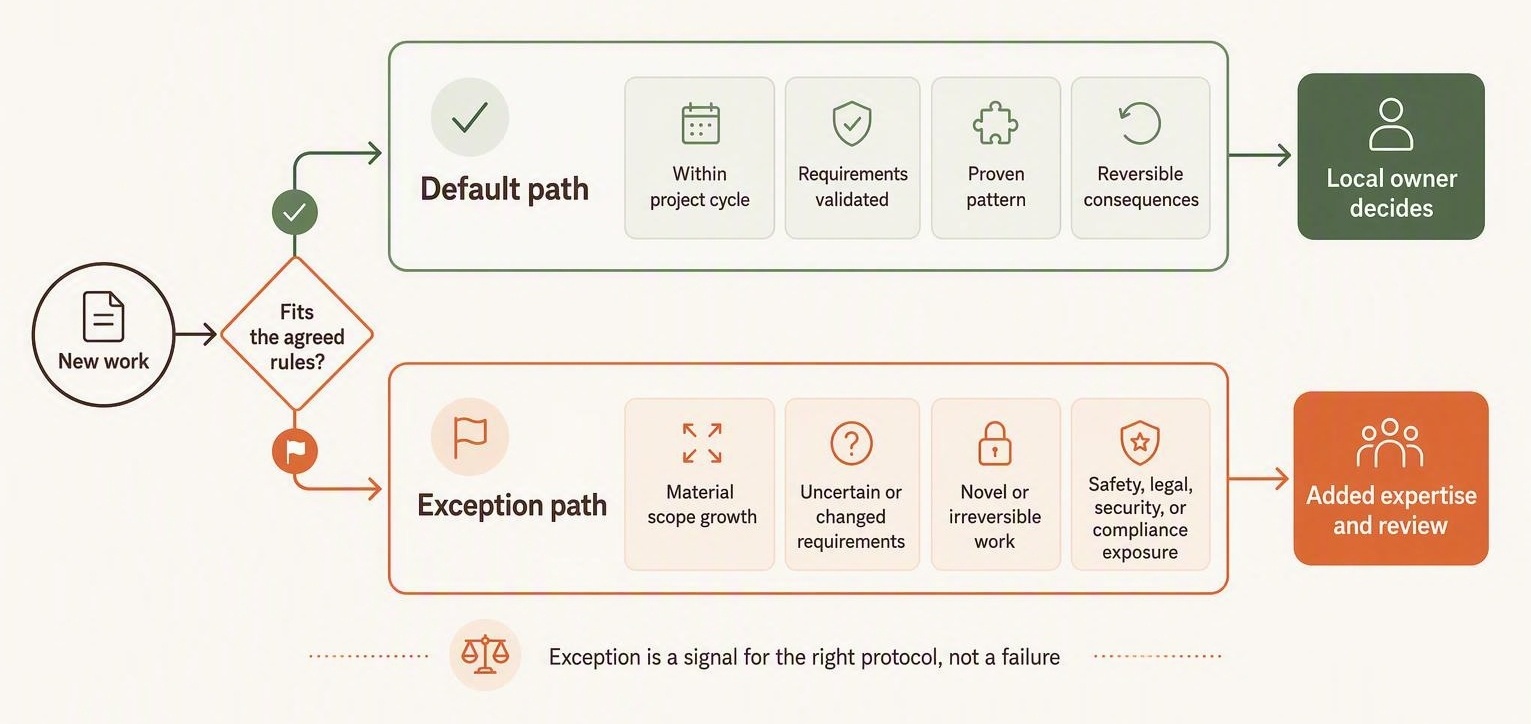
The default path covers work that fits the agreed rules, while the exception path applies when those rules no longer provide enough protection. The distinction should be specific enough that a team can recognize it in the course of work, not after a problem has occurred.
| Default path for routine work | Exception path for work needing added rigor |
|—|—|
| Fits the agreed project cycle | Exceeds the agreed cycle or introduces material scope growth |
| Requirements have been validated | Requirements remain uncertain, disputed, or materially changed |
| Uses a proven pattern or reusable component | Requires a novel technical, operational, or customer approach |
| Has consequences that are reasonably reversible | Creates an irreversible or difficult-to-reverse commitment |
| Meets the ordinary quality checks for the work | Involves heightened safety, legal, regulatory, security, or compliance exposure |
| Can be decided by the named local owner | Requires specialist expertise, cross-functional approval, or a material customer commitment |
An exception is not a failure, an excuse, or a loophole. It is a deliberate signal that the work deserves a different protocol, additional expertise, or a higher level of review. In the book’s delivery example, projects subject to regulatory audits followed more restrictive requirement-development protocols, while other projects were handled as simply and reliably as possible.
This prevents a common mistake: applying the heaviest process to every request because some requests carry serious risk. Over-processing routine work creates delay and encourages workarounds. Under-processing genuine exceptions exposes the team to risks it may not be equipped to assess. A visible boundary lets the team preserve rigor where it matters without making routine execution dependent on the leader.
How should a leader respond when a team raises an exception
A leader should treat an exception as useful information about the work and the operating system. The goal is not to take the decision back automatically. The goal is to ensure the right decision owner, evidence, expertise, and review path are in place.
Use this lightweight sequence:
- Make the condition visible in the shared project view.
- Name the rule that no longer fits, such as cycle length, requirement certainty, reversibility, or compliance exposure.
- Clarify the decision owner and identify the expertise needed to make a sound choice.
- Choose the added protocol, such as a stakeholder review, specialist assessment, formal approval, test, or documented risk decision.
- Document the decision and rationale so the team can act consistently afterward.
- Review the learning in the next operating review. Decide whether the exception was unique or whether a rule needs refinement.
Useful coaching prompts include: “What makes this work different from the default path?” “What evidence would reduce the uncertainty?” and “What is reversible before we delay a decision?” These questions keep the leader close to the quality of thinking without becoming the automatic answer for every issue.
This is a meaningful leadership shift. The leader protects the system, removes barriers, and helps people learn to use judgment within clear constraints. When a process makes authority unclear, people often wait or create workarounds instead. An explicit exception path gives them a better option.
A simple decision-rights template for the next planning conversation
A decision-rights agreement should fit on one page and be understandable by the people doing the work. Use this template for one recurring project type:
| Field | What to clarify |
|—|—|
| Decision area | What recurring choice or project type is covered? |
| Local decision owner | Who can decide on the default path? |
| Default rule | What conditions define normal work? |
| Evidence or validation required | What must be checked before proceeding? |
| Quality standard | What must be true for the work to be accepted? |
| Visible tracking location | Where can people see status, assumptions, and decisions? |
| Exception triggers | Which conditions require a different review path? |
| Escalation contact | Who coordinates the added review or provides required expertise? |
| Review cadence | When will the team inspect decisions, exceptions, and rule performance? |
Test the template in the next weekly review with one recurring category, such as customer changes, internal improvement ideas, project intake, or technical design choices. Keep the first version simple enough to use consistently. Then look for what becomes visible: repeated exceptions, unclear quality expectations, rules that are too broad, or decisions that still wait unnecessarily.
Results vary by team risk, operating context, and consistency in using the agreement. The purpose is not to create a permanent bureaucracy. It is to make normal work easier to decide and unusual work easier to recognize.
Delegation becomes clearer when leaders govern the rules, not every task
Delegating decisions does not mean removing controls. It means placing control where it can guide many decisions: in a few agreed rules, visible evidence, and explicit exception boundaries.
Control of every task turns the leader into a bottleneck. Absence of rules leaves teams to guess. A reliable default path gives people authority to act, while an exception path gives them a responsible way to surface work that needs greater care. Begin with one recurring decision category, make the agreement visible, and refine it from what the team learns in practice.