
Gemba Walks Reveal When Completed Work Hides an Unstable Process
A process can appear to be working because capable people keep finding ways to complete the task. But when workarounds recur, they introduce variation into the normal method, conceal unstable conditions, and can increase quality risk even when today’s output looks acceptable.
Picture an employee who gets a missing detail by messaging a colleague, substitutes an unavailable material, or seeks an informal approval to keep work moving. The customer receives the output, so the process looks successful. Yet the work was completed by departing from the method, not because the method was sufficient. A Gemba walk should examine how work was completed, not only whether it was completed.
Why does a workaround make a process look healthier than it is
A workaround is an alteration people make because the normal method cannot work under current conditions. It may protect the immediate result, which is often the right thing to do in the moment. The problem is not the person’s resourcefulness. The useful leadership question is: what condition made adaptation necessary?
When missing information, unavailable materials, unclear authority, or a broken handoff becomes routine, people learn whom to call and what shortcut to take. The workaround then fades into the background because the work still gets done. The source material warns that workarounds can become the standard way work gets done, hidden precisely because they allow the task to be completed.
What should leaders observe during a Gemba walk
A Gemba walk makes hidden deviations visible when leaders Go See, Ask What, Then Why, and Show Respect. This is not an inspection designed to catch someone doing something wrong. It is a way to understand the real conditions of the work and discover barriers that make good work harder.
Use this short observation sequence:
- See the stated method. What is the normal method, and what is the target condition?
- Notice the departure. What changed in the timing, sequence, information, material, or approval path?
- Understand the compensation. What made the normal method insufficient? How often does this happen, and who must compensate?
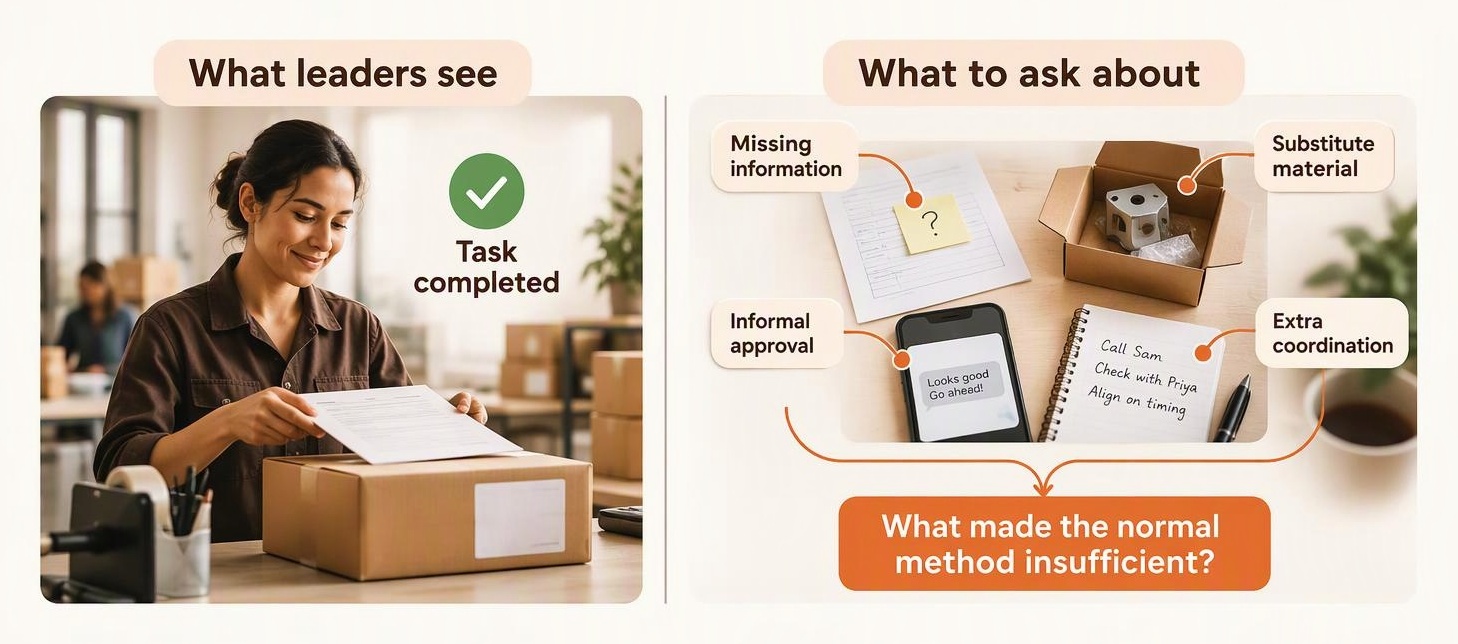
Ask open questions such as, “Can you show me what happens when this is not available?” and “What help do you need from me to make the normal method sufficient?” Avoid leading with blame or an assumed solution. Respect means treating the person closest to the work as a source of process knowledge, not as the problem to diagnose.
How do repeated workarounds create quality risk
Repeated workarounds create hidden variation because the same task is completed through multiple unofficial methods. The chain is straightforward: an obstacle prompts a workaround; the workaround changes the method or timing; repeated changes normalize several ways of working; and outcomes become harder to predict.
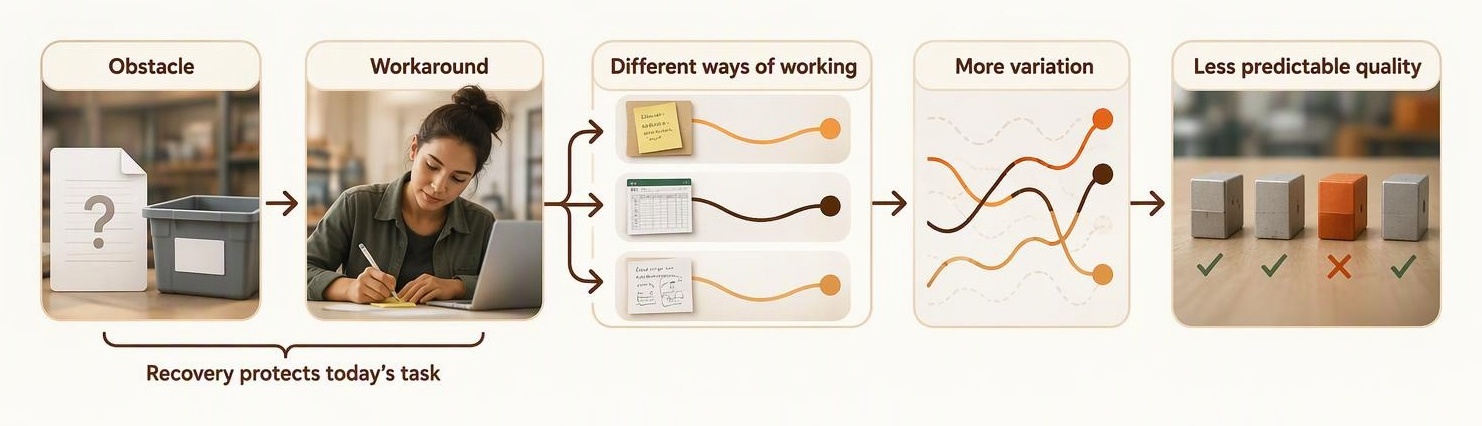
A rare exception may be tolerable while the team learns more. A recurring deviation deserves attention when it crosses shifts or teams, bypasses a check, depends on individual memory or relationships, or changes what the customer receives. The book connects repeated workarounds with process variation and explains that significant variation makes a process statistically unstable and more prone to quality problems.
Which workarounds deserve attention first
Not every abnormality can be addressed at once. Start with a simple priority filter: frequency, potential effect on customer or quality, dependence on individual heroics, and whether the workaround masks an unresolved upstream condition.
Make the work visible on a walk note or simple board. Record the condition, the altered method, and the consequence. For example: “Required input was unavailable, analyst used a prior version, review took longer.” This creates a shared fact pattern without turning the observation into a judgment of the employee.
The goal is to understand the system, choose one condition worth investigating, and follow through. Results vary by context, team, and consistency of practice, but visible recurring deviations give a team a more honest starting point for improvement.
Make recovery visible so the process can become more reliable
Resourceful recovery is useful evidence, not proof that no problem exists. On the next Gemba walk, try one question: “What help do you need from me to make the normal method sufficient?” Then review the recurring deviations with the team and choose one condition to understand. That small practice shifts attention from celebrating heroics alone to building a process that needs fewer of them.