Stop Managing by Walking Around: Lead by Seeing, Asking, and Respecting
A quick story you will recognize
I joined a plant tour that looked perfect on the surface. Leaders moved fast with clipboards, calling out safety fixes. Not one operator was asked a question. The list at the end looked impressive, but nothing important changed. As Michael Bremer explains in How to Do a Gemba Walk, that kind of tour becomes an inspection, not leadership. It teaches people to wait for leaders to spot problems instead of helping teams learn to see and solve problems together .
Why “wandering around” falls short
Walking around to look visible can settle a leader’s nerves. It rarely builds clarity, trust, or skill. Bremer’s aim is different. Go where the work happens, learn how value really flows, and lead in a way that strengthens people, process, and performance. A true Gemba Walk is a learning and coaching exercise, not a hunt for defects. Treat it like an experiment that you adjust as you learn, and it becomes far more valuable over time .
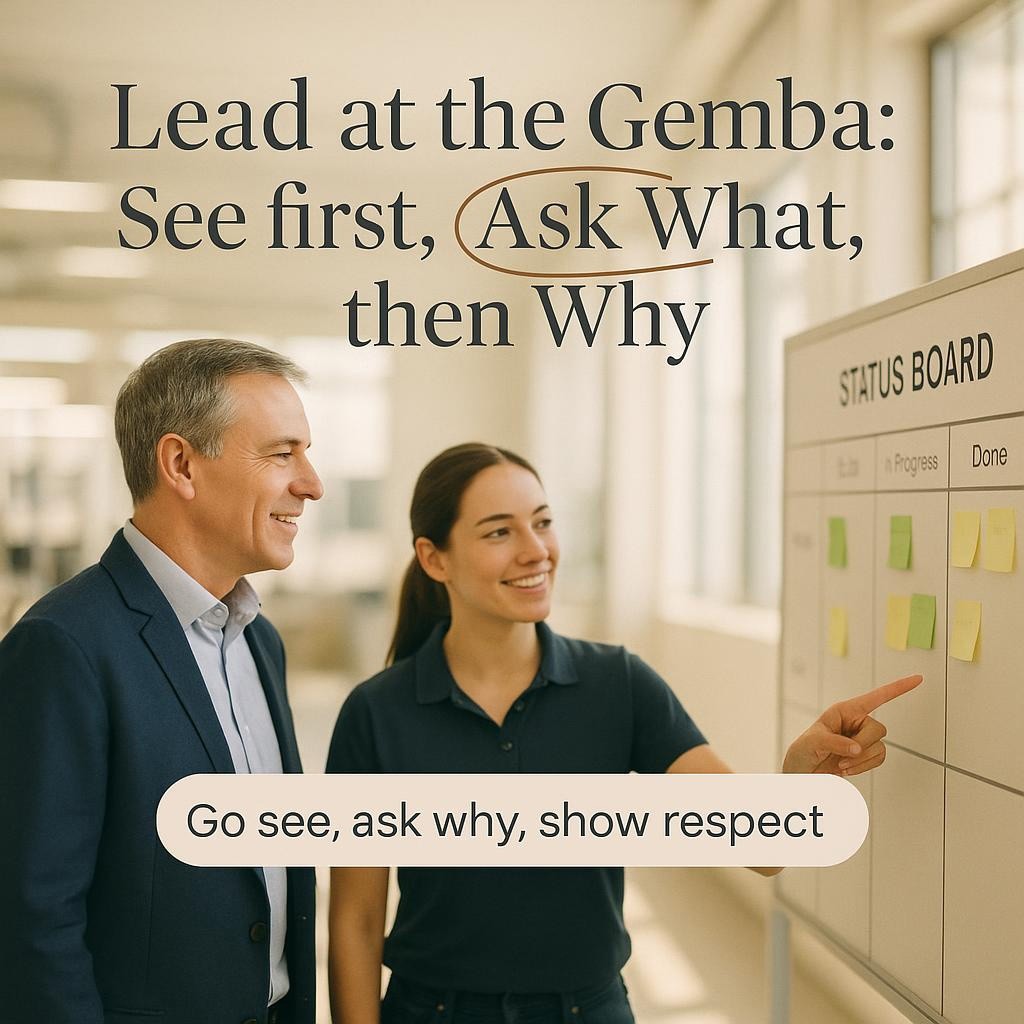
John Shook sums up the mindset with a simple triad he credits to Toyota’s Fujio Cho: go see, ask why, show respect. He calls it the way to turn scientific thinking into daily behavior, focused on real work and the people who create real value .
The common trap, and how to escape it
Even experienced leaders drift into inspection mode. Bremer shares a moment when an executive team walked for safety, found a new set of items, and checked them off. They never spoke with operators. There was no feedback loop to know if the walk achieved its purpose. The hard truth: leaders were doing work their associates should have done. The better leadership question was, Why did our process allow this to exist, and what does that tell us about how we lead today .
That shift matters. Leaders own the process. Their job is to create an environment where people closest to the work take ownership, speak up, and fix issues at the root. Bremer even suggests measuring whether leaders listen more than they talk, track idea follow through, and watch for signs that people feel safe to raise problems and drive changes themselves .
The golden shift: Ask “What” before “Why”
Here is the quiet power move. Start with What to learn the basics and calm defensiveness. Then ask Why to go deeper. Bremer’s guidance is clear. First questions should be What. What is the purpose of this activity. Who is the customer. How do you know a good day from a bad one. Only after that do you ask Why to uncover inconsistencies and root causes. Do it in a no blame way, using the 5 Whys to chase causes instead of the 5 Whos to chase people .
Respect is not soft, it is how systems change
Respect makes it safe to tell the truth. On a Gemba Walk, respect sounds like What help do you need, What have you tried, What will you test next, and How will we know if it worked. Respect looks like listening more than talking, keeping problem ownership with the team, and not jumping in with the answer even when you think you have it. That is how confidence and skill grow over time .
What actually changes when you lead this way
- Conversations move from blame to process. You look at flow, handoffs, signals, and where work waits. You notice what feels awkward or unstable, and you ask why it persists .
- Purpose becomes explicit. Each walk has a clear reason, and you check if your questions and follow up actually created the impact you wanted. Think of each walk as an experiment you refine over time .
- Capability compounds. Bremer urges leaders to coach, not fix. Use a simple pattern to help people set target conditions, grasp current conditions, surface obstacles, and run small tests. You build a team that learns faster than problems show up .
- Results show up in real places, not slides. In one office example, leaders made workload and capacity visible for engineering requests. A cross functional group prioritized twice a week, limited work in process, and the proposal win rate rose from about 25 percent to over 50 percent once capacity was clear .
Action steps you can use this week
1) Name your purpose out loud
Here is how you do it: write one clear goal for the walk that touches people, process, and performance. For example, Understand how this team knows a good day from a bad day, and find one barrier we will help remove this week. Decide how you will check impact, like noticing if you listened more than you talked or counting ideas tried this month .
2) Go see with structure
Start at the metrics board. Ask What is the target and Why is that the target. Did we make it last hour. If not, why not. Then observe staffing to standard work, WIP versus standard, material availability, cycle time, and signs of searching or waiting. You are building shared understanding, not rushing to solve .
3) Ask What, then Why
Open with What questions. What is the purpose of this step. What are you trying to accomplish. Who is the customer. Then, gently use Why questions to explore the system without blaming the person. Keep ownership with the team closest to the work .
4) Show respect you can see and hear
Ask What help do you need, What will you try next, How long will you test it, and How will you know if it worked. Congratulate progress on the spot. Share any useful learning with other teams. Never embarrass anyone during a walk. Ask, coach, enable .
5) Debrief to learn, not to judge
End with two to three insights, one barrier to remove, and one small test to run before the next walk. Close with three simple questions: Did we make decisions today. How will we share them. How will we follow up. Treat the walk itself like a small PDCA cycle for your leadership .
Keep your walks fresh
Do not reduce Gemba to a checkbox. Keep it active and useful. Get very specific about why you are walking and create a way to check whether that purpose is being met. Join a hands on improvement effort now and then so your eyes stay trained on what matters and so you keep learning to see what used to be invisible .
The deeper promise behind this practice
Michael Bremer’s message is not about a tool. It is about the kind of leader you become. When you go see, ask what then why, and show respect, you replace fear with learning and transactions with trust. As Mike Rother notes, the most important thing to watch on a walk is not the content of the work but the pattern of thinking and acting people use as they improve and reach for goals. Gemba Walks, done well, shape that pattern every day .
A question to carry on your next walk
If my presence made it safer to tell the truth and easier to try a better way, what would I see people doing differently by next week, and how will I help that happen today.