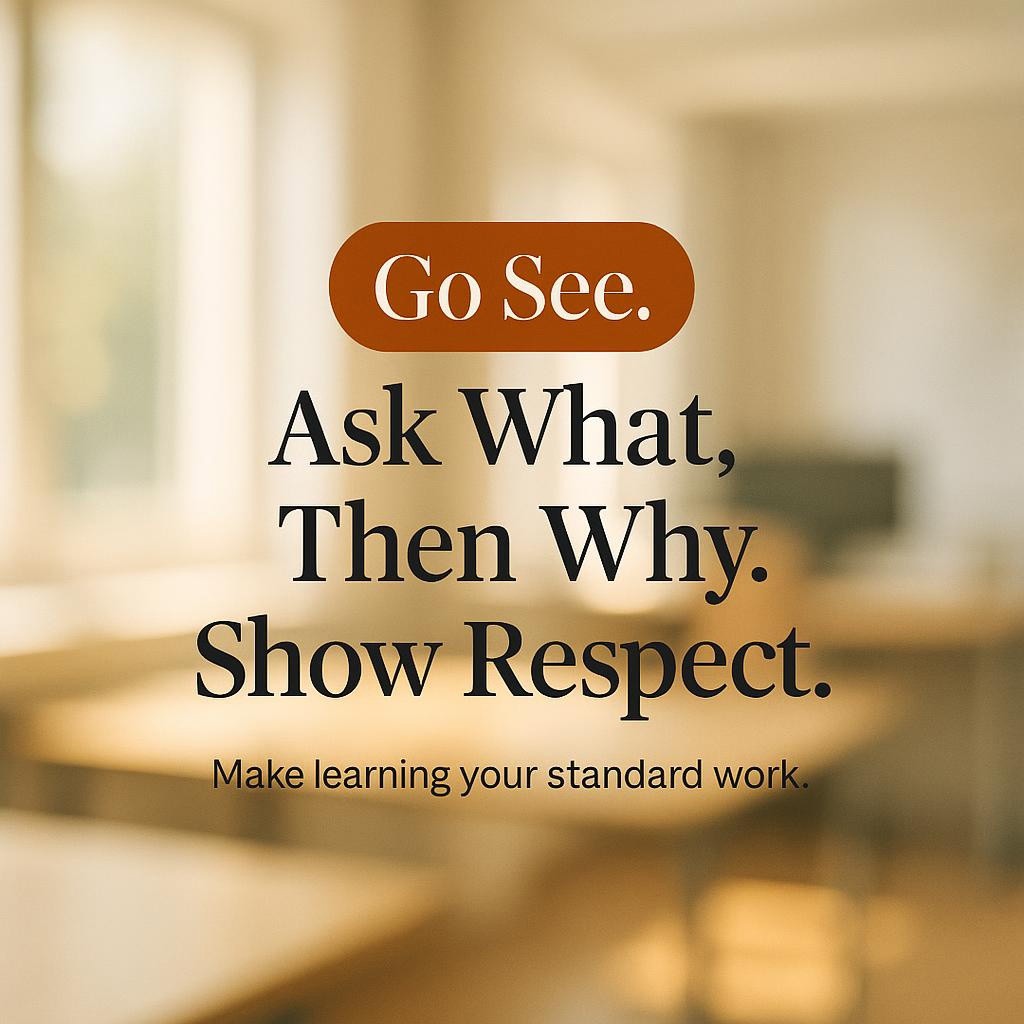
The Three Words That Change How Leaders Grow People
You can feel the shift the moment you step into the work. The buzz, the handoffs, the little workarounds. I used to jump to fixes. It looked decisive, it felt helpful, and it quietly stopped learning. Michael Bremer’s How to Do a Gemba Walk helped me see what was really happening, then change how I showed up with my team.
The Core: Go See, Ask Why, Show Respect
John Shook captured the heart of this practice in three simple words. "‘Go see, ask why, show respect’ is the way we turn the philosophy of scientific empiricism into actual behavior." He learned it from Toyota’s Fujio Cho. We go observe where the work is done, we ask to learn, and we treat people who create value with deep respect .
Here is why the sequence matters:
- Go see, reality before reports. You discover what is really happening versus your assumptions. You see gaps, delays, strain, and the ways people adapt to make the day work .
- Ask what, then why, curiosity before judgment. "Your first question should be a ‘What?’" Then probe with why to learn causes and spark better thinking, not blame .
- Show respect, dignity before improvement. When leaders create a safe place to talk about problems, people tell the truth. If leaders try to catch errors or hand out quick fixes, people hide issues and learning stops .
Hidden Insight: The Order Is the Lesson
Many leaders ask “why” from a conference room, then go see only when alarms flash. Bremer flips that habit. Go see first, so your questions are grounded in reality. Ask what, then why, so the team can think with you. Show respect the whole time, so problems are safe to surface and solve. In practice, this sequence resets power. It says value is created at the point of work, and leadership exists to enable that value .
A Story You May Recognize
A team missed targets and felt squeezed. Instead of pushing scripts, we stood in the flow and watched. Work piled up in bursts. Some steps took too long. Specialists were pulled back to rework. We asked what first, then why. The change was not harder work, it was clearer handoffs, load leveling, and a faster way to find answers. This mirrors what Bremer teaches in office and service settings: multitasking hides real issues, queues mask delays, and people get used to the fog. Go see is how you cut through it and make the real work visible again .
Respect You Can Feel
Respect is not a tone, it is action.
- Invite people to show how the work is done, then listen. Sit beside them and learn the current state before judging or coaching .
- Protect dignity. Build a safe space to discuss problems. "When we give a person the ‘right answer,’ we disrespect them." Help people discover answers, grow skills, and take pride in their thinking .
- Separate people from process. Most problems are system problems, not people problems. If you treat them that way, truth comes out faster and better fixes follow .
Your 20-Minute Gemba Walk: Simple, Clear, Human
Use this as a starter. Keep it light. Keep it real.
1) Before You Go
- Write the purpose in one line, learn the reality, not audit the people .
- Tell the team you are coming to learn, not to catch mistakes .
2) Go See
- Stand where the work happens. Watch one full cycle. Note handoffs, delays, rework, and strain points. Look for what makes the work hard to do right the first time .
- Check simple visuals or a metrics board, what is the target, are we on pace, if not, why not .
3) Ask What, Then Why
Start with What, then probe with Why.
- What is the purpose of this step, what are you trying to accomplish, who is the customer for this work .
- What tends to get in the way, what waits in queues, what signals tell you to start the next step .
- Why is the work done this way, why are we missing pace, why has this issue not been addressed yet .
4) Show Respect in the Moment
- Thank people by name. Reflect back what you heard and ask if you got it right.
- Ask, what help do you need from me, what countermeasures have you tried, what will we try next, how will we know if it worked .
5) After the Walk
- Share one page, purpose, what we saw, what we learned, what we will try. Leave at most three clear actions, then follow up soon so trust grows .
Common Traps That Quietly Kill Learning
- Touring instead of learning. Moving fast, many stops, shallow questions. Deming warned that walking around without the right questions does not work. "Management by walking around is hardly ever effective." Gemba is different, it is structured, focused, and patient .
- Fixing for people. You may have the “right” answer, but you steal growth and reduce ownership. Coach thinking. Raise capability. That is respect .
- Blaming people. Treat problems as process first. When leaders do this, people speak up sooner and solutions stick .
The Deeper Promise: Trust, Capability, Results
Bremer’s purpose is bigger than a better walk. It is to help leaders learn to see the real work, so people can do their best work. Walks help you make facts visible, align with purpose, and build trust. They develop people’s critical thinking and confidence. Over time, this becomes your culture, not just your practice .
Try This For 30 Days
- Schedule two short walks each week. Keep the same area for a month, so learning compounds.
- Use What first, then Why. Protect dignity. Invite ideas. Remove one barrier the team cannot remove alone.
- Close the loop. Share what you learned and what changed. Repeat.
If you carry the spirit of How to Do a Gemba Walk with you, you will not only solve more problems, you will grow people. And when leaders change how they see, organizations change how they learn .