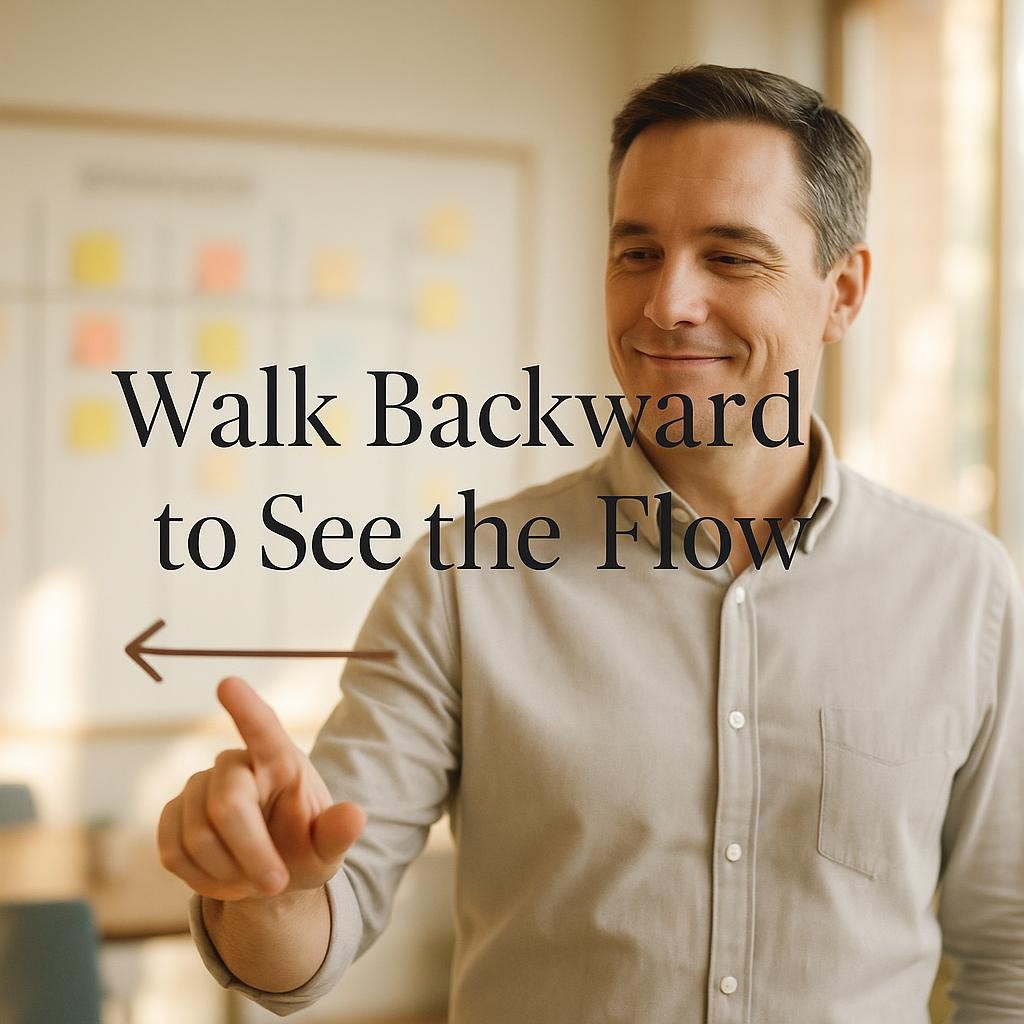
Walk Backwards to See What Is Really There
We had been staring at the same red metrics for weeks. More meetings. More charts. Nothing moved. Then we tried something different. We stood where the customer gets value, and we walked the work backward. Step by step, like we were the product itself. Ten minutes in, we found a quiet seven day pause that no one owned. Not a broken machine, a batch habit triggered only on Fridays. It sat in the seams between teams. Once we saw it, we could change it.
That is the spirit of Michael Bremer’s How to Do a Gemba Walk. He invites leaders to go see with humility, ask better questions, and show respect for the people who do the work. And he gives a practical twist that changes everything, in his words, “Pretend you are a piece of work and follow the process backwards from end to beginning” .
Why Walking Backward Works
- You see flow, not just steps. Starting at the finish shows you queues, handoffs, and decisions that actually shape delivery .
- You follow real signals, not hunches. You will notice the triggers that pull work upstream and whether they are clear or noisy .
- You surface perception gaps. Upstream and downstream teams often hold different stories about “done” and what good looks like .
- You test if boards create collaboration. Some boards spark conversation and improvement, others simply record the past .
Bremer frames it simply: go see, then “Ask What, then Why,” in a way that builds trust and thinking, not fear. Start with what, to learn the work, then use why to go deeper without blame .
Hidden Truths a Reverse Walk Reveals
- Waiting that feels normal, the pile that “has always been there” .
- Rework loops hiding in everyday language, reviewing, validating, syncing .
- Information friction, missing inputs, unclear criteria, or conflicting priorities that slow decisions .
- Local wins that hurt the system, one team at 100 percent while the value stream waits .
As Bremer reminds us, most performance problems live in the process, not in the person. Or as Deming put it, “Most problems, 85 to 95 percent, are system problems, not people problems” .
A Simple Way to Start, Today
- Stand at the finish. Ask, what must be true for this to move to the customer, or the next step, right now ?
- Trace one unit of work upstream. See the artifacts it touched, the decisions it waited on, and the people it needed .
- Listen for wait words. Waiting, pending, blocked, batching, holding, usually. Pause there and learn with “what” before “why” .
- Validate the pull signal. Who or what told this work to move, and is that signal consistent and visible ?
- Capture only what matters. Time in queue, time in process, rework counts, signal reliability, decision clarity .
The 60 Minute Reverse Gemba
- Minutes 0 to 10, at the finish, align on “done” and the true customer.
- Minutes 10 to 30, follow one piece of work through two or three steps upstream, note queues and signals.
- Minutes 30 to 45, check the board and real conversations, current and collaborative, or stale and silent .
- Minutes 45 to 55, name two systemic causes you can influence, one policy, one capability .
- Minutes 55 to 60, agree on one two week support action, something that removes friction for the team .
The Backward Walk Checklist
Use this during your next walk. Keep it to one page and stay curious.
Flow and Time
- From here to customer use, how long does it take?
- Count the queues, note the age of the oldest item.
- Rework loops, how many returns to a prior step ?
Signals and Triggers
- What is the primary pull signal upstream, clear or ambiguous?
- Where do signals delay, manual or system driven?
- Where are batch habits hiding, policy or habit ?
Perceptions and Definitions
- Do upstream and downstream agree on “done” and quality?
- What does each step believe is the biggest issue, do others agree ?
Collaboration and Boards
- Do boards prompt conversation and improvement, or just track numbers ?
- Are there daily connections around the work, not just status ?
Systemic Causes
- Which policies, approvals, or batching rules create delay?
- Which capability gaps or missing inputs slow handoffs ?
Support Actions
- One obstacle you can remove within two weeks.
- One experiment to shorten a queue or strengthen a signal.
- One leadership behavior to reinforce, ask what, then why, separate process from people .
From Demanding Results to Enabling Flow
Bremer’s deeper aim is a shift in how leaders lead. You are not there to catch errors, you are there to create the conditions where good work is easy, and bad outcomes are hard. He is clear, keep ownership with the people, and align the support systems that sit above them, communications, planning, measurement. That is real respect, and it is how trust grows .
One story from the book still stings. A team was missing takt because they ground parts to make them fit. The drawings had not been revised in 40 years. No one had asked why. As the leader shared, “For more than 40 years, no one ever asked ‘Why?’ and people continued to work that way” . That is what a walk reveals, the old agreements we never meant to make.
Pitfalls to Avoid
- Treating it like an audit. A walk is for learning and support, not blame .
- Walking once, then stopping. Capability comes from brief, regular practice .
- Measuring everything. Focus on a few leading indicators you can influence now, queue age, signal reliability, handoff quality .
Lead the Change You Want to See
Bremer’s method asks you to notice three things every time, purpose, process, people. Do people know why their work matters, does flow make sense across functions, and what support will raise trust and skill ? If you do this with humility and follow through, you will change outcomes and relationships.
The golden nugget is simple. When you walk backward as a piece of work, you stop fixing tasks and start improving the path. That is the bridge from firefighting to flow, and it is the heart of How to Do a Gemba Walk, go see, ask what then why, show respect, and support people to solve problems and grow .
If you tried this tomorrow, where would your backward walk reveal a pause everyone accepts as normal, and what is the smallest promise you can make, today, to remove it?