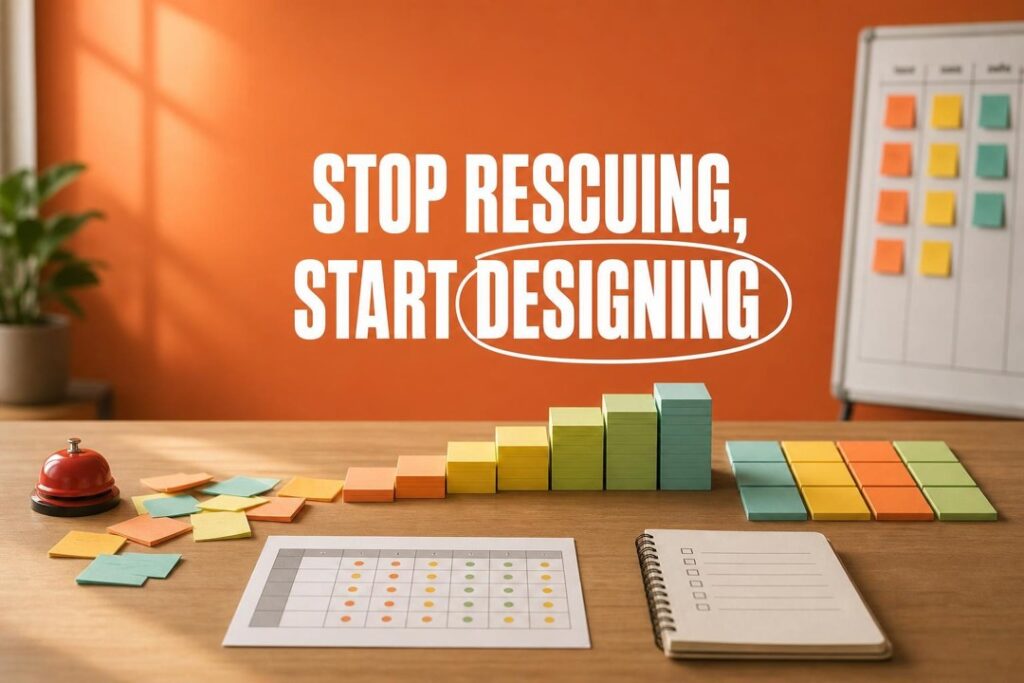
Firefighting Is Not Leadership, It Is a Dependency Engine
Firefighting feels like leadership because it is visible, urgent, and appreciated in the moment. The leader jumps in, removes the obstacle, answers the message, saves the meeting, and everyone exhales. But repeated rescue does not build a stronger team. It builds a dependency engine, where people plan less, escalate faster, and quietly learn that the fastest path through uncertainty is through the leader’s calendar.
This follows a problem-cause-solution arc: repeated rescue creates the problem, a system that rewards escalation feeds the cause, and credibility returns when leaders keep promises while naming constraints early.
That is the credibility trap. Most leaders think credibility comes from being constantly available. In practice, credibility comes from making promises that hold, naming constraints early, and designing a team system that does not require heroic intervention to function.
The uncomfortable truth is simple: every time people on the team need a workaround because the leader is the bottleneck, credibility leaks. Not all at once. More like a slow roof drip over a conference table everyone has politely agreed not to mention.
Firefighting rewards urgency while quietly weakening leadership credibility
Firefighting becomes dangerous when it stops being an exception and starts becoming the operating model. A true emergency requires leadership attention. A recurring emergency usually reveals a broken system wearing a dramatic hat.
The pattern often begins with good intent. Someone brings a problem. The leader says yes. A client needs an answer. The leader steps in. A decision feels unclear. The leader resolves it. Each rescue creates a small hit of relief, and relief is addictive in organizations. It feels like progress because the immediate fire goes out.
But the system is learning while everyone is celebrating the save. The team learns that preparation is optional if escalation works. Stakeholders learn that pressure produces attention. The leader learns that being indispensable is proof of value, even while the calendar becomes a crowded hallway where every decision waits for permission.
Credibility suffers because leadership is not measured only by effort. It is measured by the reliability of the environment a leader creates. If the team cannot move without private approvals, backchannel fixes, and last-minute exceptions, the leader may be respected for stamina while being doubted for effectiveness. That distinction matters.
There is a particular kind of exhaustion that comes from being needed too often for the wrong things. The leader is busy, the team is busy, the tools are busy, and somehow the work still feels stuck. Motion everywhere. Progress limping behind with a clipboard.
The better question is not, “How can a leader respond faster?” It is, “Why does this request need rescue at all?” That question shifts leadership from reaction to design. It turns urgency from a badge of honor into a diagnostic signal.
What most leaders get wrong about saying yes
Most leaders get this wrong: saying yes is not automatically generous, committed, or strategic. Sometimes saying yes is just a beautifully dressed form of avoidance.
A yes can avoid the discomfort of disappointing someone. It can avoid the harder conversation about capacity. It can avoid exposing the fact that priorities are not actually prioritized, just stacked like plates in a cabinet no one should open too quickly. The leader feels helpful, but the organization receives a different message: constraints do not matter if the request is loud enough.
This is where overcommitment becomes cultural training. When leaders keep absorbing requests, teams stop treating capacity as real. Deadlines become wishes with calendar invites. Dependencies become vague. Planning gets thinner because everyone assumes someone will “figure it out” later, which usually means the leader will become the human shock absorber.
Then again, the exact opposite also shows up when leaders swing too far toward refusal and mistake distance for discipline. A leader who names constraints without offering a path can sound distant, defensive, or bureaucratic. The goal is not to become the department of no. The goal is to make yes expensive enough to be meaningful and no clear enough to be useful.
A credible yes has boundaries. It includes timing, trade-offs, ownership, and the condition under which the promise can be kept. A credible no does not abandon the person asking. It clarifies reality so the team can choose the next best move without pretending physics has been temporarily suspended.
This is why commitment discipline matters. Overpromising does not make a leader dependable. It trains the organization to escalate and then calls the resulting chaos “responsiveness.” For a sharper companion lens, the idea is explored well in Commitment Discipline for Credible Promises Without Longer Hours.
The consequence of ignoring this is not just personal burnout. It is organizational learned helplessness. People who are repeatedly rescued become less precise about what they need, less rigorous about what they can solve, and less confident making decisions without cover. The leader becomes central, then saturated, then silently resented for being unavailable inside the very system that made them indispensable.
Not ideal. Also, very common.

Dependency grows when the leader becomes the fastest workaround
A dependency engine forms when the leader is the easiest way around friction. The team may not intend to create it. No one puts “increase executive bottleneck by 17 percent” on the quarterly plan. It just happens through repeated shortcuts.
The first shortcut is decision bypass. Instead of using agreed criteria, people ask the leader to decide. This feels efficient until every ambiguous choice queues behind one person. The second is priority bypass. Instead of negotiating trade-offs openly, teams escalate their work as urgent and hope proximity to leadership gives it oxygen. The third is accountability bypass. Instead of owning the next step, people wait for the leader to bless, edit, or rescue the work.
Each bypass looks small. Together, they create a fragile organization. Work slows down when the leader travels, gets sick, enters back-to-back meetings, or simply needs ninety minutes to think like a human being rather than a notification clearinghouse.
The deeper problem is that workaround cultures hide the truth. People stop saying, “We do not have capacity.” They say, “We are waiting on approval.” They stop saying, “This priority conflicts with that priority.” They say, “Just looping you in.” Four words that often mean, “Please inherit this ambiguity so nobody else has to touch it.”
The credibility cost shows up in small signals. Team members start making side agreements. Stakeholders chase answers through informal channels. People build shadow systems because the official system feels too slow or too dependent on one person’s attention. Every workaround is a vote of no confidence in the operating model.
This does not mean leaders should disappear behind process. A leader still sets direction, resolves high-stakes trade-offs, and steps in when risk exceeds the team’s authority. But if every decision feels high-stakes, the issue is not the team’s judgment. The issue is the absence of decision architecture.
A healthier system makes the default path clear. Who owns the decision? What threshold requires escalation? What information must be included before asking for help? What trade-off is being proposed? Without those rules, the leader becomes the rule. That may feel powerful, but it is structurally weak.
Burnout, quiet cracking, and AI tool-stacking make the pattern harder to see
Modern work has made dependency faster, quieter, and easier to disguise. The requests arrive through chat, email, project tools, shared docs, voice notes, and the mysterious “quick question” that somehow contains a full strategic fork in the road.
AI adds another layer. Teams can draft faster, summarize faster, generate options faster, and produce more artifacts than ever. That sounds like leverage until the constraint is not content creation but decision quality, priority clarity, or limited execution capacity. Tool-stacking can accelerate demand without fixing the underlying bottleneck.
A team can now create ten versions of a plan before lunch and still lack one clear owner, one real trade-off, or one honest capacity conversation. The machine makes motion cheaper. It does not make judgment automatic.
This is where quiet cracking enters the room. People do not always burn out dramatically. Sometimes they keep attending meetings, responding with polite punctuation, and delivering work that looks acceptable from a distance. Inside, they are running on a thinner wire. They stop volunteering judgment. They stop raising risks early. They protect themselves with vagueness because clarity has become expensive.
The honest correction is this: more communication can feel like more leadership right up until everyone realizes they have been confusing signal with smoke. There is the little inner flinch, too: maybe the team is aligned, or maybe everyone has just become very good at sounding busy in public.
Leaders often miss this because firefighting creates the illusion of closeness. Everyone is in constant contact, so the team must be aligned. Everyone is messaging, so the system must be alive. But high communication volume is not the same as health. Sometimes it is just smoke moving through the ventilation.
The consequence of ignoring this modern layer is severe. Faster tools can create faster confusion. More automation can generate more requests for human arbitration. More channels can make constraints less visible, not more. A leader who keeps saying yes inside that environment becomes the final processor for a machine that never stops feeding itself.
The answer is not to reject tools or romanticize slower work. The answer is to pair speed with constraint visibility. Before adding another tool, the team needs to know what decision it improves, what friction it removes, and what new demand it may create. Otherwise, the organization simply installs a larger hose into the same leaking bucket.

Credible leaders name constraints before the system forces a workaround
Credibility improves when leaders stop treating constraints as bad news and start treating them as design inputs. A constraint named early is not a weakness. It is a guardrail that prevents the team from driving confidently into a wall.
The practical shift is to replace rescue reflexes with operating agreements. Instead of answering every escalation with an immediate solution, the leader can ask for the decision owner, the options considered, the trade-off being proposed, and the consequence of waiting. This is not bureaucracy. It is strength training for judgment. Without that agreement, one delayed approval can stall a launch by a week, bury the team in rework, and cost the leader visibility in the room where priorities are being reset.
The same discipline applies to promises. A promise should not be a mood. It should be a contract with reality. What will be delivered? By when? By whom? What must be deprioritized to make room? What risk should be named now rather than apologized for later?
This is where a simple credibility metric helps: credibility = promises kept + constraints named early.
That equation is useful because it removes the performance theater from leadership reliability. It does not reward the leader for being endlessly available. It rewards the leader for making reality visible soon enough for people to act wisely. Keeping promises builds trust. Naming constraints early protects trust before it is damaged.
A leader who practices this begins to sound different. Not colder. Clearer. Instead of “Sure, send it over,” the response becomes, “This can be done by Friday if the reporting review moves to next week.” Instead of “Loop me in,” the response becomes, “Use the decision criteria. Escalate only if the risk crosses the agreed threshold.” Instead of “No problem,” the response becomes, “There is a problem, and naming it now gives us options.”
If this feels uncomfortably direct, that is because many teams have been trained to confuse clarity with harshness. But vague kindness often becomes delayed harm. It preserves comfort in the moment and exports confusion into the future, where it returns with interest. A constraint left unnamed on Monday becomes a missed client commitment on Friday, followed by three apology emails, a scrambled handoff, and one more quiet dent in trust.
For leaders trying to build this muscle, the companion practice is making fewer promises and keeping them visibly. Commitment Discipline for Chaotic Workdays Make Fewer Promises and Keep Them offers a useful extension of that idea.
The better path is not heroic leadership. It is designed leadership. Fewer hidden dependencies. Fewer private rescues. Fewer promises made from adrenaline. More visible constraints, clearer ownership, and a team that can move without needing the leader to become the emergency exit.
The next time a request arrives wrapped in urgency, the real leadership move may not be to answer faster. It may be to ask what the system is about to learn from the answer.
Because if every fire earns a rescue, the team is not building clarity. It is building a sprinkler system that only works when the leader is standing there with a bucket.
So what is being designed today: a calmer operating system, or another dependency with better manners?