
Delegation Agreements: Why an Assigned Owner Is Not Yet a Workable Commitment
Delegated tasks get delayed, restarted, or completed differently than expected when naming an owner is treated as the full agreement. Ownership establishes who is responsible. A workable commitment also makes available capacity, likely task size, and a realistic start time visible before the person accepts the work.
That distinction explains a familiar meeting outcome. A special project receives a name, the group feels reassured, and everyone moves to the next topic. Yet the task may not have entered a feasible plan. Day-to-day obligations continue to claim attention, the assignment proves larger than it sounded, or no one has identified when the first meaningful step can happen.
Why can a task have an owner but still never enter the plan
A task can have an owner and still remain outside the plan because responsibility is not the same as capacity or sequencing.
An owner may care about the outcome, understand its importance, and still lack a realistic opening to begin. The problem is often not effort or intent. It is that the conditions for starting the work remain invisible when the assignment is made.
Ownership answers, "Who is accountable for moving this forward?" Commitment answers additional questions: "What work will compete with it? How large is this likely to be? When can the person actually start?"
Without those answers, a task can exist on a meeting list but not in the assignee’s operating plan. Routine work, customer obligations, approvals, and existing deadlines still consume the same limited attention. A leader may hear "yes" as confirmation that work is underway, while the assignee may mean only, "I will be responsible once I can make room."
This is a planning visibility problem, not a character judgment. A named owner is necessary because it creates accountability and a point of contact. But calling the work fully delegated before its constraints are visible can create false reassurance.
What does a delegation agreement need before work is accepted
A delegation agreement is a brief, visible conversation that turns an assignment into a workable commitment.
It supplements a clear owner rather than replacing one. Its purpose is to surface practical assumptions before they become late surprises, rework, or private tradeoffs made by the assignee.
Before accepting a special project or task assignment, make these three conditions explicit:
-
Available capacity: What current commitments will this work affect, and what attention is genuinely available? This does not require a perfect workload calculation. It identifies work that must be protected, work that can move, and conflicts that require a leadership decision.
-
Likely task size: What does a first-pass estimate include? Size is more than elapsed time. It can include discovery, coordination, review cycles, quality expectations, decisions, dependencies, and rework caused by uncertain assumptions.
-
Realistic start timing: When can the first meaningful step begin? A due date may establish urgency, but it does not establish a start window. Work may need to wait for a current commitment to finish, an input to arrive, a decision to be made, or capacity to be freed.
Estimates can be provisional. The assignee does not need complete certainty before accepting responsibility. The important distinction is that a provisional estimate is named as provisional, while an unstated assumption is not mistaken for a commitment.
A useful next step is to pause after naming an owner and ask: What will this affect, what does the work appear to include, and when can the first real step start? That short check makes the invisible parts of delegation discussable.
How do capacity, task size, and start timing reveal different risks
Capacity, task size, and start timing expose different execution risks, so they should not be compressed into one deadline or status update.
| Condition | The question it answers | Risk when it stays invisible |
|—|—|—|
| Capacity | What existing work competes for this person’s attention? | The new task becomes a hidden addition to day-to-day responsibilities |
| Task size | What effort, uncertainty, coordination, and quality work does this involve? | The work is underestimated, restarted, or delivered at the wrong level of completeness |
| Start timing | When can focused work actually enter the plan? | The task appears covered even though no meaningful first step has been scheduled |
Capacity concerns competing obligations. Someone may have room next week but not this week. They may be able to take on a small task only if another item is deferred. Making work visible helps leaders and teams see that a new request is not free simply because it has an owner.
Task size concerns the work itself. A request such as "prepare a recommendation" may require gathering facts, speaking with affected people, comparing options, seeking approval, and agreeing on what a usable recommendation looks like. The assignee may understand the purpose while still needing help estimating the path. That is a coaching opportunity, not evidence of resistance.
Start timing concerns sequence. A person can accept a project and its deadline while having no feasible start window. If work cannot begin until a release, customer commitment, or review cycle is complete, that condition should be visible when the commitment is made.
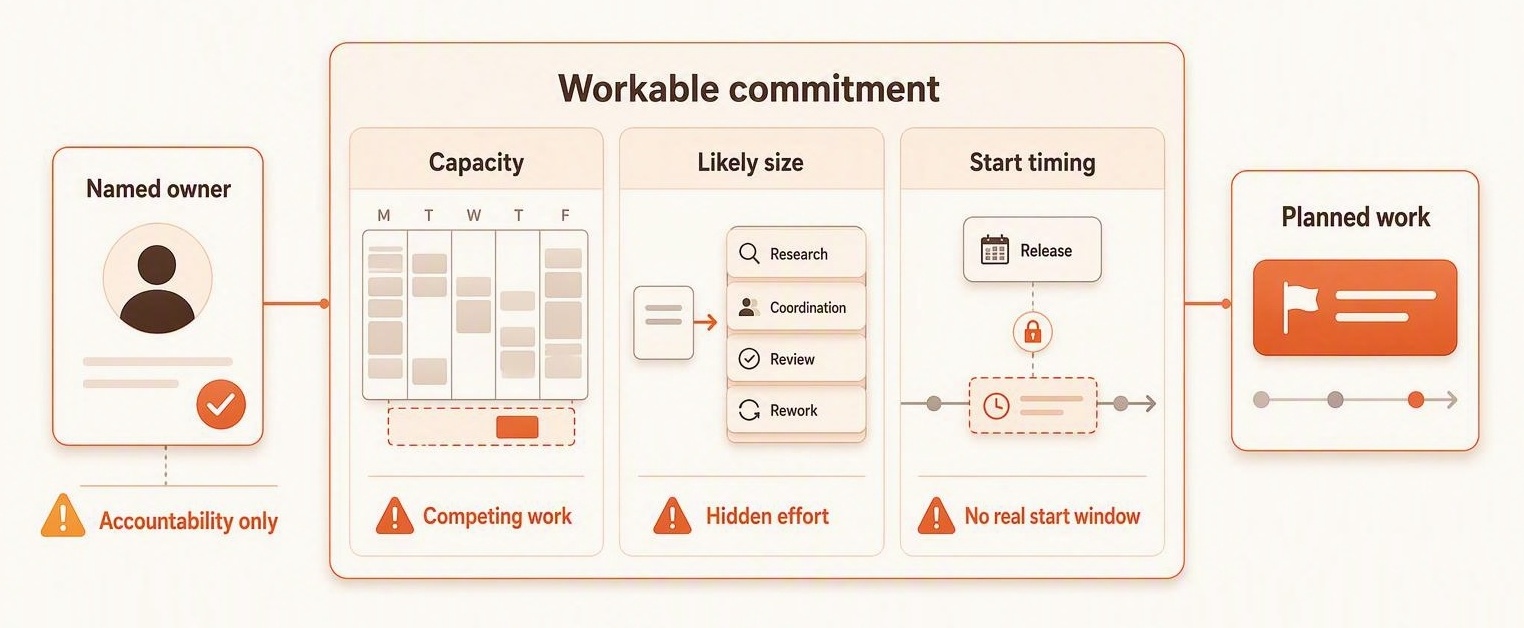
The revealing insight is that ownership can exist while start timing and capacity do not. A task may be assigned without having become planned work. The leadership question is therefore not only, "Can you own this?" It is, "What would make this a real commitment?"
What should leaders ask before calling a task delegated
Leaders should ask a small set of questions that makes tradeoffs visible before the assignment is accepted.
The tone matters. These questions are not a test of loyalty or a search for reasons to say no. They are prompts for joint problem-solving and clearer decisions.
-
What current commitment will this affect? This reveals whether the assignment is genuinely additive or whether another priority must move. If work needs to be deferred, that should be a visible leadership choice rather than a private burden for the assignee.
-
What does a first-pass estimate include? Ask the person to name visible work such as research, stakeholder input, drafting, review, and implementation. This creates a shared picture of what done may require without demanding false precision.
-
What is unknown or dependent on others? This surfaces missing information, handoffs, approvals, and decisions. Early visibility gives the leader an opportunity to remove barriers, connect the right people, or adjust expectations.
-
When can the first meaningful step start? The answer should identify a real point of entry, such as reviewing current information, scheduling discovery, or meeting a stakeholder. "Soon" is not a start condition.
-
What is the next visible milestone? A milestone is evidence that the task has entered the plan, not merely that it remains on a list. For uncertain work, the first milestone may be a discovery summary or a scoped recommendation rather than a final deliverable.
-
What decision or tradeoff is needed if the work cannot fit? This creates a direct choice: defer, rescope, reassign, share, or stop another item. It prevents vague pressure from being mistaken for a plan.
Record the answers in a shared task board, meeting note, or simple project list. The record does not need to become a lengthy project charter. It only needs to make the agreement easy to revisit when priorities shift or an assumption changes.
When should the assignee negotiate instead of simply accepting
An assignee should negotiate when accepting responsibility would also mean accepting a hidden constraint.
Constructive negotiation is not avoiding accountability. It is helping create an agreement that can be executed and signaling early when coaching, rescoping, support, or a priority decision is needed.
Use factual language that keeps the conversation focused on the work:
-
For unclear scope: "I can take ownership. Before I commit to a delivery date, can we clarify what a useful first version needs to include?"
-
For a priority conflict: "I can begin this after the current customer commitment, or we can move that commitment. Which priority should change?"
-
For a later start: "I can start the first step on [date]. If an earlier start is needed, I will need help deciding what to defer."
-
For substantial uncertainty: "The size is still unclear. I suggest a short discovery step first, then I can return with a more reliable estimate and milestone plan."
-
For missing support: "This depends on input from two other teams. Can we identify who will help secure those inputs and by when?"
These statements communicate ownership because they name both the constraint and a path forward. They also give the leader information that may not be visible from a distance. A respectful environment makes it safer to surface those facts before they become rework or a late scramble.
A simple delegation agreement for special projects
A simple delegation agreement makes an assignment visible enough to review without creating unnecessary bureaucracy.
Here is a system to try in the next weekly review:
| Field | What to capture |
|—|—|
| Intended outcome | What should be true, available, decided, or improved when the work is complete? |
| Named owner | Who is accountable for moving the work forward? |
| Likely size or first estimate | Expected effort, what the estimate includes, and what remains uncertain |
| Current commitments affected | Work that will be protected, deferred, shared, or reconsidered |
| Earliest realistic start date | When the first meaningful step can begin and what makes that start possible |
| First milestone | The next visible evidence of progress and its review point |
| Dependencies or unknowns | Inputs, decisions, stakeholders, approvals, or facts still needed |
| Leader decision needed | The tradeoff, support, or scope decision required to make the plan feasible |
For a small assignment, this may be a brief verbal check followed by a visible note. Higher-impact, cross-functional, or uncertain work may deserve a more deliberate review. The appropriate level of detail depends on the consequences of getting the commitment wrong.
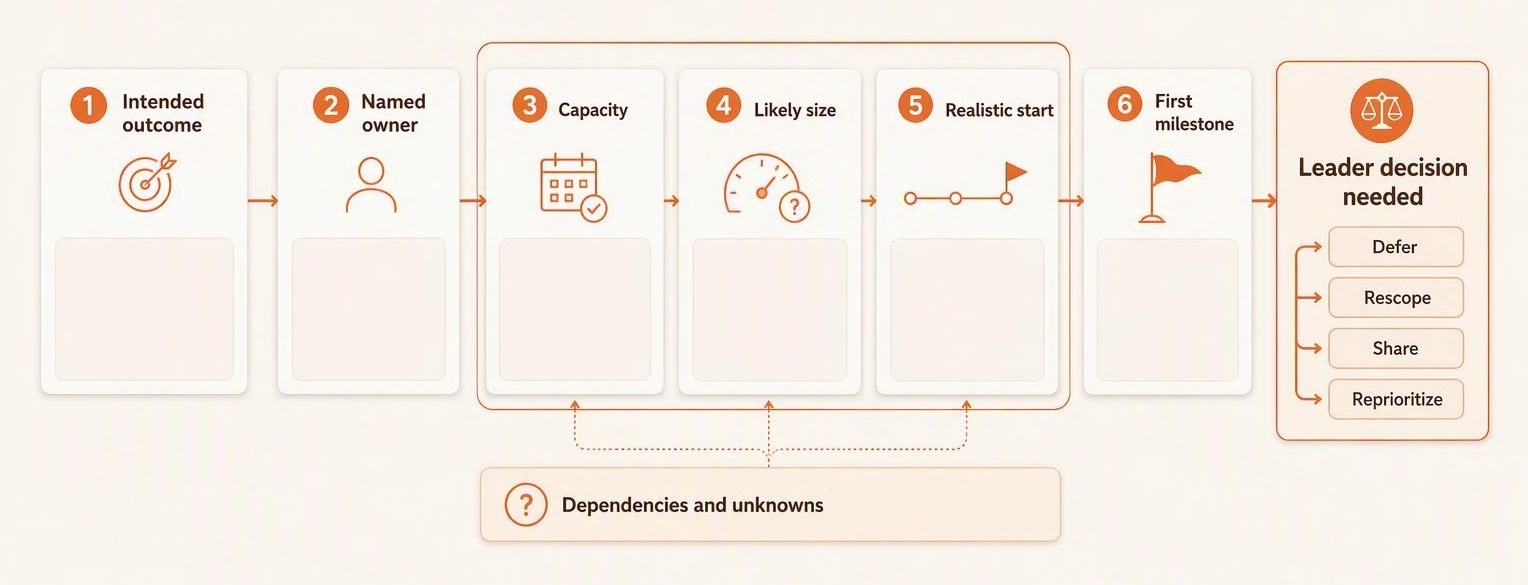
Treat the template as an experiment rather than a compliance exercise. Test it during the next weekly review. Notice which fields produce useful decisions, which assumptions keep recurring, and which details create unnecessary effort. Adapt the template to the context at hand.
How does a visible agreement turn delegation into realistic action
A named owner is necessary, but it is incomplete.
Ownership answers who is responsible. A visible delegation agreement answers whether the work has available capacity, a credible first estimate, and a place to begin. That distinction changes delegation from reassurance in a meeting to a plan the team can review and support.
When those conditions are visible, leaders can make priority choices earlier and team members can commit with greater precision. Special projects are less likely to become hidden additions to everyday work because the tradeoff is made discussable before the assignment is closed.
The practice is small: do not end the delegation conversation when someone says yes. End it when the team can see what the work involves, when it can start, and what must change if it does not fit. Results vary by workload, team context, and consistency of review, but this rule creates a more honest starting point for execution.