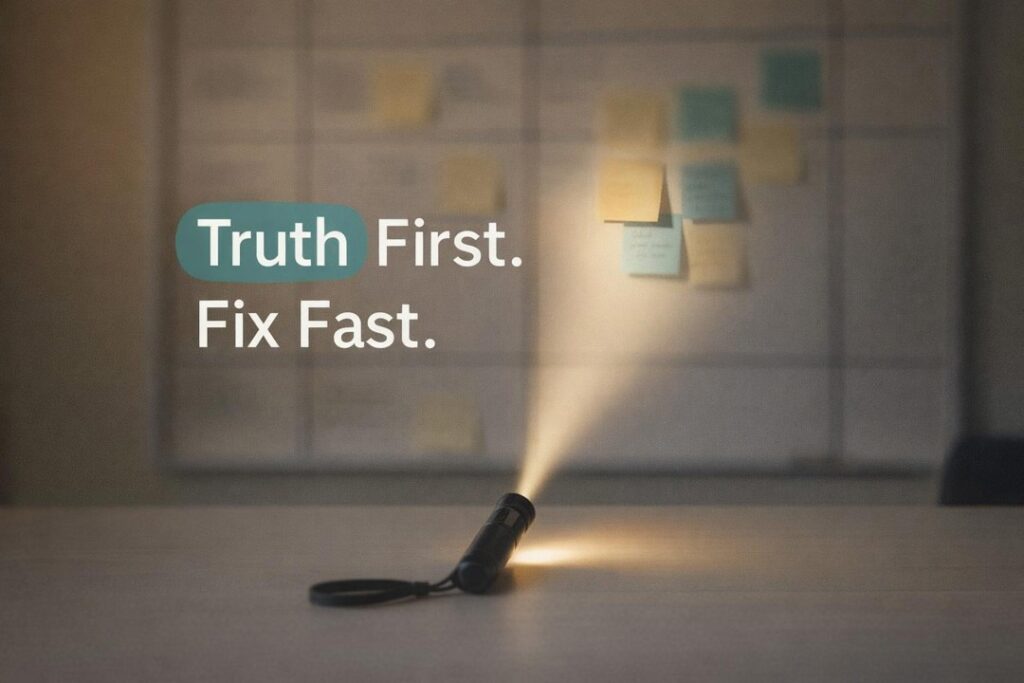
Accountability That Actually Works Stop Performing Progress and Start Solving Problems
Accountability Isn’t a Spotlight. It’s a Flashlight.
Most accountability fails because it’s built like a stage. People stand in the light, deliver updates, and try to look like progress is happening. Real accountability is built like a flashlight, it points at reality so a team can see what to do next.
“Performing progress” is the quiet habit of giving updates without making adjustments. It’s commitments without evidence, meetings that create motion but not learning. Everyone leaves with the soothing feeling of having “checked in,” and nothing in the system changes.
You’ve seen the classic scene: the weekly status call where every project is “on track” until the moment it isn’t. Then, right before the deadline, the truth arrives like a weather system. Suddenly there are blockers, dependencies, missing decisions, and a scramble that burns more energy than the work itself. The tragedy is not the delay. It’s that the delay was knowable, but the room wasn’t designed to hear it.
Accountability isn’t pressure plus punishment. Accountability is truth plus troubleshooting. The point is not to prove you’re doing well, it’s to learn fast enough to do better. In the rest of this post, you’ll build a simple learning loop that replaces performance with problem-solving: small commitments, evidence of practice, and one obstacle worth solving each week.

The Better Mental Model: Truth Plus Troubleshooting (Share Bad News First)
Accountability works when it’s reduced to two linked behaviors: tell the truth about what’s happening, then troubleshoot what to do about it. Miss either half and you get a familiar dysfunction. Truth without troubleshooting becomes confession. Troubleshooting without truth becomes fantasy planning.
The cleanest psychological-safety standard I’ve ever seen is also the simplest: share bad news first, no problem is a problem. Not because pessimism is fashionable, but because early signal is cheaper than late surprise. Bad news is information about the system. When a team treats it like a moral failure, people hide it. When a team treats it like a cue for problem-solving, people surface it.
There’s an important distinction here, especially for high performers who were raised on “no excuses.” Sharing bad news is not the same as making excuses. An excuse is a story designed to protect identity. Bad news is a fact designed to protect outcomes. “This slipped because I’m overwhelmed” is a mood. “This slipped because the handoff process is ambiguous and the spec isn’t final” is a diagnosis.
Most “accountability issues” are process issues wearing a person costume. Blame makes the room smaller, truth-telling makes it usable. You don’t need more intensity. You need a better feedback environment.
What Real Accountability Looks Like A Weekly Learning Loop (Not a Weekly Report)
Real accountability is a cadence that converts reality into action. It’s not a weekly report, it’s a weekly learning loop, a small, repeatable mechanism that keeps the work honest and the next step clear.
Here’s a simple version that runs in 20 to 30 minutes and gets more done than a beautifully formatted deck:
- Make one specific commitment with a clear finish, not “make progress,” but “ship the first draft to the client by Thursday at 2.”
- Define evidence of practice, what would you be able to show if the commitment is real. A doc, a pull request, a calendar block completed, a customer call logged.
- Surface reality fast, starting with bad news. If something is late, unclear, blocked, or quietly avoided, it goes first.
- Pick one obstacle to solve this week, not five, not “everything,” one meaningful constraint.
- Choose the next experiment or action with an owner and a date, then get out of the meeting.
The loop holds when the room stays curious instead of performative. A few questions keep it grounded: “What problem are you trying to solve?”, “What made this harder than expected?”, “Can you show me an example of what you mean?”, “What have you learned from what you tried?”, “What’s the next action, and why that one?”
The meeting itself has two guardrails. It focuses on exceptions (what’s blocked or off-track), not a full report-out of everything that’s working. It also avoids solving the whole problem in the room, the output is a next action with an owner, not a satisfying debate.
One team replaced weekly “updates” with a weekly “one obstacle round.” Within a few weeks, cycle time improved for an unromantic reason: people named the obstacle on Tuesday instead of dressing it up on Friday. Evidence of practice did the quiet heavy lifting, because it made progress visible before results arrived. Lead measures beat lag trophies, not because goals don’t matter, but because they stop the room from confusing hope with traction.

Design Rules for High-Integrity Groups (So Accountability Doesn’t Rot)
Even a good loop will rot in the wrong environment. Accountability deteriorates when the group is too big, the commitments are fuzzy, the signals are hidden, and trust is treated like a personality trait instead of an engineered condition.
Start with size. Smaller groups create enough intimacy for truth and enough attention for follow-through. When a circle gets too large, people protect status because they’re being watched by too many nervous systems at once. A 3 to 5 person pod is often the sweet spot for real work, especially for overloaded adults trying to make progress without burning their evenings.
Next, make agreements specific. High-integrity groups don’t deal in fog. “I’ll get to it soon” is not an agreement, it’s a hope wearing a deadline costume. Specific agreements are clear, realistic, and renegotiated early when reality changes. Dependability isn’t perfection, it’s the habit of updating commitments before they break.
Then, keep signals visible and lightweight. A simple scoreboard beats a complex dashboard, because it gets used. If your accountability system requires a slide deck, it’s already lying to you. The best visuals are readable in seconds and updateable in minutes. A simple green, yellow, red marker next to top commitments is enough to tell the truth without drama.
Finally, treat trust as mechanics: making and keeping agreements, openness, and credibility. Openness is the willingness to say “I don’t know” without theatrics. Credibility is alignment between what you say and what you do. When those are present, accountability stops feeling like pressure and starts feeling like support.
The Hidden Cost of Fake Accountability Shame Plus Stagnation (And How to Start This Week)
Performative accountability has two hidden costs. It generates shame because people learn that telling the truth makes them look unreliable. It generates stagnation because the same obstacles repeat, week after week, dressed up in new vocabulary.
This is why “more accountability” often backfires. When metrics become weapons, people game the system. When meetings become performances, people manage impressions. The work turns into a public relations campaign for your own to-do list.
Start small for the next seven days. Form a 3 to 5 person loop with people who actually share dependencies. Each person sets one commitment and names evidence of practice. Open the meeting with bad news first, then choose one obstacle per person that is worth solving this week. End with a single next action, an owner, and a date.
The quiet promise of this approach is simple: trade intensity for design. Make progress inevitable by making learning unavoidable. The question isn’t “Did you work hard?” The question is “Did you see reality clearly enough to adjust?”