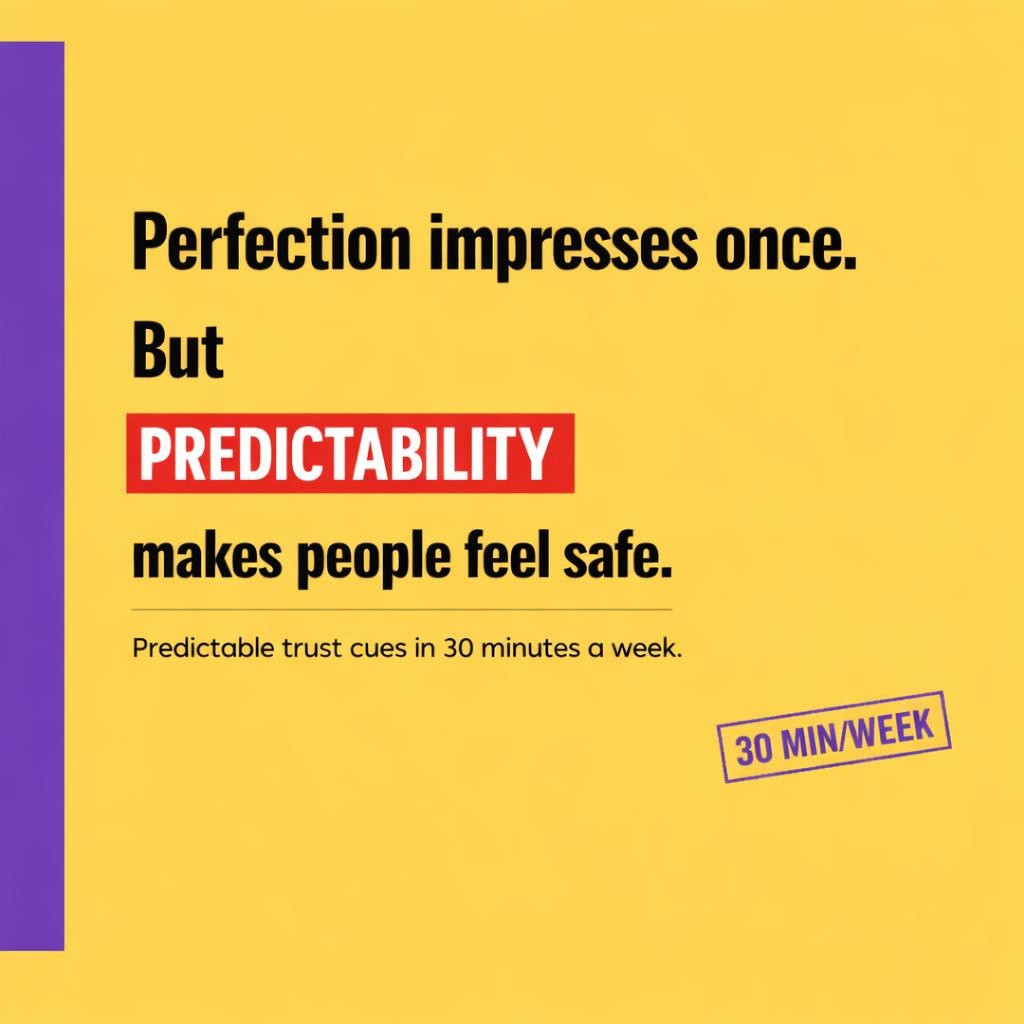
The Predictability Ladder: A 30-Minute/Week System to Build a “Familiarity Field”
You can build trust without posting more. You do it by installing predictable trust cues people can recognize on sight, week after week, even when they’re not ready to buy yet.
Here’s the whole system in one breath: pick one core belief to repeat, write three proof stories, list five recurring customer questions, define a signature vocabulary, and commit to one weekly ritual you can keep forever.
That’s the Predictability Ladder. It turns you into a “familiar stranger”, someone your market feels like they already know. And it works for one simple reason: “Perfection impresses once, but predictability makes an audience feel safe.”
What a “familiarity field” is (and why it beats posting more)
A “familiarity field” is the invisible sense of recognition people get when they keep seeing the same signals from you:
- The same point of view
- The same types of proof
- The same questions answered
- The same language patterns
- The same cadence
Most marketing doesn’t fail because it’s bad. It fails because it’s inconsistent.
When people can’t predict you, they can’t relax. And when they can’t relax, they don’t buy.
Here’s the subtle part most people miss: predictability is not sameness. It’s predictable variation. The core stays stable (belief, vocabulary, ritual), while the surface changes (stories, examples, answers). That’s how you create momentum without burning out.
Why predictability builds trust (the questions people never say out loud)
Trust is often treated like a reward for quality. Quality matters, but it’s not the first gate people walk through.
Most prospects are quietly asking:
- “Are you stable?”
- “Will you disappear?”
- “Will this get messy?”
- “If I work with you, will I regret it?”
Predictability lowers uncertainty. When people see the same signals repeatedly, your brand becomes cognitively “cheap” to understand. That’s not an insult. It’s relief.
Lower cognitive load means:
- Faster comprehension
- Less skepticism
- More remembered impressions
- More willingness to take the next step
This is how “familiar strangers” are made: repeated exposure to consistent cues until the brain flags you as known and safe.
Or said another way: your audience isn’t only judging your skill. They’re judging whether you’re a safe decision.
The Predictability Ladder: 5 rungs that make you recognizable fast
This is a step-by-step install. Do it once, then maintain it in 30 minutes a week.
Rung 1: Pick one core belief to repeat (your anchor sentence)
Your core belief is the sentence your audience should be able to repeat after bumping into you a few times.
Rule: one belief, one sentence, one spine.
Use one of these templates:
- “We help [who] get [outcome] without [pain].”
- “The best way to get [result] is not [common approach], it’s [your approach].”
Examples:
- “You don’t need more leads, you need a clearer offer people can trust fast.”
- “Consistency beats intensity because buyers reward reliability, not bursts.”
- “Simple systems beat heroic effort, especially for small teams.”
Then repeat it where it actually counts (pick 3):
- Your bio (everywhere)
- Your website hero section
- A pinned post or pinned video
- Your email footer line
- Your first slide or first sentence in presentations
“Your goal is not creativity. Your goal is recognition.”
Rung 2: Draft 3 proof stories (so your belief doesn’t sound like a slogan)
Beliefs create gravity. Proof creates permission.
Write three stories you can reuse forever. Not fancy case studies, but proof packets you can deploy in posts, sales calls, landing pages, podcasts, and DMs.
Use this 6-line format:
- Before: what was broken
- Cost: what it was costing (time, money, stress, confidence)
- Turn: the moment the approach changed
- After: what improved (specific and measurable if possible)
- Mechanism: what actually caused the improvement
- Lesson: the principle that reinforces your core belief
Draft these three types:
- The client win (external proof)
- The founder shift (internal proof, your own evolution)
- The “near miss” (a mistake you caught, what it taught you)
One line to keep you honest: your stories should prove the mechanism, not just the outcome. Outcomes can feel lucky. Mechanisms feel repeatable.
Rung 3: List 5 recurring customer questions (your evergreen content map)
If you’re stuck on what to say, you’re probably overthinking. Your market is already telling you what they want clarified.
Write down the five questions you hear repeatedly, like:
- “How long does this take?”
- “What’s the risk if I do it wrong?”
- “How is this different from what I’m doing now?”
- “What should I do first?”
- “Do I need a big audience/budget/team for this?”
Now turn each question into a reusable asset:
- A 60-second answer (spoken)
- A 150–250 word answer (written)
- One concrete example
- One “avoid this” warning
This creates a pattern your audience can feel: “Oh, they’re the person who answers the real questions clearly.”
And the stakes are real: if you don’t answer the recurring questions, the prospect answers them for you, usually in the least flattering way.
Rung 4: Define a signature vocabulary set (so you sound like you)
Most people think “brand voice” is vibes. It’s not. It’s repeatable language choices.
Create a list of 7–12 signature terms you will use consistently for 6–12 months.
Include:
- 2–3 phrases for the enemy (what you’re against)
- 2–3 phrases for the method (how you do it)
- 2–3 phrases for the outcome (what changes)
- 1–2 phrases that are uniquely you (your “stickiness”)
Example structure:
- Enemy: “random posting,” “marketing guilt,” “content treadmill”
- Method: “predictable trust cues,” “proof packets,” “weekly ritual”
- Outcome: “calm momentum,” “earned demand,” “compounding visibility”
- You-isms: a phrase you’d actually say out loud
Rule: don’t force clever. Force consistent.
When your vocabulary repeats, your audience doesn’t just recognize your ideas. They recognize you.
Rung 5: Choose one weekly ritual (the 30-minute trust deposit)
This is where the system becomes real.
Pick one ritual you can do every week, even when you’re tired, busy, or traveling. It must be:
- Small enough to keep
- Specific enough to repeat
- Valuable enough to matter
Choose one:
Option A: The Weekly Answer
- Choose 1 of your 5 recurring questions
- Publish a clear answer
- Add one example or one warning
Option B: The Proof Drop
- Publish one of your 3 proof stories (or a slice of it)
- Tie it back to your core belief in one line
Option C: The Belief + Build
- Restate your core belief
- Share what you’re building or learning that supports it
Your 30-minute weekly workflow:
- (5 min) Pick the ritual type for the week
- (10 min) Draft or outline (ugly is fine)
- (10 min) Add one proof detail (number, moment, mistake, constraint)
- (5 min) Publish and save it in a “Proof + Answers” folder
You’re not chasing virality. You’re making weekly trust deposits.
The ethics of familiarity: clarity and care, not manipulation
Yes, familiarity can influence decisions. That’s exactly why you should treat this like a responsibility, not a hack.
Use predictability to reduce confusion, not to manufacture consent.
Ethical guidelines:
- Be consistent about what you do and don’t do. Predictability should include boundaries.
- Don’t hide trade-offs. If your method has constraints, say so early.
- Don’t overclaim. Proof stories must be real and representative, not highlight-reel fiction.
- Speak to autonomy. The goal is informed confidence, not pressure.
A healthy familiarity field makes people feel safe because you’re clear and steady, not because you’re loud.
One of the most trustworthy things you can communicate is this: “You don’t have to decode me. I won’t make you work for clarity.”
Pick your weekly ritual and do the first one today. Then do it again next week. Trust stops being a hope when you make it predictable.