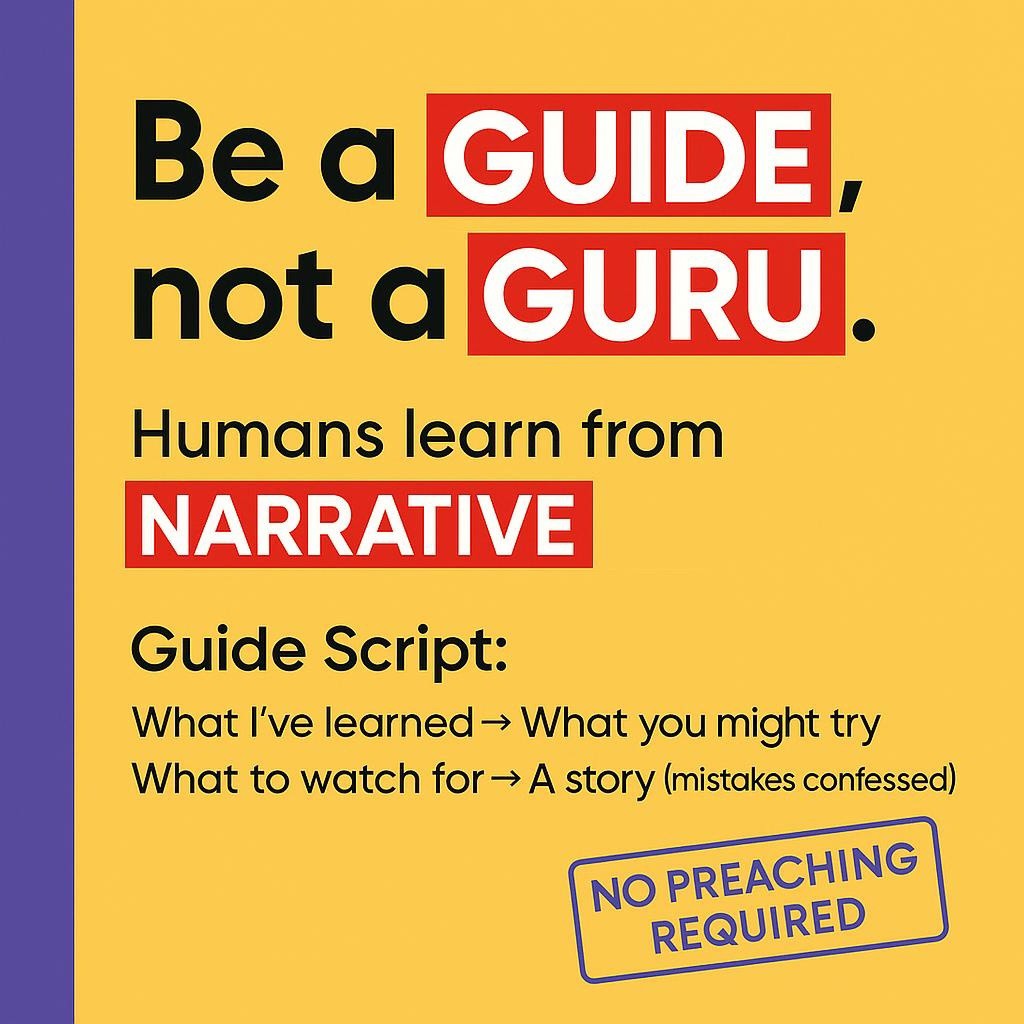
Guide, Not Guru: The Trust-Building Communication Style That Turns Followers Into a Mission-Centered Community
You can feel it when a brand is talking at you. It’s polished. Certain. Slightly above you. And somehow… less believable.
That’s the pedestal problem. The higher you climb, the harder it is for people to trust you when you speak.
So we’ll say it clean, because it matters: “You become a guide, not a guru.”
Not because you lack expertise. Because you want the kind of trust that lasts, the kind that turns followers into a real community.
How to lead without preaching (and still sound like a confident founder)
Here are three questions we see mission-driven founders wrestle with, even when they have something powerful to teach:
- How do you lead without preaching?
- How do you show knowledge without ego?
- How do you build trust without building a pedestal?
The answer is not “be louder.” The answer is posture.
A guru posture says: “I’m above you.”
A guide posture says: “I’m with you.”
And people can feel the difference in one paragraph.
Guide vs. guru: the exact language that changes how people experience you
Gurus position themselves above their audience. They say things like:
- “Follow me.”
- “I have the answer.”
- “If you disagree, you’re wrong.”
- “My method is the only method.”
That style can get attention. But it’s brittle. One mistake and the whole image cracks.
Guides do something quieter, and way more powerful. They say:
- “Here’s what I’ve learned.”
- “Here’s what might help.”
- “Here’s what I’ve seen in the field.”
- “Here’s what you may not have considered.”
- “Here’s a perspective, use what resonates.”
That last line is the heart of it.
Guides create space for the audience to think. Gurus want followers. Guides create leaders.
Why “guru energy” breaks trust with modern audiences
People today are more skeptical, more aware, more informed. They reject:
- condescension
- inflated claims
- superiority
- unearned confidence
And they lean toward:
- transparency
- sincerity
- expertise grounded in experience
- vulnerability mixed with clarity
That phrase matters, so we’ll put it in your hands as a standard:
“Vulnerability mixed with clarity.”
Not “look how messy I am.”
Not fake humility.
Real humanity, paired with real competence.
Because, as we say at Inkflare, “humility is not weakness. It’s relatability. And relatability is a superpower.”
The most durable trust is built through story, not commands
Here’s one line worth building your whole content style around:
“Humans don’t learn best from instruction. They learn from narrative.”
And the kind of narrative that teaches best has a few traits:
- the story is personal
- the lesson is relatable
- the vulnerability is real
- the outcome is earned
- the mistake is confessed
- the journey is unclear until it resolves
That’s why guides win long-term. They don’t teach by ordering people around.
They teach by showing the real road.
“Stories build connection. Connection builds trust. Trust drives action.”
The Guide Script: teach without preaching (use this every time you post)
If you’re a founder who hates “marketing voice,” this is your way out. It’s simple. It’s human. It keeps you out of guru territory.
1) What I’ve learned
Start with the guide posture, not the pedestal.
Use the exact kind of language that signals humility with authority:
“Here’s what I’ve learned.”
This works because you’re not forcing belief. You’re offering earned experience.
2) What you might try
Guides don’t trap people in one “right way.” They offer options without control.
Try:
“Here’s what might help.”
That line gives people room to choose. And when people feel ownership, they trust faster.
3) What to watch for
This is where you protect your relationship with your audience.
Watch for anything that starts to smell like forced authority:
- condescension
- inflated claims
- superiority
- unearned confidence
If you feel yourself slipping into “I’m right and you’re wrong,” pause.
A guide doesn’t need to win. A guide needs to help.
4) A story (with a confessed mistake)
This is where trust becomes strong, not just pleasant.
A guru must always know. “A guide is allowed to explore.”
A guru is fragile. “A guide is robust, mistakes become lessons.”
So tell the story in a way that includes the real learning moment, especially the part you used to hide.
Not to look good.
To be useful.
If you want a mission-centered community, stop trying to collect fans
This is a line we want every founder to internalize:
Gurus create fans. Guides create communities.
And real communities form around:
- shared beliefs
- shared aspirations
- shared identity
- shared mission
- shared values
If your company exists to make something better, your brand deserves depth.
Because, at the end of the day: “People don’t follow content. People follow conviction.”
Founders don’t need to become celebrities, they need to become steady
A lot of founders think the job is to become louder, more charismatic, more camera-ready.
But what people actually want is simpler, and honestly more refreshing:
They’re looking for someone who can articulate truth, teach with clarity, provide emotional grounding, and express mission with sincerity.
In plain words: they want a guide.
And there’s a hidden trust rule here that most brands miss:
Your voice can’t build trust if it only appears once in a while.
“Voice becomes valuable when it becomes predictable.”
That’s why the image we love most is this:
“Your brand becomes a lighthouse, steady, warm, directional, human.”
“Not a megaphone. A beacon.”
The fastest way to sound trustworthy: stop performing
Here’s the gut-check many founders need:
Founders often think, “I need to sound bigger.”
But audiences think, “I need someone real.”
So we’ll say it exactly:
“Performance says: ‘Look at me.’ Transparency says: ‘I see you.’”
If your content makes people feel seen, their defenses dissolve.
That’s not manipulation. That’s connection.
How Inkflare helps you show up as the guide (without turning content into your second job)
Inkflare exists for knowledge creators and mission-led builders who want to teach powerfully without becoming preachy.
We’re not here to turn you into a guru. We’re here to help you do the guide work at scale:
- articulate your philosophy
- teach with clarity
- share your mission
- connect emotionally
- express your truth
- guide your audience forward
And we do it without sanding off your humanity.
Because the goal is not “perfect content.” The goal is a system that:
- captures your truth
- expresses it consistently
- protects your authenticity
- reinforces your mission
- strengthens your emotional presence
So your real voice becomes the voice people keep coming back to.
Sit with this before your next post:
Are you trying to sound impressive, or are you trying to be a lighthouse?