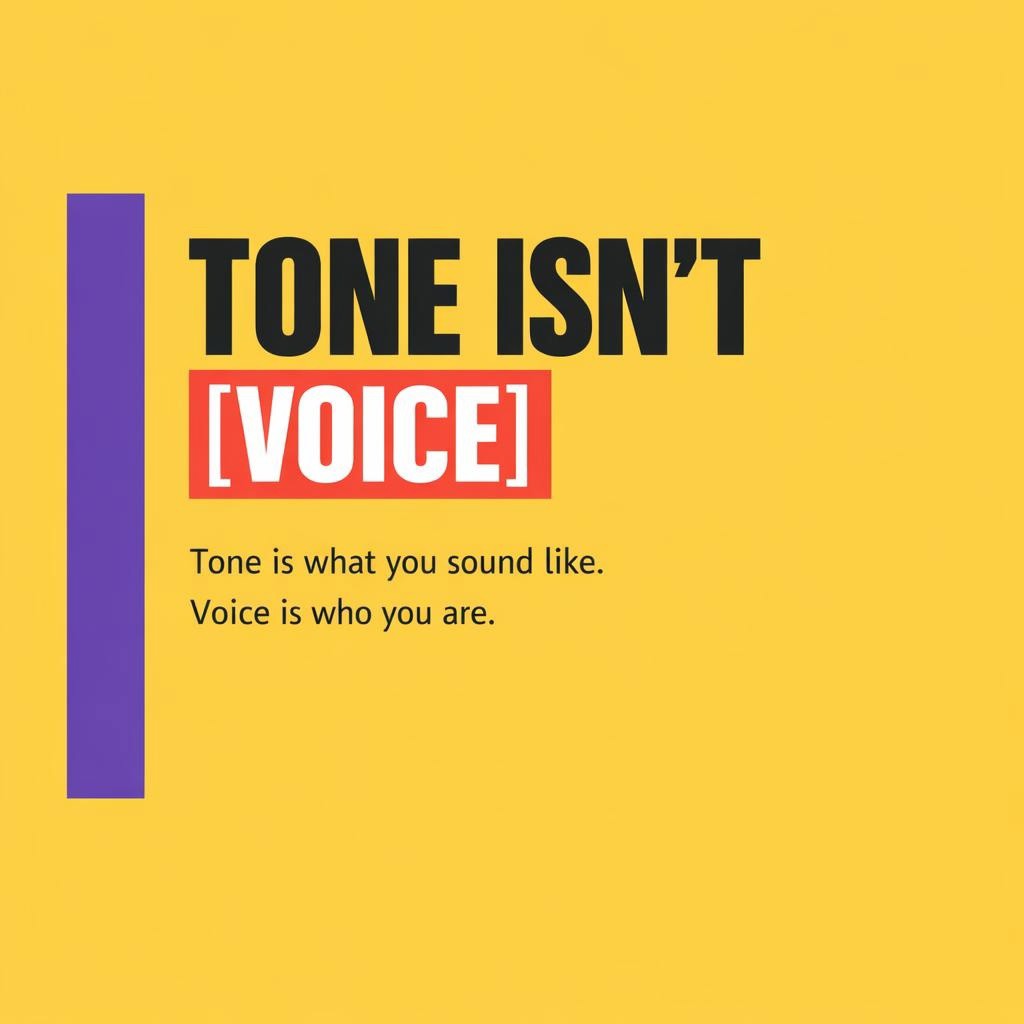
Tone Is Not Voice: Why “Professional + Confident” Brands All Sound the Same
Most brands try to “pick a brand voice” by picking tone words, then they wonder why their content still sounds like everyone else. Here’s the cleaner truth, "Tone is what you sound like. Voice is who you are." Tone is a mood. Voice is a personality, consistent, layered, and recognizable across time. When you confuse the two, you don’t get credibility. You get sameness. And in a world where AI can produce endless polished posts, “polished” is not a moat.
The common belief: “Choose the right tone words, and you’ll have a brand voice”
This is the most common shortcut:
- “Friendly.”
- “Professional.”
- “Confident.”
- “Playful.”
Those words can describe a mood you want to hit in a moment. But they can’t carry an identity.
Because a tone doesn’t tell your team:
- what you believe
- what you value
- what you stand for
- what you don’t do
- what you reject
- what nuance you’re willing to name out loud
So your content becomes clean, safe, and forgettable. It doesn’t feel wrong. It just doesn’t feel like you.
This is why so many brands blur together into what one line nails perfectly: "the same beige noise."
If you’ve ever looked at a competitor’s post and thought, “This could be ours,” you’re not dealing with a writing problem. You’re dealing with an identity problem.
The cost of “safe professionalism”: invisible, replaceable, forgettable
Safe content feels like protection. But it comes with a hidden price.
When brands default to “safe professionalism,” they flatten their personality. They try to please everybody. They start to "speak like committees instead of humans."
And the result is brutal (and common):
- Invisible
- Replaceable
- Forgettable
That’s not because your product is weak. It’s because your voice is missing.
There’s also a deeper trap founders fall into: performance.
Many founders feel pressure to look polished, act confident, and write perfectly. But "your audience isn’t waiting for your performance. They’re waiting for you." Your real voice. Your real mind. Your real mission.
Here’s the paradox: the more perfect you sound, the more distance people feel. Polished personas create skepticism and emotional distance. Human voices create rapport, familiarity, connection, and resonance.
So if your content feels “professional” but not personal, it might be doing the exact opposite of what you want.
The better model: voice is identity, expressed through language
A tone is a mood. A voice is a personality.
A real voice has “tone, texture, rhythm, worldview, emotional nuance, and psychological depth.” It’s the kind of voice people recognize even when your logo is nowhere in sight.
The simplest definition to hold onto is this: "Voice is identity expressed through language."
And identity comes from depth, not adjectives.
Why most brands can’t find their voice (they don’t know what they believe yet)
Here’s the uncomfortable truth: "Most companies don’t know what they believe deeply enough to sound unique."
So their content stays:
- safe
- surface-level
- predictable
- algorithm-chasing
- buzzword-heavy
Brands without depth cannot develop voice.
And if you’re building something mission-driven, this matters even more. A mission-driven company’s biggest advantage is sincerity, real conviction, real purpose, real service. But sincerity that isn’t expressed becomes invisible.
A strong voice is “contrarian in subtle ways”
Standing out doesn’t require being loud. "You don’t need to be loud to stand out. You need to be clear."
A strong voice doesn’t shout. It speaks with conviction. It sounds like:
- “Here’s the truth as we see it.”
- “Here’s what actually matters.”
- “Here’s what people get wrong.”
- “Here’s what we stand for.”
- “Here’s what we don’t do.”
- “Here’s the nuance no one talks about.”
That’s what a real brand voice does. It makes choices. It draws lines. It tells the truth the way you would tell it.
Why voice matters more in the AI era (and why “polished” is a trap)
AI didn’t just make content faster. It made “good enough” content cheap.
That’s why voice is the differentiator. Because most AI content feels:
- generic
- soulless
- overly polished
- emotionless
- predictable
But content with a real brand voice feels:
- alive
- grounded
- human
- honest
- textured
- rhythmic
- wise
- relatable
- emotionally resonant
This isn’t about being anti-AI. It’s about not losing the one thing that makes people trust you.
And trust doesn’t form from one perfect post. It forms from a pattern.
You aren’t judged by a single page. "You’re judged by a pattern." Your feed becomes proof, not marketing, evidence.
People don’t trust what a brand claims to care about. They trust what the brand consistently talks about.
That’s also why a voice becomes valuable when it becomes predictable. "Voice becomes valuable when it becomes predictable." When you show up steadily, your voice becomes a stable presence in people’s lives, like a lighthouse, not a megaphone.
How to uncover a real voice (and keep it consistent without performing)
The biggest shift is this: "Voice isn’t created, it’s uncovered." Brands don’t invent their voice. "They discover it."
It’s already inside the founder, in how they think, speak, teach, joke, question, reflect, and lead.
So the path forward is not “try harder to sound confident.” It’s to stop sanding off your humanity.
Here are the raw materials a real voice pulls from (the things that make you unmistakable):
- your personal philosophy
- your leadership style
- your mission energy
- your values
- your worldview
- your emotional cadence
- your founder personality
- your linguistic preferences
- your identity markers
And the goal is simple: stop hiding your internal voice behind an external filter.
Because many founders have two voices:
- Internal voice: vivid, energetic, opinionated, wise, emotionally nuanced
- External voice: filtered, cautious, overly formal, slightly stiff
Why the difference? Fear. Fear of being judged, misunderstood, criticized, disliked, or “unprofessional.”
But the truth is, a brand doesn’t become trusted by being perfect. It becomes trusted by being real, clear, and consistent.
Be a guide, not a performer
Audiences don’t want a celebrity. "They’re looking for a guide."
A guide blends humility with authority, clarity with empathy, and expertise with humanity. They teach through stories, not commands. They create space for the audience to think for themselves.
And when you communicate this way, something powerful happens: your brand becomes a voice people feel, not just a brand people see.
Let voice compound through accumulated expression
Voice is not a one-time “brand exercise.” "Voice isn’t created once. Voice is created through accumulated expression."
Over time, your voice strengthens. It matures. It becomes unmistakable.
That’s how a brand becomes unforgettable, not because it shouts, but because it sounds like itself.
If you want one question to carry into your next post, make it this:
Are you picking words to sound “professional,” or are you expressing the truth you actually believe, clearly enough that the right people feel it?