The Voice Extraction Sprint: A 7-Step Playbook to Find Your Unmistakable Voice (and Scale It Without Burnout)
You can find your real brand voice faster than you think, not by inventing it, but by pulling it out of what’s already true about you. Your beliefs. Your mission. Your stories. Your natural phrases. Your rhythm. Then you systemize it so it stays consistent, even when you’re busy, tired, or not the one writing.
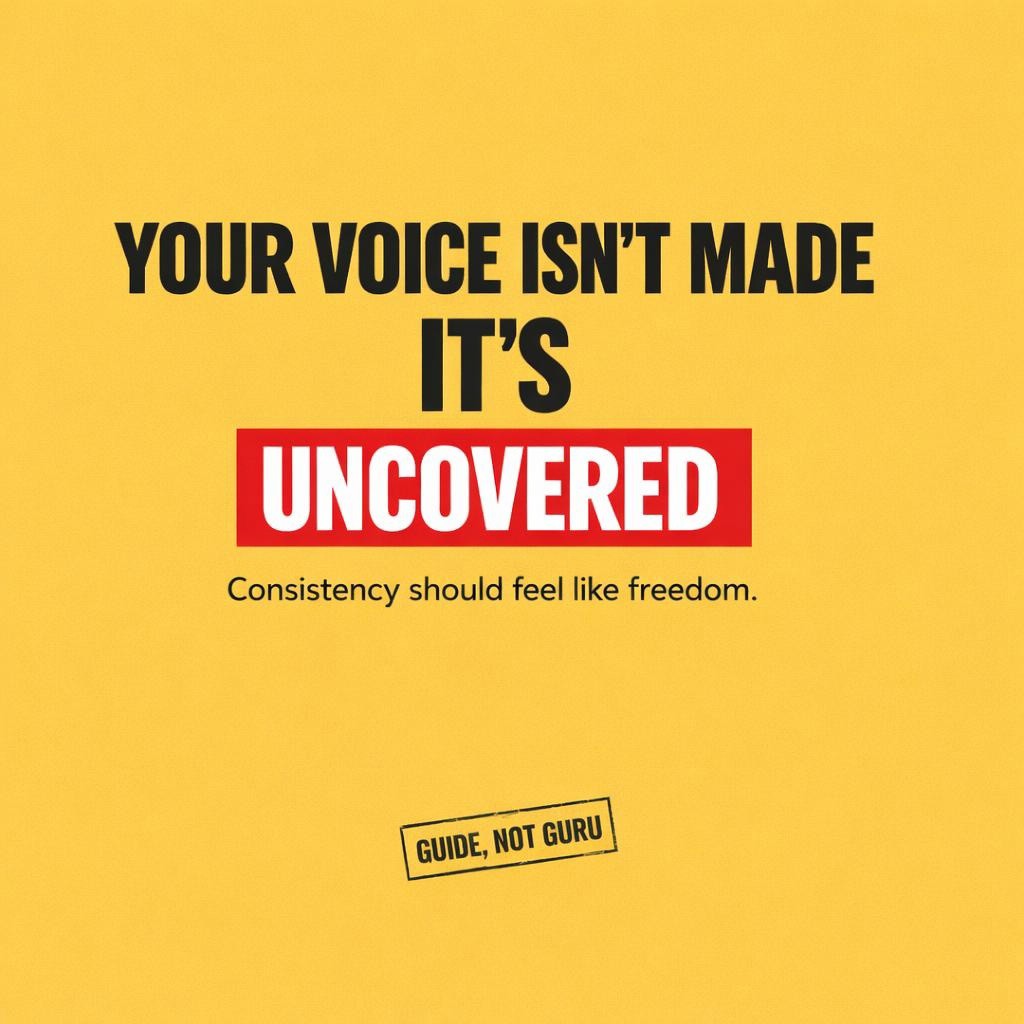
Here’s the core truth: "Voice isn’t created — it’s uncovered." When you uncover it and lock it into a simple system, you stop sounding like “marketing” and start sounding like you, steady, human, and recognizable.
1) Brand voice is not tone, it’s identity (and it’s why people remember you)
Most brands pick tone words, “confident,” “professional,” “playful,” then wonder why their content still blends in.
Tone is a mood. Voice is a personality. Voice is what people recognize even when your logo is nowhere in sight. It has texture, rhythm, worldview, and emotional nuance. It’s “who you are,” not just “how you sound.”
This is why “safe professionalism” is so expensive. When you flatten your personality to avoid being judged, you don’t just lose style, you lose trust.
And when your voice is real, something shifts. Your audience starts thinking things like:
- “This sounds like them.”
- “I knew this was their content before I saw the name.”
- “I trust this brand.”
That kind of memory is the holy grail. Not louder. Not trendier. Just unmistakable.
2) Steps 1–2: Extract your convictions, then name your boundaries
A strong voice has depth. And depth comes from what you believe.
Step 1: Extract your core beliefs (your worldview, your truth)
Most companies don’t sound unique because they don’t know what they believe deeply enough. Their content stays safe, surface-level, and predictable.
Your raw material is already there:
- your mission
- your contrarian beliefs
- your lived experience
- your emotional truth
- your personal stories
- your values and worldview
If you built something because you saw a problem, felt a calling, or believed in a better version of your industry, you already have a philosophy. You don’t need to “become” anything. You need to extract what’s already inside.
Step 2: Write what you stand for, and what you don’t do
A strong voice is contrarian in subtle ways. You don’t need to be loud to stand out. You need to be clear.
A clear voice sounds like:
- “Here’s what people get wrong.”
- “Here’s what actually matters.”
- “Here’s what we stand for.”
- “Here’s what we don’t do.”
- “Here’s the nuance no one talks about.”
Those “we don’t do” lines matter. They keep you from sliding into hype, fear, or performative posting just to get attention. They also make your brand feel safer to trust.
3) Steps 3–5: Capture your real phrases, your repeatable metaphors, and your proof stories
This is where your voice stops being “nice” and starts being recognizable.
Step 3: Capture your real phrases (the words you use when you’re not performing)
Many founders have two voices:
- an internal voice that’s vivid, opinionated, emotionally nuanced
- an external voice that’s filtered, cautious, and stiff
That gap usually comes from fear (of judgment, criticism, sounding “unprofessional”).
But your quirks, your humor, your insights, and your natural language are assets. People do not bond with polished personas. They bond with patterns of humanity.
Step 4: Pick a few metaphors you will repeat until people associate them with you
A recognizable voice is built through patterns:
- narrative repetition
- linguistic patterns
- identifiable rhythms
- brand-specific metaphors
Metaphors are not decoration. They are memory hooks. When your metaphors repeat, your audience learns your worldview faster.
Step 5: Write proof stories that teach (not speeches that preach)
If you want trust without a pedestal, stories do the heavy lifting.
People learn through narrative, especially when:
- the story is personal
- the lesson is relatable
- the vulnerability is real
- the outcome is earned
- the mistake is confessed
- the journey is unclear until it resolves
Stories build connection. Connection builds trust. Trust drives action.
4) Step 6: Choose the “guide not guru” posture (humility with authority)
Your posture is how you hold power.
A guru says:
- “Follow me.”
- “I have the answer.”
- “If you disagree, you’re wrong.”
- “My method is the only method.”
A guide sounds more like:
- “Here’s what I’ve learned.”
- “Here’s what might help.”
- “Here’s what I’ve seen in the field.”
- “Here’s what you may not have considered.”
- “Here’s a perspective, use what resonates.”
Modern audiences resist authority that feels forced. They reject condescension and inflated claims. They gravitate toward transparency, sincerity, and expertise grounded in experience.
This is how you lead without preaching.
This is how you show knowledge without ego.
This is how you build trust without building a pedestal.
5) Step 7: Systemize your voice with a simple checklist (so consistency feels like freedom)
Voice becomes valuable when it becomes predictable. If your voice only shows up once in a while (when you have time, energy, or confidence), it can’t build trust.
Consistency creates rhythm. And rhythm reduces anxiety, for your audience and for you. When you show up, your audience doesn’t have to “re-learn” who you are. Your presence becomes emotionally predictable, and that makes trust easier.
Use this voice checklist before you publish anything:
- Does this capture my truth?
- Does this express it consistently?
- Does this amplify it intelligently?
- Does this protect authenticity?
- Does this reinforce the mission?
- Does this strengthen emotional presence?
- Is the voice recognizable (stable rhythm, grounded messages, daily reinforcement of worldview)?
This is also where AI fits, without stealing your humanity: "AI doesn’t replace voice. It amplifies it — when used correctly." When your voice is clear, AI becomes an amplifier, not a personality generator.
You don’t need to pretend. You don’t need to craft every sentence perfectly. You need a system that keeps your real voice present.
If your marketing has been draining you, ask yourself one honest question: are you trying to sound “right”, or are you letting your real voice become a predictable presence people can finally trust?