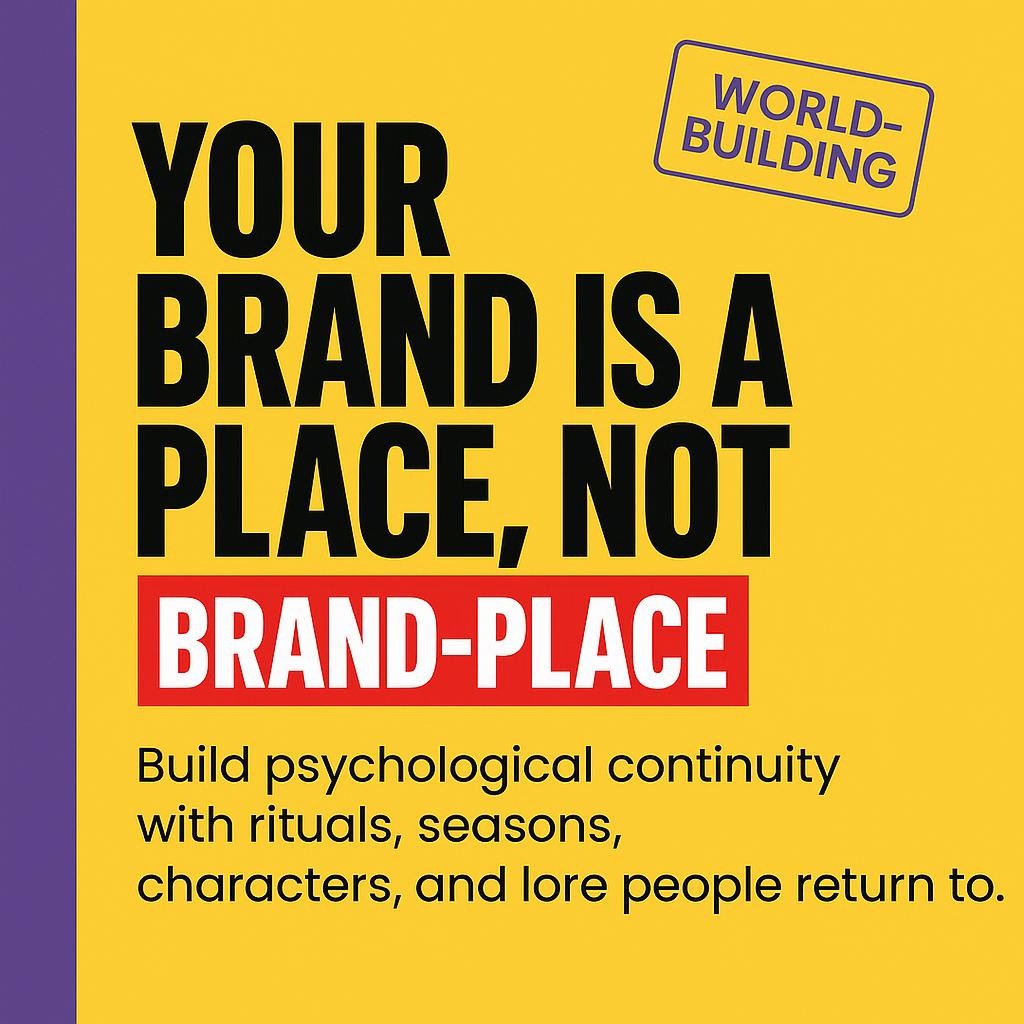
Your Brand Is Not a Product. It’s a Place. (Build One People Want to Return To.)
You can post great content and still feel invisible.
Not because your ideas are weak, but because you’re speaking into what Inkflare calls an empty room, “Most brands are talking to an empty room.”
And when the room is cold, even a masterpiece lands with a thud.
Here’s the twist: the fix is not “post more.” The fix is to stop treating your brand like a feed, and start treating it like a place people can return to.
Because “Humans remember universes. They forget fragments.”
At Inkflare, we don’t treat content as output. We treat it as environment. Or, in the simplest words we know, “We don’t create content. We architect your atmosphere.”
Why “just posting” fails (even when your content is good)
Most founders don’t have a content problem.
They have a continuity problem.
A TikTok here. A LinkedIn post there. A random carousel. A blog once in a while. All disconnected. No thread. No emotional stability. No psychological continuity.
And that’s why audiences forget you, not because you lack quality, but because you lack place.
A strong brand does not feel like scattered information. It feels like an environment.
It has a tone you can recognize.
A rhythm you can count on.
A personality that stays consistent over time.
That’s why Inkflare says it so bluntly, “Content without atmosphere is noise. Content with atmosphere is a home.”
People don’t follow brands, they enter worlds
Humans are wired for environments.
We don’t only consume information, we immerse ourselves in “vibes, atmospheres, moods, patterns, rituals, emotional cues.”
When your content carries those cues consistently, your brand stops being informational and starts being experiential.
People don’t just follow you.
They enter your world.
And once they feel that coherence, something changes fast:
They linger.
They save posts.
They return.
They explore.
They binge.
They trust.
That’s not luck. That’s structure.
The core shift: stop building posts, start building a brand-place
Think about a place you love returning to in real life.
You don’t return because it’s “optimized.”
You return because it feels like itself.
That’s the target.
A brand-place has character. It expresses:
- your worldview
- your emotional tone
- your values
- your mission
- your unique perspective
- your stories
- your humor
- your depth
- your identity
When those pieces show up together, over time, your brand becomes familiar, and familiarity becomes trust.
Inkflare calls this relationship economics. The longer someone stays in your world, the more likely they are to buy, refer, advocate, partner, collaborate, amplify, or join.
The 4 elements that make a brand-place feel alive
A place people return to is not built from random topics.
It’s built from a living world.
Inkflare breaks that world down into four parts: rituals, seasons, characters, and lore.
1) Rituals (the rhythm your audience can feel)
Ritual is the opposite of randomness.
Inkflare puts it plainly, “Posting daily with recognizable cadence, tone, and thematic throughlines is ritual.”
Ritual looks like:
- weekly segments
- predictable formats
- recurring characters or themes
- signature phrases
- signature visuals
- patterns people can anticipate and emotionally invest in
A ritual gives your brand a heartbeat.
And it does something most founders underestimate: it creates emotional safety.
In a chaotic feed full of noise, inconsistency, and dopamine traps, ritual becomes a steady anchor. Customers return to what feels stable.
Your audience won’t call it ritual. They’ll say things like:
- “Your content always feels grounding.”
- “Your brand just feels clear.”
- “Your tone feels trustworthy.”
That’s ritual working on the inside.
And it lasts. “Algorithms change. Trends come and go. New platforms rise and die. But ritual is timeless.”
2) Seasons (the moods your brand can move through)
A place has seasons.
A brand can too.
Inkflare describes it simply: a brand can shift moods, reflective in winter, expansive in spring, while staying emotionally consistent.
This matters because people don’t trust emotional volatility. They trust steady presence that still feels human.
3) Characters (the cast your audience recognizes)
Worlds feel real because they have characters.
In your brand, characters include:
- your founders
- your customers
- your internal team
- your mission
These aren’t “content categories.” They’re recurring elements your audience can attach to.
Over time, those characters form arcs. The world feels alive.
4) Lore (the beliefs your audience starts repeating)
Lore is what repeats.
It’s the philosophies, frameworks, inside jokes, narratives, and beliefs that show up again and again, across formats and platforms.
This is where brands become unforgettable.
Because in a world where everyone is producing more content, most of it shallow and algorithm-chasing, Inkflare’s stance is clear: meaning wins.
People don’t share posts. They share ideas that make them feel seen.
Why emotional consistency turns your brand into a sanctuary
The strongest brand-places do one thing especially well:
They regulate the room.
Inkflare calls it an emotional sanctuary. In a chaotic digital universe, people long for places that feel:
- grounded
- wise
- human
- uplifting
- thoughtful
- encouraging
- mission-driven
This is not soft stuff. It’s conversion stuff.
Consistency creates a predictable identity. And brands without identity cause anxiety.
When your tone, beliefs, visuals, posting rhythm, and narrative stay coherent, your audience feels psychological ease. That ease becomes trust.
Inkflare goes even deeper: content doesn’t just communicate, it co-regulates. When your brand shows up with calm leadership, grounded truths, and emotional maturity, your audience feels calmer, more focused, more guided.
That’s why people come back.
Don’t forget the silent followers (they’re watching everything)
If you’ve ever looked at your low likes and thought, “Nobody cares,” this matters.
Silent followers do not engage much, but they observe everything.
They are often decision-makers, thinkers, busy professionals, serious buyers, and mission-driven people. They’re not passive. They’re deliberate.
And they crave stability, not hype.
They hate gimmicks, trend-chasing, sudden identity shifts, loud guru energy, and inconsistent posting.
They love thoughtful insights, consistent tone, calm confidence, mission-driven language, educational depth, emotional intelligence, and reliability.
A brand-place is built for them.
How to build your brand-place (simple steps you can use today)
You don’t need a full creative department, a strategist, a designer, a storyteller, or a “brand philosopher” to do this.
You need structure that you can repeat.
Step 1: Extract your philosophy (the truth inside your mission)
Brands without philosophy fall into generic advice, safe statements, recycled ideas, and interchangeable posts.
Inkflare’s belief is sharp: content without philosophy is decoration.
If you built something because you saw a problem, felt a calling, or believed in a better version of your industry, you already have a philosophy.
Your job is to pull it out of your head and put it at the center.
Step 2: Name it (clarity creates gravity)
Giving shape to a worldview gives it power.
A clear worldview becomes a filter. It attracts the people who resonate, and it helps them stay.
Step 3: Structure it (so it can become a universe)
Inkflare structures your philosophy into content pillars, sub-themes, emotional arcs, and teaching formats.
This is where fragments become a world.
Step 4: Reinforce it daily (so your brand becomes familiar)
This is the compounding part.
When your audience sees your worldview expressed across posts, articles, videos, captions, stories, and teaching, your brand stops feeling like a series of one-off ideas.
It becomes accumulated presence.
And presence creates the “I know them” effect.
Inkflare sums up the result in one line that’s hard to forget: “You become a feeling, not just a logo. Feelings scale faster than funnels.”
Where Inkflare fits: presence, not posts
Most founders think they need to become a marketer.
Inkflare disagrees.
The old model was persona-based: be charismatic, be everywhere, be the face.
The new model is system-based: build a system that expresses your identity even when you’re sleeping, traveling, parenting, or solving real business problems.
That’s what Inkflare is built to do.
We unify your story across platforms, formats, topics, moods, angles, and time, so everything feels like part of the same universe.
We build the rituals.
We maintain the emotional continuity.
We keep the room warm.
Or, in Inkflare’s words, “You’re running the business. Inkflare runs the rituals.”
If you stopped trying to “post more,” and started building a place instead, what would your audience finally feel when they step inside, and why would they never want to leave?