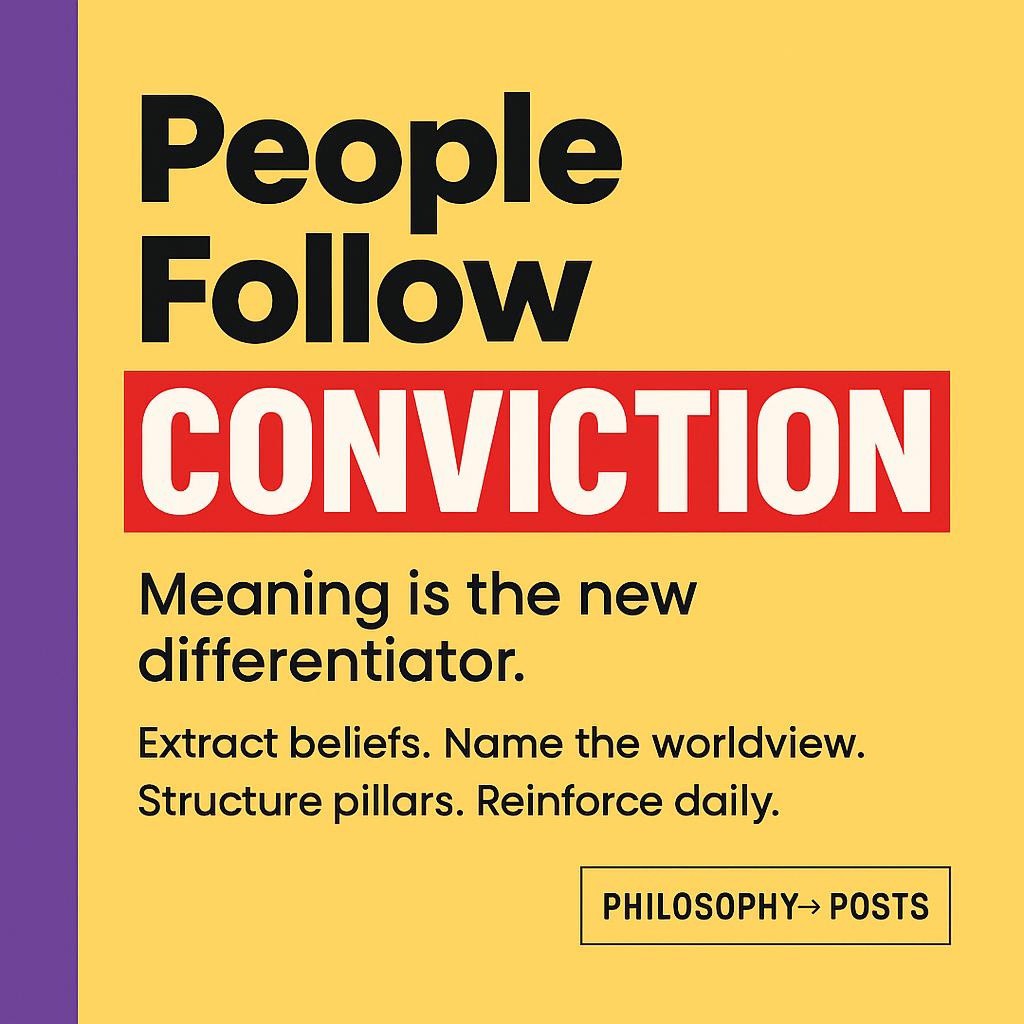
Content Without Philosophy Is Decoration: The Backbone That Makes Your Brand Unignorable
You can feel it when a brand is posting without a backbone.
It shows up as the same quiet panic every time you sit down to write:
- "What should I talk about today?"
- "What do I even stand for?"
- "Do people understand what we’re building?"
- "Is there a deeper story I’m not expressing?"
That isn’t a “content problem.”
That’s a philosophy problem.
Content without philosophy becomes digital wallpaper
You can have "the prettiest branding on earth", "perfect typography", "outstanding visuals", "great production value", and still lose. Because without a philosophy, your content collapses into "generic advice", "safe statements", "recycled ideas", and "interchangeable posts."
It becomes "digital wallpaper."
"Forgettable. Exchangeable. Indistinguishable."
And that last word is brutal, because the market can’t commit to what it can’t recognize.
People don’t follow content, they follow conviction
Here’s the truth that changes everything: "People don’t follow content. People follow conviction."
Not because your posts are louder.
Because your message is clearer.
Audiences don’t just want information. They want a brand that says, "Here’s what we believe, here’s why it matters, and here’s how the world changes through this lens."
That is what makes a brand feel real.
That is what makes a brand feel like it has a spine.
In an AI-saturated market, meaning is the new differentiator
AI tools made content easy. So now everyone is producing more content than ever, and most of it is "shallow, repetitive, and algorithm-chasing."
So the advantage has moved.
"Meaning is the new differentiator."
A brand that says "Here’s our product" will always lose to a brand that says:
"Here’s the truth we believe about the world, and here’s how our product serves that truth."
That’s the shift from vendor to guide.
And if you’re building something mission-driven, that shift is not optional. It’s your edge.
A philosophical backbone does four things your tips never will
A philosophy is not a slogan. It’s a living worldview, a consistent center.
When you build it, your content stops being random output and starts becoming identity in motion.
1) It makes you stand for something (and loyalty follows)
"A philosophy makes you stand for something, and standing for something builds loyalty."
The best brands don’t appeal to everyone. "They resonate deeply with specific people."
A philosophy becomes a filter. It attracts the people who believe what you believe, and it helps the right people stay.
2) It makes you different without trying to be loud
Most brands try to stand out with style.
Philosophy makes you stand out with truth.
"Brands with no philosophy try to ‘say something.’ Brands with philosophy say something true, and the market recognizes the difference instantly."
3) It turns customers into advocates (because it becomes culture)
This is one of the most overlooked lines in modern marketing:
"People don’t share ‘posts.’ They share ideas that make them feel seen."
When your worldview resonates, customers don’t just read it. They repost, retell, reinterpret, and reframe it. Your philosophy becomes cultural.
That is how movements are built.
4) It ends founder content fatigue
Here’s the relief most founders are really looking for:
"Without philosophy, every post feels like a performance. With philosophy, every post feels like an expression."
That one change turns content from a burden into a natural extension of who you already are.
The Philosophy-to-Posts pipeline (the 4-step path to content that feels inevitable)
At Inkflare, we don’t treat philosophy like a nice-to-have. We treat it like the engine.
We don’t just help you post. We help you build "a philosophical backbone, a consistent, clear, emotionally resonant worldview that becomes the gravitational center" of your brand.
And we do it through four steps.
Step 1: Extract the truth that’s already inside you
You don’t need to “become a philosopher.”
"You already are."
If you built something because you "saw a problem," "felt a calling," or "believed in a better version of your industry," you already have a philosophy.
Inkflare extracts it through your onboarding, your stories, your product, and your mission. Not surface messaging, your real beliefs.
Step 2: Name your worldview (because shape gives power)
"Giving shape to a worldview gives it power."
Most brands stay vague because it feels safer. But vague brands sound like committees. Clear brands sound like humans.
Naming your worldview is how you stop blending in.
Step 3: Structure it into pillars (so content stops being fragmented)
Inkflare structures your philosophy into "content pillars, sub-themes, emotional arcs, and teaching formats."
Why this matters: most brands feel scattered.
A TikTok here. A LinkedIn post there. A random carousel. A blog once in a while. No thread. No stability. No continuity.
And that’s why people forget, even when the content is “good.”
"Humans remember universes. They forget fragments."
Step 4: Reinforce it daily (until your brand becomes memory)
This is where the compounding starts.
"Everything your audience sees ties back to the same backbone, expressed through different angles, tones, and mediums."
Then the simplest formula kicks in:
"Consistency = belief clarity. Belief clarity = brand memorability."
Daily reinforcement doesn’t make you repetitive. It makes you recognizable.
And recognition is where trust begins.
Lead without preaching: become a guide, not a guru
A lot of founders resist philosophy because they fear sounding arrogant.
Good instinct. Modern audiences reject forced authority. They resist condescension, inflated claims, and superiority. They gravitate toward transparency, sincerity, and expertise grounded in experience.
So how do you lead with depth without turning into a loud internet persona?
"You become a guide, not a guru."
Gurus position themselves above people. Guides create space.
Guides say:
- "Here’s what I’ve learned."
- "Here’s what might help."
- "Here’s what I’ve seen in the field."
- "Here’s a perspective, use what resonates."
And guides teach through stories, not commands. Because narrative builds connection, and connection builds trust, and trust drives action.
Inkflare is not here to inflate your ego. We’re here to amplify your wisdom, your humanity, and your mission.
Your brand is not a product, it’s a place
This is where “content strategy” becomes something deeper.
"People don’t follow brands, they enter worlds."
A strong brand creates a felt sense, a climate, a personality people can recognize instantly.
That’s why "just posting content" doesn’t work.
"Content without atmosphere is noise. Content with atmosphere is a home."
When your content is philosophically anchored, your brand can become "an emotional sanctuary" in a chaotic feed. Grounded. Wise. Human. Uplifting. Mission-driven.
That kind of presence doesn’t just get attention.
It earns staying power.
Ritual is the only future-proof strategy
Consistency is good. But the deeper win is rhythm people can feel.
"Posting daily with recognizable cadence, tone, and thematic throughlines is ritual."
Customers don’t bond with randomness. They bond with predictable patterns they can emotionally invest in.
Ritual creates emotional safety. It reduces uncertainty. It gives your brand a heartbeat.
And it’s not just for your audience. It protects you, too.
Ritual reduces decision fatigue, the endless loop of “What should we post?” and “Does this align?” Inkflare builds those rhythms automatically so your mission stays visible even when you’re busy, tired, parenting, traveling, or building the actual business.
Because the future belongs to founders who build systems, not personas.
The question that decides whether you blend in or become unavoidable
Most companies flood the internet with content and stay strangely forgettable.
Not because they didn’t post enough.
Because they never gave the market something to believe.
So ask yourself the one question that makes your next year of content easier, stronger, and more human:
If "people don’t follow content" and "people follow conviction," what do you believe strongly enough to reinforce every day until the market can’t unsee it?