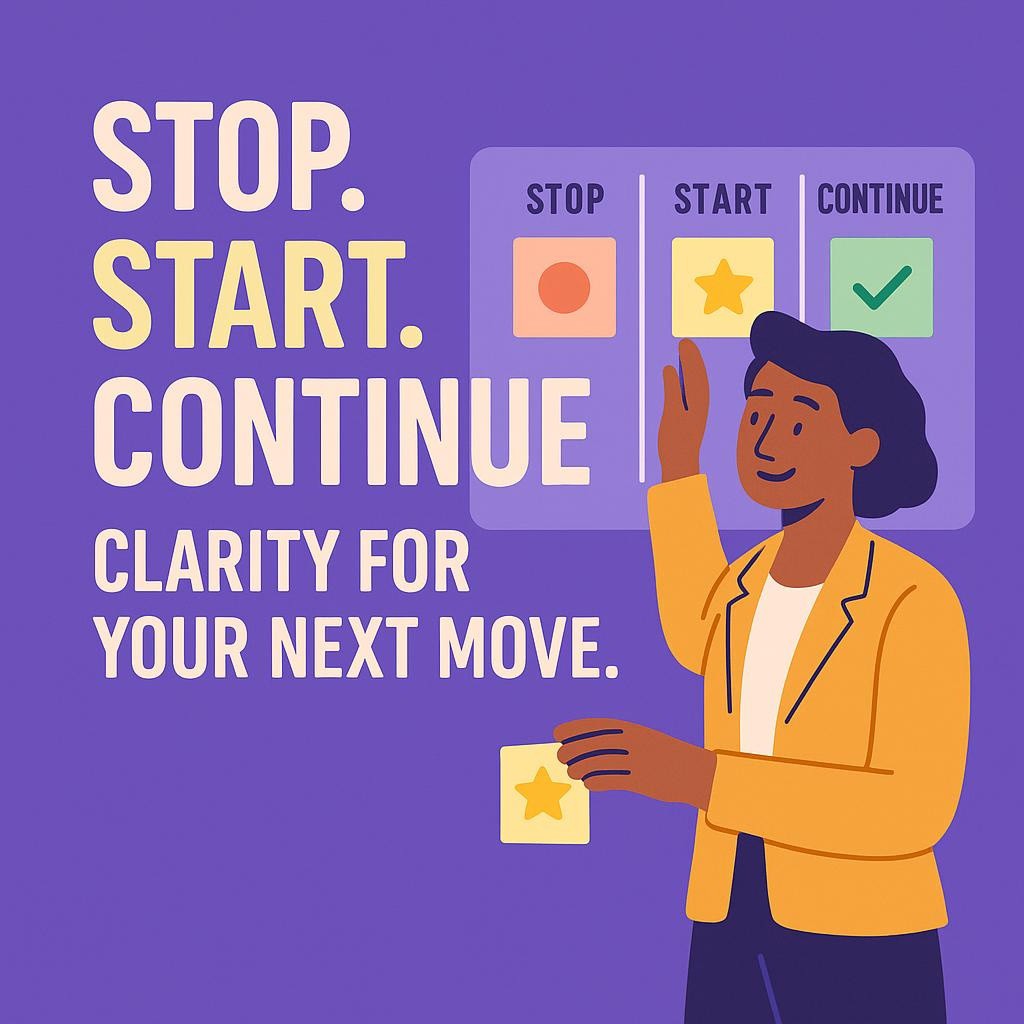
The Power of Stop-Start-Continue in Career Transition
Change your career by changing three behaviors. Stop what drains you, start what moves you forward, continue what sustains you. This is more than a tidy list. It is a clear path out of fog and into a focused plan that fits your life.
Christine Carter’s book, Restart Strong, treats transition as a chance to rewrite how you live and work, not just where you work. The Stop-Start-Continue exercise is a simple tool with serious depth. Used well, it helps you release what is outdated, add what is needed, and protect what already works. You create space for the person your next chapter requires you to be .
Why This Three-Part Tool Works When You Feel Stuck
Career shifts stall for two common reasons. You carry old habits into new goals. You try to add new actions without dropping the old ones. Stop-Start-Continue forces real tradeoffs that match your direction. In Restart Strong, Carter positions it as a tool for personal reinvention during change, not a quick activity for a busy day .
- Stop creates space. When you let go of the title you once held or habits that drain your energy, you free time and focus for what comes next. The book offers clear stop examples for career changers, including the choice to stop clinging to a past job title and to stop negative self-talk that blocks action .
- Start builds momentum. Tiny steps, taken daily, shift identity and results. The book names the power of brief bursts of bravery. A 20-second act, like sending an application or making an introduction, can change your path .
- Continue protects the essentials. You keep the rituals and relationships that already support your growth, such as steady outreach to your network and routines that stabilize your energy and mood .
A Small Story You Might Recognize
You have a calendar full of job boards, résumé edits, and worry. Yet, progress feels invisible. One Sunday, you list three stops, three starts, three continues. You stop late-night scrolling after 8 p.m. You start a 30-minute morning power block to learn and to reach out. You continue the weekly coffee chats that lift your spirit. Ten days later, you have a few warm conversations and one interview. Nothing flashy. Just aligned behavior done daily. That is the point.
This matches the spirit of the book, which shows how small, brave actions and steady community support can open doors during transition .
The Hidden Shift Behind This Simple Exercise
The core message is deeper than a to-do list. Restart Strong calls you to value yourself beyond your job title. When you stop clinging to what you used to be called, you reclaim authorship of your identity and your goals. In the book’s examples, the sequence reads like a blueprint for change: stop clinging to the old title, start embracing new learning and growth, continue to leverage your network. It is release, then growth, then support, in that order .
This order matters. First, you take your hands off the past. Then, you pick up new skills and actions. Finally, you protect the relationships and routines that keep you steady while you grow.
Build Around Your Big Rocks, Not the Sand
If you pour the small stuff in first, there is no room for what matters. The book uses the big rocks story to highlight a simple truth. You must place the important things first, like health, family, and purpose, or they will get crowded out by noise. Make your Stop-Start-Continue plan reflect your big rocks, not the pebbles or sand that claim your attention but do not shape your life .
How To Run Stop-Start-Continue For Your Transition
Set aside 20 minutes. Divide a page into three columns. Work in this order. Write the truth. Then schedule one small action for each item today.
1) Stop, create space for your future
Ask, what will I stop because it no longer serves my next role or my well-being?
- Stop clinging to your former title. Introduce yourself with your next chapter in mind. Use language like product analyst or talent partner, not former manager. Your words shape how others see you and how you see yourself .
- Stop negative self-talk. Replace harsh scripts with positive self talk and celebrate your accomplishments.
- Stop unbounded job-board scrolling. Cap it at 20 minutes and move to higher-yield outreach. Give your best energy to actions that build relationships and skill .
Starter moves you can do now:
- Remove your old title from bios and email signature.
- Set a phone downtime at 8 p.m. to protect sleep.
- Write three positive statements to replace your most common negative thought.
2) Start, build momentum that sticks
Ask, what new habits or skills will bridge today to my desired future?
- Start practicing self-compassion and resilience. Close each day with a two-minute reflection on what went well and why. This keeps the focus on progress, not perfection .
- Start micro-learning. Take one 25-minute course block each weekday morning to build a core skill for your next role.
- Start courage reps. Use 20 seconds of bravery to send a note, ask for a conversation, or hit submit on an application. The book underscores how tiny acts can reset your direction .
Starter moves you can do now:
- Block a 30-minute morning skill sprint, Monday to Friday.
- Draft one outreach template and send it to two contacts today.
- Create a visible streak tracker. Mark an X for each day you complete your habits. This commitment technique keeps your effort steady with a simple visual cue .
3) Continue, protect what already works
Ask, which routines and relationships already help me move forward?
- Continue to cultivate your network. Keep the coffee chats and check-ins that lift your energy and open doors. Many opportunities flow through people who know and trust you .
- Continue energy management. Guard sleep, movement, and focus. Energy, not time, is often the true limit in a transition, and the book treats it as a central lever for follow-through .
Starter moves you can do now:
- Keep your weekly workout or run club on the calendar.
- Set a Friday reminder to thank or update three contacts.
A 30-Day Plan To Put This Into Motion
Week 1, Clarify and commit
- Write 3 stops, 3 starts, 3 continues.
- Choose one from each list and define a daily minimum, like two targeted messages or one micro-learning block.
- Share your plan with a partner or group. The book shows how accountability turns a solo climb into a collective ascent, and it raises your odds of follow-through .
Week 2, Build rhythm and energy
- Use a streak tracker to visualize consistency. Short feedback loops beat long waits for results, especially during a search .
- Remove one friction per stop, like uninstalling a low-yield app or setting an email filter for job alerts.
- Add one energy booster, like a 20-minute midday walk, to fuel your afternoon outreach. The book names energy management as a key to sustained action .
Week 3, Align lifestyle and role
- Check that your target roles match your desired life. Design for location, flexibility, travel, and pace. Talk with people in those roles to ground your expectations. Fit comes first, then the leap .
- Adjust your starts and stops to reflect what you learn. If your field values visible output, start small portfolio projects now.
Week 4, Review and raise your aim
- Ask, which stop created the most space, which start moved the needle, which continue kept me steady.
- Pick your One Big Thing for the next quarter, one bold focus that amplifies your gains. The book pairs Stop-Start-Continue with this kind of focal point to drive meaningful change .
Three Use Cases You Can Copy
Identity shift in action
- Stop, introducing yourself with your past label.
- Start, using your future positioning, like revenue strategist for B2B SaaS.
- Continue, weekly outreach to mentors and peers who can validate and amplify your new story. In the book, Carter’s own cross-country restart is supported by mentors and a strong network, which shows the power of community during a pivot .
Skill-building without overwhelm
- Stop, passive job-board reading at night.
- Start, a 25-minute morning course block, then ship a tiny exercise by 9:30 a.m.
- Continue, your Saturday study group or peer accountability thread. Accountability is a strategy for momentum and resilience, not a nice-to-have .
Energy first, excellence follows
- Stop, late-night screen time that wrecks sleep.
- Start, a 10 p.m. device curfew and a two-minute reflection to close your day.
- Continue, the morning movement that keeps your mindset steady. The book treats energy as the engine behind action when motivation dips .
Pitfalls To Avoid
- Too many starts, not enough stops. New habits need space. Trim at least one commitment for every new behavior. The book calls this step hard yet essential because it creates the space to do something new .
- A dream job that does not fit your life. Before a big leap in function or industry, talk with people who live that work. Design the life first, then choose the role that supports it .
- Waiting for confidence before you act. Confidence grows from action. Use micro commitments, tiny bursts of courage, and visible streaks to make progress feel inevitable .
A Line To Carry With You
The book shares a line that captures the spirit of transition: “Move toward the next thing, not away from the last thing. Same direction, completely different energy.” -James Clear, Author of Atomic Habits. Let this guide your choices. When you choose your stops, starts, and continues through that lens, you act from aspiration, not fear. You stop to honor your future self. You start because curiosity beats doubt. You continue because you already stand on some solid ground .
Build A Personal Brand That Matches Your Next Chapter
- Use your starts to build proof. If you aim for product, share user stories, mockups, or teardown notes. If you aim for people leadership, lead a volunteer project and show your approach.
- Use your stops to align your public footprint. Remove outdated titles and keywords from your profiles so your story points forward.
- Use your continues to show consistency. Highlight practices that reflect your values, such as ongoing mentorship or community support. This shows you value yourself beyond your last role and that you are already living your next identity with integrity .
A Simple Template To Use Today
- Stop
- Behavior to stop:
- Why it matters to stop:
- Friction removal step I will do today:
- Accountability check, who and when:
- Start
- Behavior to start:
- Daily minimum action:
- Trigger and time:
- Visible tracker I will use:
- Continue
- Behavior to continue:
- How I will protect it on my calendar:
- Person or group that keeps me consistent:
When You Feel Stuck, Ask Three Honest Questions
- Which commitments were right for a past season, but no longer fit the life I am building now, stop candidates often hide here.
- Which single skill, learned to a basic level, would make me far more compelling to the teams I want to join, start candidates often hide here.
- Which relationships or routines leave me better than they found me, continue candidates often hide here. Your network and supportive habits are part of your foundation .
A Final Word Of Encouragement
Carter’s own story carries a truth you can trust. After leaving corporate life and traveling the country, she returned to a new city and a new start. She leaned on mentors, coaches, and friends. She used the very exercises she offers and built a life that matched her values. Her message is clear. You can restart strong too, with clarity, community, and simple tools that move you forward one day at a time .
Your next step is small and clear. Choose one stop, one start, and one continue. Schedule a first action for each before you close this page. Then give yourself 20 seconds of bravery, send the note, ask for the conversation, submit the application. You are not behind, you are becoming. What will you stop, what will you start, what will you continue, to restart strong?