Master Agile Cloud Transformation with Architecture Guardrails and Fast Feedback
Agile can speed up cloud delivery, but only when it is paired with architectural guardrails that keep change safe. After reading this, you will be able to spot the friction points that slow most migrations, set up a delivery system that supports fast iteration (teams, backlog, CI/CD, infrastructure as code), and measure whether your cloud program is improving outcomes instead of just producing activity.
A cloud transformation is rarely blocked by a lack of cloud services. It is blocked by an operating model that cannot turn decisions into production changes reliably. Agile helps, but only when it is treated as a way to design feedback loops, not as a set of meetings.
Agile + Cloud: The principles that actually matter (and the ones that don’t)
Agile in a cloud context means optimizing for short feedback loops, reversible decisions, and tight collaboration across product, engineering, and operations. Cloud work changes the shape of delivery because infrastructure is no longer something configured “later” by a separate team. It is code, it is versioned, and it can fail in ways customers feel.
The principle that matters most is safe speed. Teams move faster when they can change small things often, observe what happened, and recover quickly. That requires guardrails, not heroics. A baseline reference architecture, a security baseline, and a few platform standards (networking, identity, logging, deployment patterns) keep every sprint from becoming a negotiation about fundamentals.
Ceremonies and tools do not create agility on their own. Agility shows up when teams can learn from production reality and ship without betting the business on each release. That is why cloud migration is not a single project with an end date, it is a delivery system change that rewires how work moves from idea to running service.
Where cloud transformations stall—and how Agile removes the friction
Most cloud programs slow down in predictable places, and the symptoms are easy to recognize when you know what to look for. The common thread is that uncertainty shows up late, when changes are expensive.
A common example is a funded startup modernizing a monolith while still shipping features. The team wants cloud benefits (faster releases, better reliability, cleaner scaling) but is also under pressure to keep roadmap promises. That tension often drives big batches, deferred risk, and “we’ll fix it after the migration,” which is exactly when the risk becomes hardest to unwind.
Agile removes friction by forcing uncertainty to surface earlier, in smaller increments, with clearer ownership. When migration plans keep slipping, it is usually not because the team “is not Agile enough.” It is because the work is too big to validate, too risky to deploy, or too dependent on other teams to complete inside a sprint. The fix is not more process, it is changing what gets built, and when it gets proven.
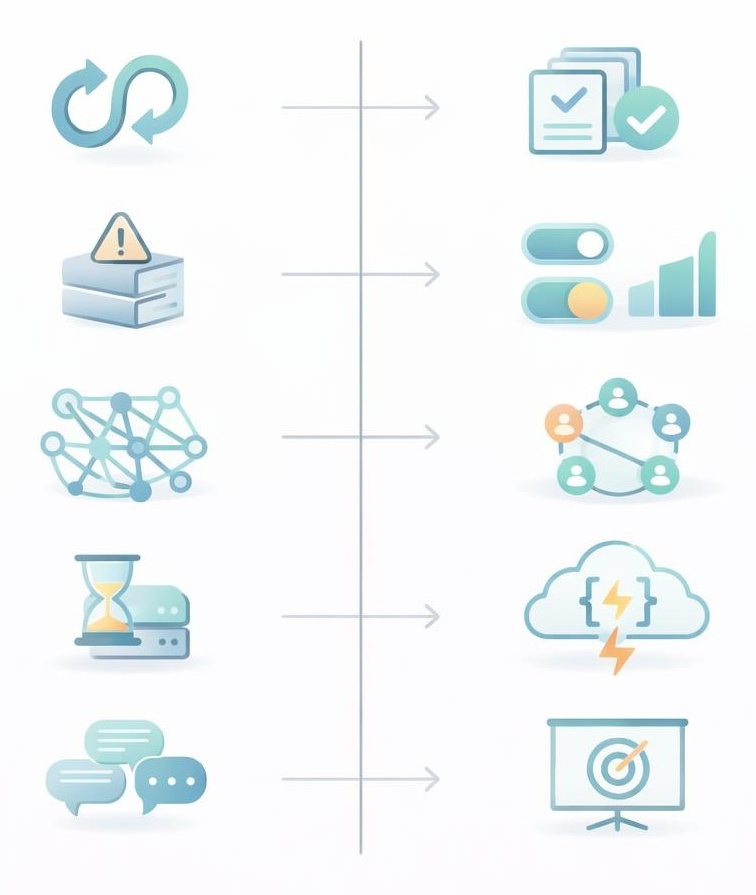
If you see X, do Y:
- If the scope keeps shifting, cut work into thin vertical slices and refine the backlog with clear acceptance criteria so each sprint proves something concrete.
- If releases feel risky, use incremental migration patterns plus feature flags and parallel runs so production exposure increases gradually.
- If security, ops, or data dependencies keep blocking progress, form cross-functional squads and make dependencies explicit early (owners, dates, and what “done” means).
- If environments take days to provision, treat infrastructure as code as product work and build self-service so teams can create what they need without tickets.
- If stakeholders disagree on what “success” looks like, use demo-driven governance and an outcome-based roadmap so every review ties work to a measurable result.
When those countermeasures work, the organization feels a shift: the work stops being a vague migration “program” and starts behaving like a delivery engine. The next section is how to build that engine on purpose, so a cloud effort does not rely on a few people holding it together in their heads.
Practical implementation: Build an Agile cloud delivery engine (teams, backlog, and pipelines)
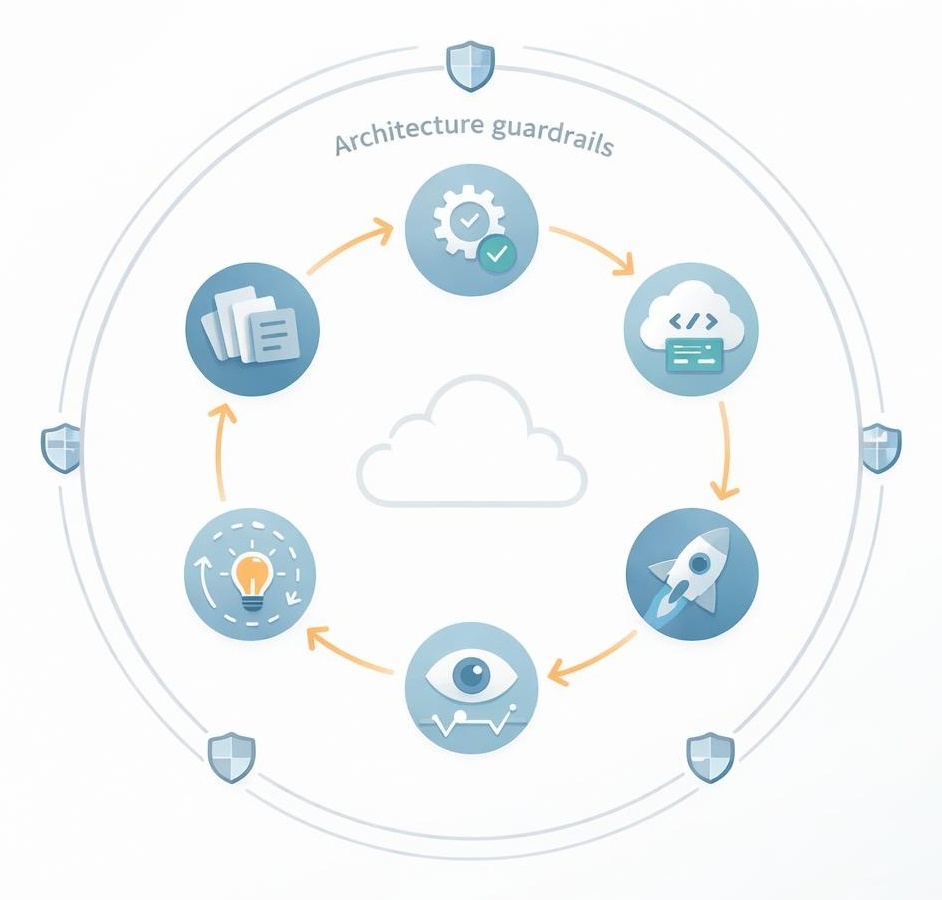
A cloud transformation accelerates when the organization stops treating delivery as a sequence of handoffs and starts treating it as a system. The goal is not to “do Agile,” it is to create a loop where each sprint increases production capability with less risk than the sprint before.
Start by forming a cross-functional unit and making the ownership boundary unambiguous. Product, application engineering, cloud or platform engineering, and security all need to be in the room as active participants. The concrete output is a team charter that states what the group owns end-to-end, including what happens when something breaks. For a startup modernizing a monolith, this is where “ownership” becomes real: who gets paged, who can deploy, what must be true before production traffic is shifted, and how dependencies are handled when another team controls identity, networking, or data.
Next, build a cloud backlog that is sliceable by value, not by component. The output you want is a set of vertical slices that can be demonstrated, each with non-functional requirements treated as acceptance criteria. Instead of “move service to cloud,” a slice might be “run one customer workflow in the new environment with defined SLOs, audit logging, and cost limits.” For monolith modernization, another useful slice looks like “route a small percentage of traffic through the new path with a clear rollback,” because it forces real production learning without a full cutover.
Treat infrastructure as code as “definition of done” work, then get CI/CD in place early so progress can be proven in running systems. The outputs are versioned modules for reproducible environments and a pipeline that builds artifacts, runs automated tests, deploys to non-production, and supports progressive delivery to production. Include the checks that reduce late surprises, such as security scanning, configuration validation, and policy rules that prevent unsafe changes from ever reaching production. Progressive delivery matters because it turns release risk into something you can manage in steps, with rollback as a normal action, not a crisis move.
Finally, adapt ceremonies so they reflect cloud reality. Sprint planning should reserve explicit capacity for reliability and security, daily standups should surface service health signals and blocked dependencies, and sprint reviews should demo working software plus operational posture. Keep architecture decision records for decisions that would otherwise be re-litigated, maintain a baseline reference architecture teams can start from, and define “stop-the-line” criteria when safety is at risk (for example, failing security controls, untested data migrations, or missing rollback paths). Those guardrails are what let teams move fast even when the work is complex.
Tools and frameworks that make Agile ‘real’ in cloud: automation, containers, and microservices (without over-engineering)
Cloud speed is less about picking trendy tools and more about choosing patterns that reduce repetition and uncertainty. The best tool is the one that makes the next ten changes easier, not the one that makes the first change impressive.
Automation and infrastructure as code are almost always the earliest win, because they remove the slowest feedback loop in many organizations: waiting for environments. If the team cannot create, change, and tear down infrastructure safely, it will compensate with long-lived environments and manual steps, and that pushes risk into late-stage releases.
Containers are valuable when consistent runtime behavior matters, especially across dev, test, and production, or when teams need portability across environments. They are not mandatory for every workload, and forcing them too early can distract from the basics of observability, deployment safety, and cost control. For a startup untangling a monolith, containerization often pays off most when it makes deployments predictable and repeatable, not when it introduces a complex platform that the team is not staffed to operate.
Microservices can increase independent deployment, but only when the organization is ready for the operational cost. Clear domain boundaries, independent release needs, and mature observability are the entry price. Without that, microservices often become distributed confusion, with more deployments to coordinate and more failure modes to diagnose.
This is where platform engineering helps. An internal developer platform, even a lightweight one, creates paved roads: self-service templates, golden paths for deployment and observability, and standardized defaults. The tradeoff is real, every additional layer increases operational surface area. Standardize intentionally, and keep the platform focused on removing the friction that shows up every sprint.
Prove it’s working: KPIs for Agile cloud transformation + common pitfalls to avoid
If a cloud transformation cannot demonstrate improved outcomes, it will eventually be treated as a cost center with unclear value. The fix is not more reporting. The fix is choosing a small set of metrics that reflect the health of the delivery system.
Start with delivery flow and recovery, because they reveal whether Agile is increasing safe speed. Lead time for change shows how long it takes to go from committed code to running in production. Deployment frequency shows whether the team can ship in small increments. Change failure rate and mean time to recovery (MTTR) show whether releases are becoming safer and whether the team can respond when something goes wrong.
Pair those with reliability and quality signals that match the customer experience. SLO attainment and incident rate are clearer than vague “stability” discussions. Escaped defects help you see if speed is being purchased with customer pain. Add cost signals that are tied to unit economics, not just a monthly bill, such as unit cost trends for key workloads, environment waste (idle resources), and right-sizing progress. For a funded startup, these metrics also make progress legible to leadership, because they show momentum without pretending the migration is “done.”
Review these in a lightweight weekly ops and product cadence, with a bias toward decisions. If MTTR is climbing, invest in observability and rollback paths. If lead time is stuck, look for manual steps and approval bottlenecks. If cost per transaction is rising, fix the workload or the architecture instead of asking teams to “be more careful.”
The most common pitfalls are predictable: migrating everything before shipping any value, treating security and compliance as a late phase, measuring story points as success, adopting microservices before the organization can operate them, postponing CI/CD until “after migration,” and letting architecture decisions drift because nobody captures the tradeoffs. Each one looks reasonable in isolation, and each one quietly slows delivery until the cloud program becomes a backlog of half-finished moves.
The next step is simple and demanding: assess the constraints that are actually slowing delivery, set a few non-negotiable guardrails, choose one pilot value stream, and iterate until shipping to production becomes normal. Cloud speed is earned by designing for repeatable change.