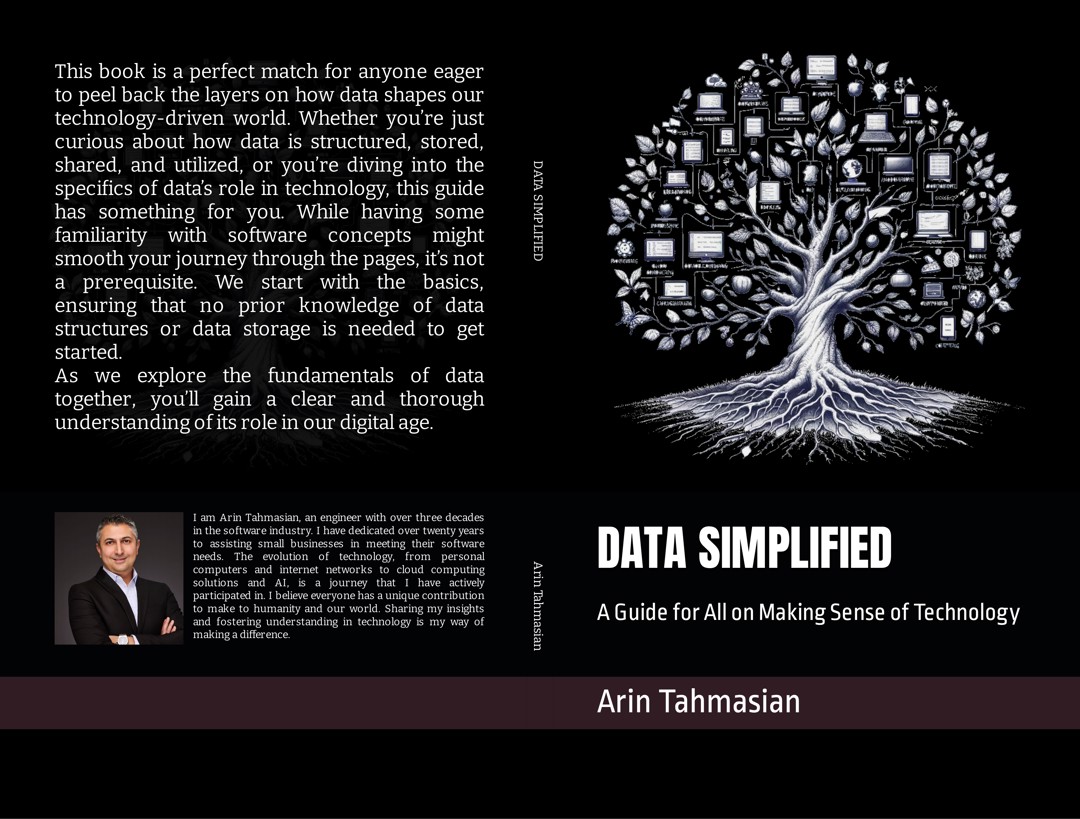
By the final page, readers gain a practical, big‑picture fluency in how data is defined, structured, secured, stored, analyzed, and ultimately applied to real decisions—without getting lost in jargon. The book moves from “first principles” of data types and structures to the disciplined steps of analysis, visualization, and communication, so you can go from raw inputs to clear, defensible insights that drive action . This confidence translates into immediate upgrades in your work: better questions, cleaner datasets, smarter tool choices, and more persuasive presentations that win alignment and accelerate outcomes . Readers also learn to spot common pitfalls—quality issues, privacy risks, and ethical traps—so decisions are not only effective but responsible, a critical edge in today’s data‑saturated world . In short, this is a “from fundamentals to impact” roadmap that helps professionals of any background turn data into clarity, credibility, and momentum.
Data Simplified: A Guide for All on Making Sense of the Complex Terms in Technology
Key Points
1: Part I: The ABCs of Data — The Foundation
Data literacy starts with story—grasp how “datum” became today’s ocean of data to reframe why fundamentals matter.
The book opens by demystifying data through a brief, narrative history that turns abstraction into intuition. It traces the word’s journey from Latin “datum” (meaning “something given”) to the empirical rigor of the Enlightenment and the industrial rise of telegraph, telephone, and computing—before landing in our digital present, where “with every click, swipe, and keystroke, we contribute to the ever-expanding universe of digital data.” This mini‑story reframes data not as cold numbers, but as a living continuum that mirrors human curiosity and progress, helping you internalize why foundations like types, structures, and algorithms are not trivia but the grammar of modern decision‑making . The payoff is practical: when you see data as a centuries‑long conversation, you approach terminology with patience and purpose. Instead of memorizing definitions, you connect each concept to the deeper “why”—which speeds up learning and makes it stick. This is especially valuable if you’re new to tech; the narrative lowers the barrier to entry and replaces anxiety with curiosity. From a marketing perspective, this section’s voice is invitational and human, proving that anyone can build a durable data mindset. The book’s core promise—turn complexity into clarity—is on display from page one, giving you a foundation to evaluate choices later (storage trade‑offs, analysis steps, visualization methods) with more confidence and less overwhelm .
1: Part I: The ABCs of Data — The Foundation
Think in networks: use the city‑map metaphor of graphs to model real‑world complexity without forcing a hierarchy.
The book’s graph metaphor makes complexity graspable: “Unlike trees, which have a clear hierarchy from root to leaves, graphs thrive on their ability to illustrate a maze of interconnections… They can include cycles… and offer multiple pathways,” like a city with one‑way and two‑way streets. Social networks, the web, and air travel all crystallize when you picture vertices and edges instead of linear lists. This model invites a mindset shift: not every problem is a hierarchy, and insisting on one hides signal. In practice, treating products, users, or systems as graphs reveals influence hubs, bottlenecks, and multi‑path journeys—insights you’d miss with tables alone. For a product manager, mapping features and dependencies as a graph surfaces critical nodes that, if improved, cascade benefits. For analysts, graph queries unlock patterns (clusters, centrality) that refine segmentation and recommendations. The emotional win is clarity: you’re no longer staring at a tangle; you’re navigating a map. The marketing edge is immediacy—this metaphor equips you to communicate complex architectures to non‑technical stakeholders in a single picture, earning buy‑in faster. Taken with the book’s emphasis on simple, vivid analogies, the graph lesson models how to translate deep structure into narrative visuals that drive action .
1: Part I: The ABCs of Data — The Foundation
Retrieve at “library speed”: the hash‑table library analogy teaches you to design for constant‑time access where it counts.
When the book likens hash tables to a “magical” library catalog that jumps you straight to a book via its unique identifier, it’s more than a cute image—it’s a performance north star. The message: when access speed defines value (e.g., configuration lookups, session stores, caching layers), choose structures designed for direct addressing. This clarifies a common confusion for newcomers who default to scanning lists: if your use case is frequent, key‑based retrieval, architect around hashes, not linear search. The immediate benefit is practical prioritization. In product instrumentation, for instance, storing feature flags in a hash map means near‑instant reads at scale, improving resilience and user experience. In analytics, pre‑hashing join keys reduces processing time in pipelines. This analogy also helps you explain engineering decisions to cross‑functional teams: instead of saying “O(1),” you say, “We’re upgrading the catalog so you don’t roam the stacks.” That persuasive framing—rooted in the book’s style of clear metaphors—secures alignment for performance investments that non‑engineers might otherwise overlook. By championing hash‑table thinking where it fits, you translate fundamentals into tangible wins: speed, stability, and simpler mental models for your team .
2: Part II: Data Security & Redundancy
Build trust before insights: ethics, privacy, and quality control are the non‑negotiable spine of any credible data practice.
This section moves beyond checklists to a principled stance: data work must be “fair, responsible, and beneficial to society,” with legal anchors like GDPR and rigorous practices such as anonymization, consent, and robust security. The book demystifies why “garbage in, garbage out” isn’t a cliché but an operational risk—duplicate records, missing values, and inconsistent formats silently poison downstream analysis. The result is a crisp mandate: you can’t get to good modeling without first safeguarding quality and privacy. For leaders, this reframes compliance from cost center to growth enabler—credibility compounds when your insights withstand scrutiny. For practitioners, the payoff is fewer rework loops and more confident decision‑making. The tone is both practical and conscientious, urging you to pause and fortify the foundation before racing to dashboards. Marketing‑wise, this message resonates now: stakeholders demand not just answers but defensible, ethical answers. Equip your team to meet that bar, and you’ll differentiate on trust as much as on technique .
2: Part II: Data Security & Redundancy
Guard against illusion: the book’s candid look at “Fake it till you make it” shows how fabricated activity corrupts analytics—and strategy.
Few books tackle this so directly: startups may “inject fabricated data,” seed fake accounts, and generate artificial interactions to project traction. The author warns that analytics built on this scaffolding “constructs an unstable foundation,” derailing growth teams whose metrics no longer reflect reality. The insight is bracing and timely: dashboards can lie beautifully. Your defense is cultural and technical—insist on auditable event streams, periodic data provenance checks, and sanity tests that compare behavior across independent signals (e.g., payment processors vs. in‑app events). This doesn’t just prevent embarrassment; it preserves focus. When teams chase mirages, prioritization decays and burn escalates. The emotional pull of this section is its realism; it validates practitioners who’ve sensed the disconnect and gives leaders language to reset norms. Marketing takeaway: trust is a competitive moat. Brands that surface and fix measurement integrity issues don’t just avoid downside—they win loyalty by owning the truth, a theme the book returns to repeatedly in its ethics‑first posture .
3: Part III: Data Storage
Choose storage like an architect: match access patterns and sensitivity to a hybrid model for agility without compromise.
Instead of presenting storage as a binary (on‑prem vs. cloud), the book steers you to a balancing act: hybrid solutions “handling sensitive or heavily accessed data” locally while leveraging cloud scalability and remote access deliver a “versatile solution in the modern digital storage paradigm.” The move is from dogma to design. You start with how data is used—latency needs, regulatory constraints, collaboration patterns—and let those needs pick the medium. In practice, this yields smarter cost curves (hot data near, cold data far), improved performance for critical paths, and simpler compliance postures. The narrative tone is pragmatic and confidence‑building; you’re not told what to buy, but how to think. For cross‑functional buy‑in, this framing translates into persuasive business language: “We’re putting the most active and sensitive assets behind the strongest, closest walls, while letting everything else scale elastically.” That’s a strategy both IT and finance can champion. The core promise—turn fundamentals into clear, actionable decisions—lands here as an infrastructure blueprint you can use tomorrow .
4: Part IV: Data Analysis & Utilization
Design for the questions, not the tools: analysis begins by defining what you seek—then collecting only the data that matters.
The book’s workflow insists on purpose first. Before touching models, clarify the questions or hypotheses, then collect “relevant data from multiple sources,” aligning inputs with intent. That shift prevents the common trap of tool‑driven analysis that dazzles but doesn’t decide. A vivid, business‑focused example follows: a customer survey producing mixed numeric ratings and text, which then guides targeted cleaning (removing incomplete responses, standardizing formats, categorizing open‑ended feedback with NLP into themes like “pricing,” “product quality,” and “customer service”). The immediate value is discipline: you cut noise at the source and plan transformations around the decisions you need to make. This saves hours downstream and raises signal quality, setting up the rest of the pipeline—exploration, modeling, and communication—for success. The book’s tone is calm and methodical, building your confidence that rigor is achievable with simple steps and clear intent .
4: Part IV: Data Analysis & Utilization
Clean and explore like a skeptic: the book’s checklists and EDA guidance make quality visible—and fixable—before you model.
Data rarely arrives ready. The author spotlights practical cleaning moves—deduplicate, handle missing values, correct errors—and preparation such as standardizing text or dates, and categorizing open‑ended responses. Then comes exploration: descriptive stats and visualizations to surface patterns, outliers, and anomalies that sharpen analysis choices. The mindset is surgical skepticism: you validate assumptions and let the data hint at structure before committing to models. For teams under deadline, this is a time saver, not a detour; catching schema drift or outlier bias early avoids weeks of rework. The emphasis on visualization as cognition multiplier—turning complex results into “a bridge between complex data sets and their practical application”—arms you to bring stakeholders along, fast. The benefit is two‑fold: higher integrity in your models and higher adoption of your insights because they’re seen, not just stated. This is the book’s clarity promise in action: simple steps, big impact .
4: Part IV: Data Analysis & Utilization
Tell the story, then show the math: communicate results so decisions happen—reports, dashboards, and narratives that move people.
The author elevates communication to a formal step: insights only matter when they change minds. That means creating “reports, dashboards, or presentations that convey the insights in a clear and compelling manner to stakeholders or decision‑makers.” The payoff is immediate: precision without persuasion stalls; clarity with narrative momentum gets resourced. The guidance dovetails with visualization principles—encode key relationships in charts and infographics so “statistical nuances and trends” are grasped at a glance, then support with detail for those who need it. The tone is practical and empathetic toward cross‑functional audiences; it recognizes that adoption hinges on trust, not just correctness. For marketers and product leaders, this section is a blueprint for faster alignment cycles and more decisive roadmaps. In short, the book turns the last mile—too often an afterthought—into a core competency that compounds your impact with every analysis you deliver .
5: Part V: Data in AI & ML
Prepare data like a pro: normalization, standardization, and encoding make models learn patterns—not scale or label quirks.
This section translates pre‑processing into everyday language. Normalization “resizing” features to a 0–1 scale puts apples and oranges on the same field; standardization “shifts the average to the new middle” (mean 0) and measures spread so algorithms like SVMs or neural nets don’t get confused by magnitude. Then comes encoding: one‑hot for nominal categories (like independent light switches) and label encoding for ordered categories (“Small,” “Medium,” “Large”). The clarity matters: many failed models are victims of bad input scales or mislabeled categories, not weak algorithms. By applying these steps, you gift your models a fair fight—faster convergence, more stable training, and better generalization. Crucially, the author’s analogies make the concepts teachable to non‑experts, enabling cross‑team collaboration and reducing hand‑off errors between analysts and engineers. For immediate wins, standardize a reusable pre‑processing pipeline so every experiment starts clean, consistent, and comparable .
5: Part V: Data in AI & ML
Cook the right features: treat feature engineering like choosing and mixing ingredients to elevate model performance.
“Think of building a machine learning model like cooking a fancy dinner.” This metaphor reorients your focus from algorithms to representation: success often hinges on which inputs you select and how you transform them. The book frames Feature Selection as choosing the ingredients that truly enhance flavor, then encourages creative transformations that surface the signal your model can use. The benefit is tangible: cleaner features reduce overfitting, accelerate training, and often outperform jumping to a more complex model. This approach is also a collaboration accelerator—product and domain experts can now join the conversation by suggesting “ingredients” that reflect real behaviors or constraints. The tone is hands‑on and empowering, consistent with the series’ mission to demystify sophisticated work with simple, accurate metaphors. Make this your habit, and your baseline model quality rises before you write a single new algorithmic line .
5: Part V: Data in AI & ML
Augment for resilience: rotate, flip, and add noise so vision models recognize the world beyond your dataset.
The book’s wardrobe metaphor for augmentation makes robustness intuitive: by “rotating,” “flipping,” and “adding noise,” you create new, realistic variations so the model learns to see the essence—“a flipped image of a dog is still a dog.” This matters now, when data collection is costly, biased, or incomplete. Augmentation stretches limited datasets and hardens models against real‑world variance—angles, lighting, clutter—so performance holds up off the lab bench. Strategically, it’s an ROI amplifier: you upgrade model reliability without expensive data gathering. The storytelling tone—“showing it different ‘outfits’ of the same object”—is sticky, which helps non‑technical stakeholders grasp why training takes time and compute. For immediate application, formalize an augmentation policy aligned to deployment conditions (e.g., expected camera tilt or noise), then measure gains on held‑out scenarios to avoid overfitting to synthetic patterns. The result is a model that’s not just accurate, but dependable where it counts: in the messiness of the real world .